Opto Circuits (India) Ltd. – Will it successfully invade the global medical equipment market?
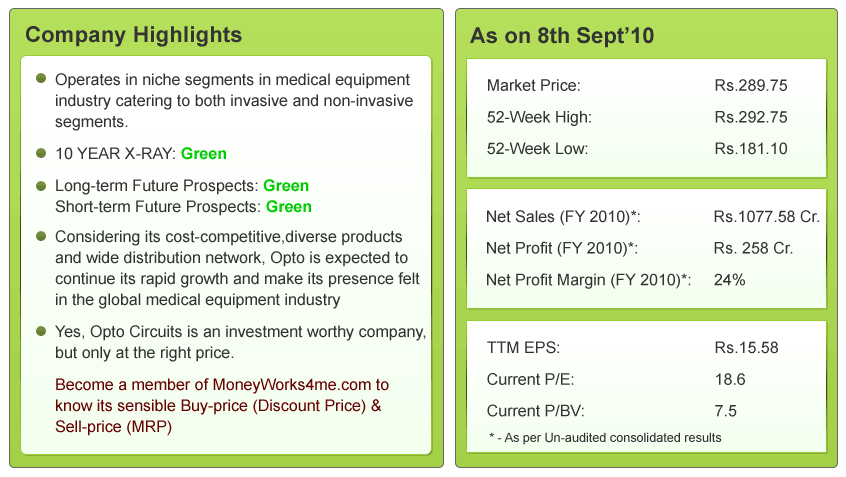
OCIL’s 10 YEAR X-RAY*: Green (Very Good)
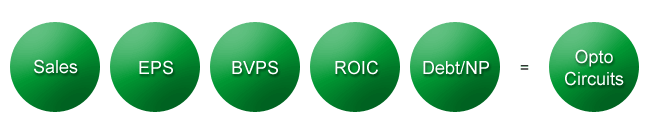
*The 10 YEAR X-RAY of OCIL is on a consolidated basis, as it derives a major portion of its revenue from its subsidiaries.
Opto Circuits (India) Ltd. in Brief:
Based in Bengaluru, Opto Circuits India Ltd (OCI) is engaged in the development, manufacture, distribution and marketing of medical equipment and devices. OCI also provides ancillary and complementary services such as after-sales service for the patient monitoring devices.
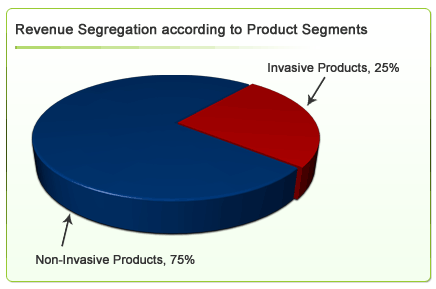
Its medical equipments can be segregated into 2 segments viz.
-
Invasive (equipment that require the entry of a needle, or other instrument into a part of the body e.g. coronary stents) which contributes 25% of its revenues and
-
Non-invasive (equipments used to monitor health, but which do not enter body for e.g. Digital thermometer, sensors, etc.) which contributes 75% of revenues.
OCI’s range of products includes Pulse Oximeters, Pulse Oximeter Sensors, fluid warmers, Cholesterol monitors and Stents and is sold in more than 100 countries. (To get a better understanding about the various products click here.) The company has made several acquisitions over the years and currently has 14 subsidiaries based out of 3 continents. OCI has a strong R&D base and holds around 40 patents. It derives majority of its revenue from exports (around 94%). Its clients include Philips Medizine Systems, General Electric Medical Systems, Life Stream Technologies etc. and hospitals like Apollo, Escorts, Breach Candy, Lilavati and Wockhardt. It was incorporated in 1992 and got listed in 2000.
Shareholding Pattern:
The promoter shareholding in the company as on 30th June 2010 is 27.41% whereas 72.59% is the non-promoter holding. Foreign Institutional Investors holding stands at 36% whereas Mutual Funds hold around 2%.
What Does Opto’s Past Say?
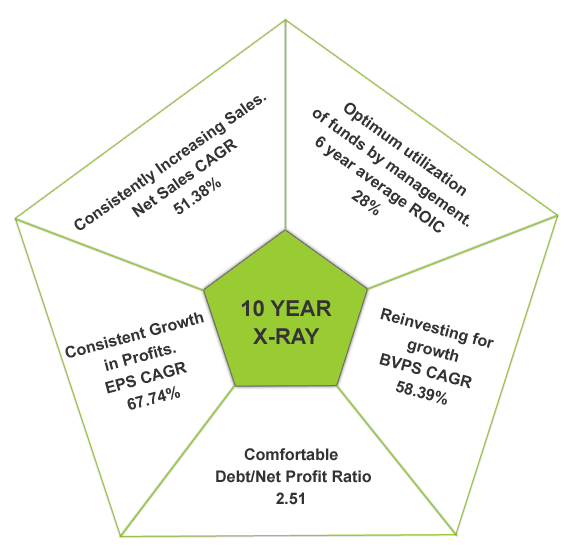
Opto Circuits (India) has performed robustly in all its parameters over the last 10 years. Its impressive fundamentals in the past form a strong base for its future.
On a consolidated basis, the company has grown its Net sales with a robust CAGR of 51.38% over the last 6 years, showing a consistent increase in demand. The company has improved its margins significantly over the years from 13% in FY 2003 to around 25% as of FY 2009. This has been possible due to new, innovative products and the entry into the invasive segments in the last couple of years. This along with good re-investment in the business has helped it clock an impressive EPS CAGR of 67.74% over the last 6 years.
The company has an average ROIC of 28% indicating efficient management of funds. The Debt to Net Profit ratio of the company on a consolidated basis as of March 2009 stands at 2.50. OCIL has taken further efforts to reduce its debt. According to an update released by the company, its total Debt as of 31st March 2010 stood at Rs. 218 Cr. Considering the un-audited Net Profit figure for the FY 2010 of Rs. 258 Cr., the Debt to Net Profit ratio on a consolidated basis works out to just 0.85. Thus the debt position of the company is very comfortable and OCIL is further looking to become a debt free company soon.
Hence, the 10 YEAR X-RAY of Opto Circuits is Green (Very Good).
To view its past 10-year performance in a simple color-coded 10 Year X-Ray, visitMoneyworks4me.com
What is OCIL’s short-term outlook?
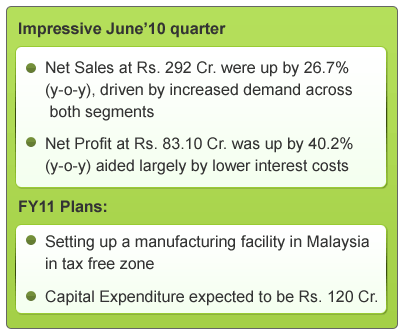 Strong performance across both segments drives growth in the June 2010 quarter:
Both the invasive and non-invasive segments registered good growth in revenues for the June 2010 quarter.
-
Invasive business (Rs. 78.8 Cr.) grew by 63% (YoY) backed by aggressive marketing and promotional activities by the company. Eurocor, Opto’s German subsidiary engaged in manufacturing of stents, posted a revenue growth of 44% (Rs. 59 Cr.)
-
Non-invasive business (Rs. 207.3 Cr.) registered a growth of 17.4% buoyed by the performance of Criticare, Opto’s US subsidiary engaged in the manufacturing of patient monitors, which reported revenue growth of 51% (Rs. 62 Cr.)
Recent acquisitions to further improve growth:
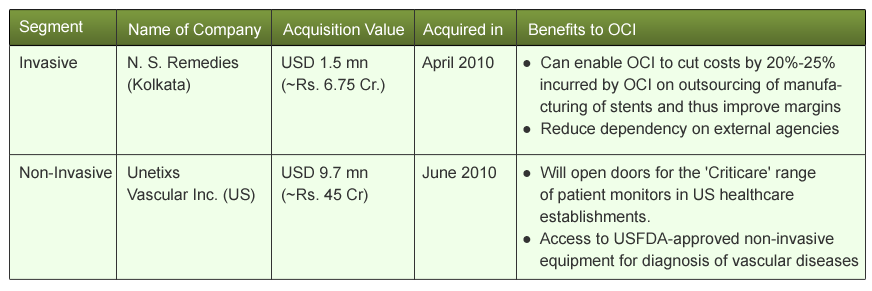
Opto Circuits completed two acquisitions in the last few months, one each in the invasive and non-invasive segments. Both acquisitions were all cash deals funded through internal accruals.
The first company, N.S. Remedies, has an advanced facility for stent manufacturing and research and development and capabilities to produce stainless steel and cobalt chromium stents. The consolidation of this company into OCI has already taken place in quarter of June 2010
The second company Unetixs Vascular is a specialist in detection of peripheral arterial disease (PAD). It designs, develops and markets a full line of world class, USFDA-approved vascular diagnostic systems and accessories and holds 14 patents worldwide. Consolidation of the company into OCI is expected to take place by next quarter.
Criticare expected to contribute significantly to revenues in coming quarters:
Opto acquired Criticare Systems Inc.- a US-based healthcare company in April 2009 to strengthen its non-invasive segments. OCI has been successful in improving the margins of Criticare significantly post its acquisition by shifting some of the Criticare production from US to Indian facility. Criticare Systems, is also moving into a new facility in Pewaukee, Wisconsin. The new facility will allow it to increase production of its new line of vital signs monitors, pulse oximetry devices and sensors. The company has won large orders for nGenuityTM (A multiparameter vital signs patient monitor) and nCompassTM (A multiparameter vital signs patient monitor) from leading hospitals based out of Delhi and Trivandrum.
Thus, considering the strong demand for both its segments and new acquisitions contributing to revenue, we expect the Short-term outlook of the company to be Green (Very Good)
What is OCI’s Long-term outlook?
Opto Circuits India has had an impressive performance in the past, clocking excellent growth rates especially over the last 6 years. It operates in a niche market and is the largest Indian medical equipment manufacturer. Its major competition comes from larger international players like Boston Scientific, Medtronics, Nihon Kohden and Johnson and Johnson. So, what makes Opto Circuits capable of competing with these large companies?
Very good growth opportunities for invasive segment:
OCI entered into the invasive products business in 2006 with the acquisition of Eurocor in Germany. This acquisition enabled Opto to diversify its product offerings through invasive products like catheters and stents. The company has over the last couple of years developed products with features that address the limitations imposed by the current range of products. This includes Taxcor/Taxcor+ – a drug eluting coronary stent, DIOR – a drug eluting balloon dilation catheter and Magical – a balloon combined with a bare metal stent. Opto has been participating in various seminars and conferences to increase awareness of these products.
The global market for coronary stents is estimated to be close to USD 7 billion and is dominated by US, which accounts for 37% share, followed by Europe, 26% and Japan 12%. The products produced by Eurocor are CE-approved (European Conformity) however are not approved for sale in US and Japan – two of the largest markets. An approval to sell its products in US is expected to be obtained in 1-2 years and will be a major growth driver for the company.
Core business of non-invasive products getting stronger:
Opto’s core business is of non-invasive products. The company started off with manufacture and sale of pulse oximeter sensors and with subsequent acquisitions forward integrated into manufacture of pulse oximeter sensors and patient monitoring devices. Currently, around 75% of its revenues come from the non-invasive segment of which supply of sensors contributes around 35%.
The global patient monitoring device market size is estimated at US$5.7b in 2011, up from US$2.8b in 2002. Opto currently has less than 3% market share in the patient monitoring equipment industry. The company has the advantage of a strong distribution network and a diverse product portfolio. This has been obtained through the numerous acquisitions done by the company over the years. Opto also has the advantage of cost competitive products which enables it to maintain its margins. Recently, it has developed new products like modular and green patient monitoring system – eVision 9100, modular gas bench – Poet IQ 8500H and eTraq, a compact, portable, multi-parameter monitor.
Strategy of growth through the acquisition route has been highly successful:
Since 2000 Opto has completed 10 acquisitions in US, Europe and India thus adopting the strategy of inorganic growth. The motive behind these acquisitions was either to get an entry into new product segments or expand its distribution reach and lower its costs. The medical equipment industry is characterised by rapidly changing technology. Hence it becomes important to bring out products at a faster pace in the market which is not always possible if a company tries to develop the product from scratch. As a result, the company has adopted this strategy of inorganic growth and is constantly on the lookout for acquisition opportunities.
Infact, Opto has been very successful at acquiring companies and turning them around. For e.g. In FY 2007 when it acquired Eurocor, Eurocor’s revenues were Rs. 48.7 Cr and Net Profit stood at Rs. 0.70 Cr. In FY 2009, Eurocor posted revenues of Rs. 103.8 Cr. with a Net Profit of Rs. 27.6 Cr.
Opto is looking to continue with this strategy and expects to spend around Rs. 150-200 Cr. for developing new products and further acquisitions.
Thus, strong opportunities in both its product segments combined with Opto’s advantage of cost competitive, diverse product offerings and a wide distribution network are expected to enable Opto to capture a larger share of the global medical equipment industry.
After looking at all these positive points for OCI, is there anything you should be concerned about?
a) High working capital requirements: Opto requires very high working capital which eats away into its profits. As of March 2009, its Days of inventory holding (DIH) stood at 101 days whereas Debtors receivable period stood at 181 days. The reason for such high working capital requirement is primarily the nature of its business. The company has to maintain products like stents and pulse oximeter sensors of different specifications to cater to different patients and clients respectively. This increases the inventory holding. The reason for high debtors receivable could be the competition with large MNC players and Opto’s effort to get higher revenues leading to liberal credit terms for its distributors
However, Opto has been focusing on reducing the working capital requirements. According to a company update, as of March 2010, the Debtors receivable days stood at 150
b) There is huge Foreign Exchange related exposure as the company gets around 94% of revenues from outside India. However the company does not have a hedging policy in place. It relies on natural hedge because of its heavy imports (40-50% of sales).
c) Opto Circuits competes with big companies having huge finances and resources. Its main competitors are Nihon Koden, Boston Scientific, Medtronics and Johnson and Johnson. It also faces the threat of a hostile takeover by these companies.
Thus, considering the diverse product offering of the company and opportunities in the global medical equipment market, we can expect the long-term future of Opto Circuits to be Green (Very Good)
Conclusion:
Opto Circuits India Ltd. operates in the niche area of medical equipment and supplies mainly to the international markets. It faces competition from MNC players who are much bigger in size. However, Opto Circuits has held its own and grown well over the past backed by innovative and diverse products offered at very competitive prices. It has managed to maintain its profitability due to cost advantage and strong distribution network. With the medical equipment industry expected to grow over the next few years, Opto Circuits is poised for good growth in future.
Yes, Opto Circuits (India) Ltd. is an investment-worthy company, but is it at a good price to buy? Or is the market overvaluing it? To find out what investment decision you must take on Opto right now, become a member of www.MoneyWorks4me.com to find its right value.
 If you liked what you read and would like to put it in to practice Register at MoneyWorks4me.com. You will get amazing FREE features that will enable you to invest in Stocks and Mutual Funds the right way.


Need help on Investing? And more….Puchho Befikar

Kyunki yeh paise ka mamala hai
Start Chat | Request a Callback | Call 020 6725 8333 | WhatsApp 8055769463