
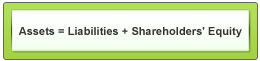
A balance sheet of a company is divided into two parts, that as the name suggests, must balance each other out. The formula behind balance sheets is:
In the previous Stock Shastra, we discussed how companies manipulate assets to present a stronger financial position than reality. It is now equally important to understand how companies may undervalue liabilities to improve the appearance of their balance sheet. An undervalued liability refers to an obligation that is reported at a lower amount than its actual value. Such practices delay the recognition of true liabilities, making the company appear financially healthier and more profitable than it actually is.
So, let us now understand the different techniques companies use to manage or understate liabilities. More importantly, what are the warning signs investors should look for while analysing financial statements?
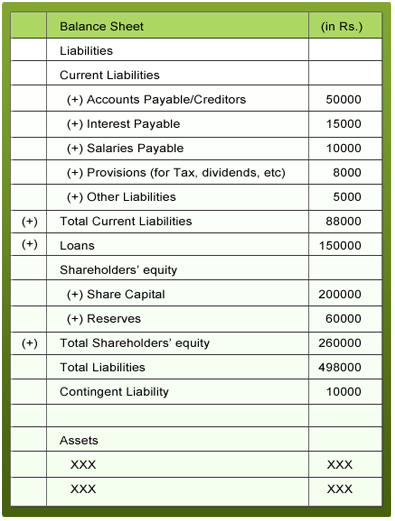
The liabilities most commonly vulnerable to manipulation are those directly linked to business operations – such as accounts payable, accrued expenses, tax obligations, and contingent liabilities. These items have a more immediate impact on reported earnings and usually involve a higher degree of estimation or management judgment, making them more susceptible to accounting manipulation. The table below shows how liabilities are placed on a balance sheet:
Let’s see what are the methods used for undervaluation of liabilities?
Accounts Payable
Just as individuals have regular monthly obligations such as electricity bills, credit card dues, and other household expenses, companies also have payments they owe as part of their normal business operations. Businesses purchase raw materials, components, and services — often on credit — and the amount owed to suppliers is recorded as accounts payable.
However, during financially weak periods, some companies may attempt to understate these obligations to present a healthier financial position. Lower reported payables can artificially improve profitability ratios, liquidity metrics, and the overall appearance of the balance sheet. As a result, investors should closely monitor trends in accounts payable and compare them with purchases, inventory movement, and revenue growth to identify inconsistencies. Have a look at the table below to see how their accounts would look in this case.
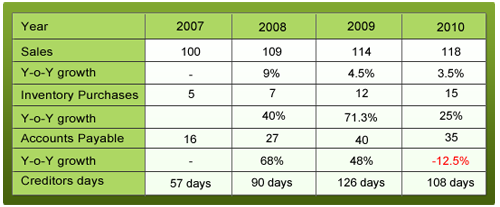
As can be seen, even when revenue and inventory purchases grew in FY 10, accounts payable decreased by 12.5%. Though such a situation does not necessarily indicate an account manipulation, it definitely warrants further scrutiny on the part of investors.
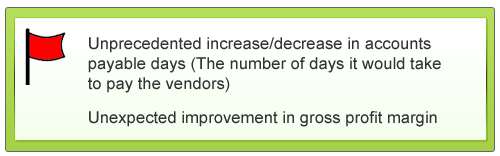
Let’s see what are the warning signals available to investors to identify accounts payable fraud?
Contingent Liabilities
A contingent liability refers to a possible financial obligation that may arise depending on the outcome of a future event. For example, suppose Mr. A, whom we met in earlier Stock Shastras, continues operating his bakery using outdated technology that causes excessive pollution. A nearby resident files a legal complaint against him for environmental damage, resulting in a court case.
Accounting standards require companies to disclose and, where necessary, provide for such potential obligations if there is a reasonable possibility of loss. However, if a company chooses not to record or adequately disclose these liabilities, it leads to an understatement of liabilities and creates a misleading picture of financial strength.
Investors should be particularly cautious when contingent liabilities are unusually high relative to the company’s size or profitability. In such situations, it becomes important to carefully examine the footnotes and disclosures related to contingent liabilities to understand the actual financial risks faced by the business.
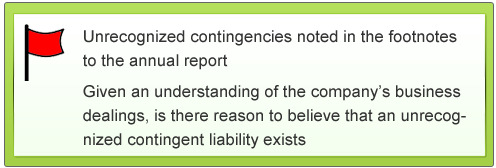
So what are the red flags that will help investors identify these contingent liabilities?
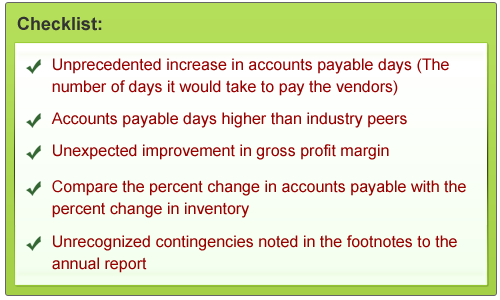
Concluding, it is necessary that we investors shortlist a few companies we would like to invests in. And before investing in these companies analyse their annual reports and notes to accounts to be sure of the company’s business and dealings. Given below is a checklist that summarizes all the warnings available to investors that suggest that a company may be involved in undervaluation of liabilities.

Best Stocks From:
Nifty 50 Nifty Next 50 Nifty 100 Nifty 200 Nifty 500 Healthcare Auto FMCG Nifty Financial Services Chemicals & Fertilizers Dividend Opportunities SmallCap 250 MidCap 100

Get the Investment Shastra letter
Occasional, practical investing notes from the MoneyWorks4Me desk. No noise, unsubscribe any time.