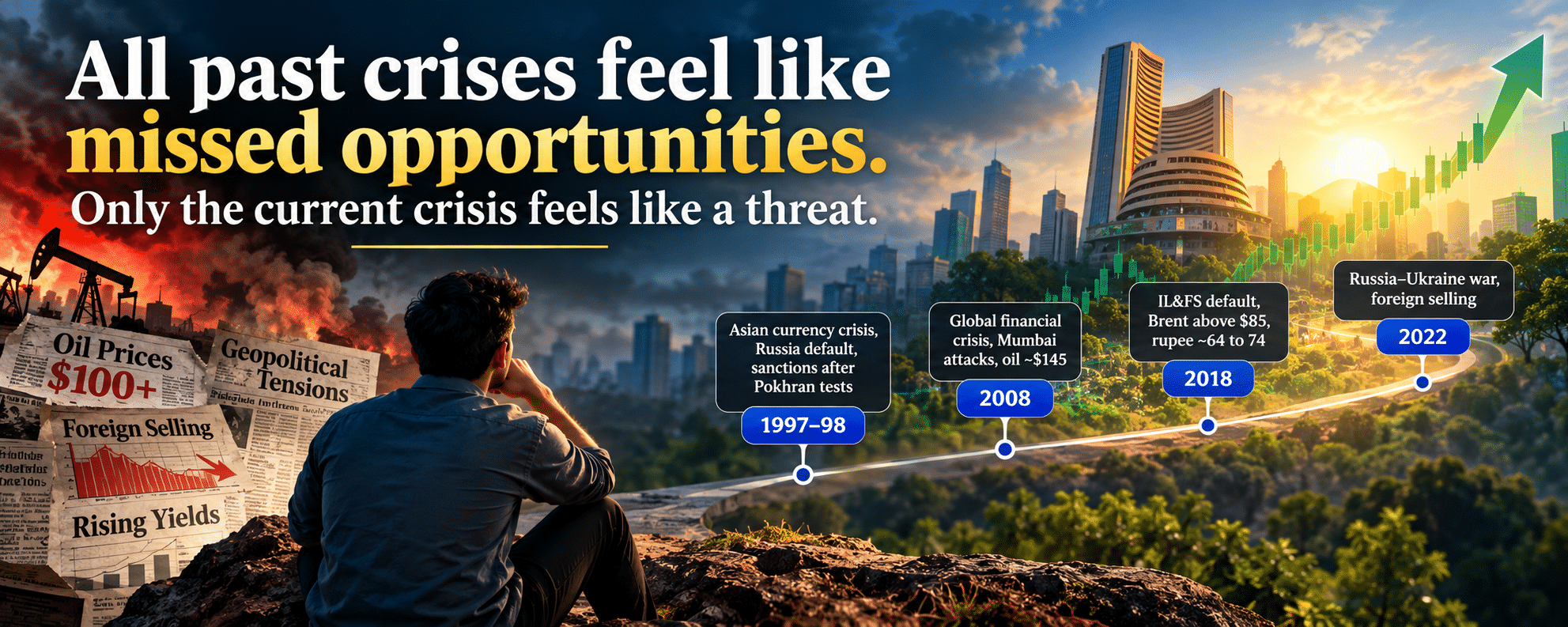
All past crises feel like missed opportunities. Only the current crisis feels like a threat.
The headlines are loud right now. The Middle East conflict has pushed Brent crude above $100 a barrel, and US 10-year yields have risen above 5%, with the Fed funds rate at 3.75–4.00%. Foreign investors have sold about ₹3 lakh crore of Indian equities this year, well above the ₹1.66 lakh crore sold in all of 2025, and the rupee has touched a record low. Strong domestic buying has cushioned the impact on the market.
These worries feel new. They are not.
We have been here before
Every few years the same set of worries returns: a weaker rupee, costlier oil, foreign selling and geopolitical tension. Stress has been a regular feature of Indian markets, from the Asian currency crisis, Russia’s default and the sanctions that followed the Pokhran tests in the late 1990s, through the dot-com bust and the 9/11 attacks, to the 2008 global financial crisis, the 2011–13 rupee slide, the 2018 IL&FS default, the Covid-19 crash and the war in Ukraine.
Asian currency crisis, Russia default, sanctions after Pokhran tests
Global financial crisis, Mumbai attacks, oil ~$145
IL&FS default, Brent above $85, rupee ~64 to 74
Russia–Ukraine war, foreign selling
Dot-com bust, 9/11, Afghanistan and Iraq wars
Nifty -25% in 2011; rupee mid-40s to high-60s; US taper fears
Covid-19 crash
Oil above $100, record-low rupee, FPI outflows
Major stress episodes since the late 1990s. Spacing is not to scale.
The pattern is consistent. A current account deficit, foreign outflows, a weaker rupee and expensive oil are each presented as a new threat. In hindsight, however, past crises tend to look like missed opportunities, while the current one always feels like a threat.
invested
invested
invested
The chart below shows what followed in several such years. In seven of the eight calendar years since 1991 in which the Nifty fell, the next three years were positive, at roughly 6% to 25% a year. The exception was 1995, after which returns were about flat.
This needs context. Three-year periods have been positive most of the time regardless (27 of the 32 since 1991), averaging about 12% a year. Falling years have therefore been followed by somewhat better returns on average, but with no guarantee.
What history does support is a simple principle: over time, returns follow earnings growth and the price paid for those earnings.
Earnings and valuations
The question for a long-term investor is not whether the news is good or bad. It is whether prices are reasonable for the earnings that businesses can deliver over the next three to five years.
On earnings, the picture is encouraging. Real GDP grew 7.8% year-on-year in Q1 FY2026–27. Nifty 50 profit after tax rose about 12% year-on-year in the same quarter, a four-quarter high, and about 17% excluding the energy sector, where high crude prices squeezed fuel-marketing margins. For the broader Nifty 500, profit grew about 11%, or about 23% excluding energy.
Our own Q1 FY27 reviews of portfolio companies, across financial and non-financial sectors, offer a useful bottom-up view of the same trend, and we have covered them in our recent notes. They reinforce our view that the earnings opportunity extends across several sectors rather than a single market theme.
Within the market, however, the gap between businesses is wide. Some combine healthy earnings growth, strong balance sheets and reasonable prices. Others are expensive for their prospects or face structural challenges. A lower price helps only when the underlying business is sound. Good earnings growth is a real strength, but it is uneven. This is a market for selecting businesses, not for buying the index.
How we are positioning portfolios
Our approach is to select the companies best placed to benefit and to pay a sensible price for them. Our process centres on the earnings power of the businesses we own and their prospects over at least three to five years. We track operating performance, growth drivers, valuations and emerging risks, and we make changes when our assessment calls for it. The aim is to own businesses where earnings growth, balance-sheet strength and valuation line up.
This does not eliminate market risk, and prices may stay under pressure while the global factors above play out. What we can do is own businesses whose earnings we understand and avoid overpaying for them.
What this means for you
Your equity allocation should be set by your goals, time horizon and ability to take risk, not by anyone’s view of the market or by the headlines. With that in mind:
- Review your allocation: Check that your equity exposure still matches your goals. Rising and falling prices can both move it away from your plan.
- Consider staging new capital: If you have surplus funds beyond your liquidity needs and a horizon of at least three to five years, investing in stages reduces the risk of poor timing.
- Keep near-term money safe: Funds you will need within the next three years belong in less volatile assets, whatever we think of the market.
Why not simply wait for clarity? Because good times rarely come with advance notice. A resolution of the Middle East conflict could ease crude oil concerns. Foreign flows, negative so far this year, could reverse. India-specific reforms or policy measures supportive of investment could be announced. Any one of these, or a combination, could lift sentiment, and sentiment can turn faster than fundamentals change. Equally, none of them may happen soon, and prices could fall further before they recover. That is why we favour investing in stages over a single lump sum.
The case for acting today is not that a recovery is imminent, but that waiting for certainty can mean paying a higher price for the same underlying opportunity.
Yours sincerely,
MoneyWorks4me Investment Advisers
SEBI Registered Investment Advisers Registration No. INA000013323
BASL ID: 1187 ; CIN: U74999PN2000PTC015084
(Type of Registration- Non-Individual, Validity of Registration- Perpetual)
Address: B-101, Signet Corner, Baner Road, Baner, Pune, Maharashtra, 411045
Contact No: +91 98603 59463 Email: besafe@moneyworks4me.com
Investment in securities market are subject to market risks. Read all the related documents carefully before investing. Registration granted by SEBI, enlistment with BSE and certification from NISM in no way guarantee performance of the intermediary or provide any assurance of returns to investors.
This note is for educational purposes only and does not construe investment advice