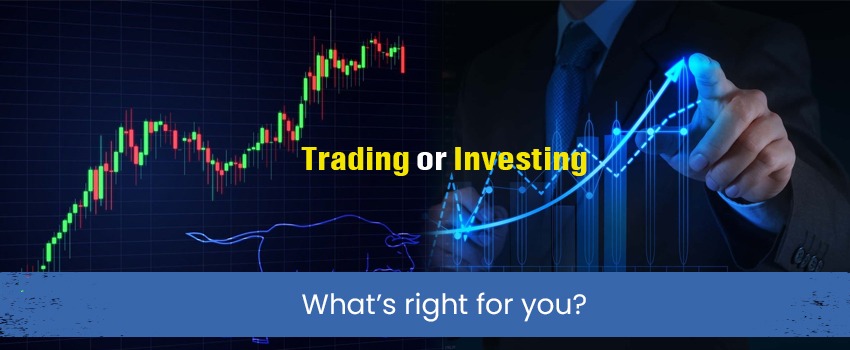
Most participants in the stock market eventually face a common question: should you trade actively or choose investing for the long term? The terms are often used interchangeably, but they represent very different approaches.
Understanding how each works—and what it demands from you—can help you decide which path aligns better with your goals, temperament, and time commitment.
1. How Trading Works
Trading focuses on short-term price movements. The objective is to buy and sell stocks quickly to capture small price differences.
Traders typically rely on two broad approaches:
- Anticipating short-term events or news that may move a stock
- Using technical analysis based on price patterns, volume trends, and market signals
Positions are often held for very short durations—sometimes hours or days. Traders usually define clear exit points, such as a target price or a strict time window.
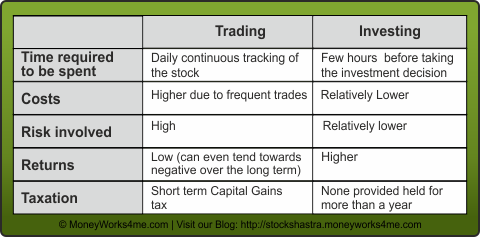
While trading can produce quick gains, it also involves:
- Frequent transactions
- Higher costs from brokerage and fees
- Greater exposure to market volatility
- In some cases, leverage or borrowed funds
Success in trading often depends on precise timing, which is difficult to sustain consistently.
2. How Investing Differs
Investing is built around long-term ownership of businesses rather than short-term price movements.
Investors typically evaluate:
- Company fundamentals and financial strength
- Industry dynamics and competition
- Long-term growth potential
- Intrinsic value compared to market price
The goal is to buy businesses that are undervalued or capable of sustained earnings growth and hold them through market cycles.
Unlike traders, long-term investors:
- Are less focused on short-term price fluctuations
- Benefit from compounding returns
- May earn dividends in addition to price appreciation
- Often reinvest gains to build wealth over time
In many cases, investors do not define a fixed selling price in advance, as long as the investment thesis remains intact.
3. Risk, Costs, and Practical Reality
Both trading and investing involve risk, but the nature of that risk differs.
Trading typically carries:
- Higher transaction costs due to frequent buying and selling
- Greater reliance on timing the market
- Increased emotional pressure and time commitment
Research across markets has shown that a large majority of active traders struggle to consistently outperform broad market returns over long periods.
Investing, on the other hand, relies more on:
- Business quality
- Earnings growth
- Long-term discipline
For most retail investors, this approach tends to be more practical and sustainable.
4. Why Mixing the Two Often Creates Confusion
Some investors attempt to combine trading and investing. In practice, this can blur decision-making.
A common pattern emerges:
- When a stock rises quickly, it is treated like a trade
- When a position falls, it suddenly becomes a “long-term investment”
This shift in mindset can weaken discipline and increase risk.
A clearer approach is to decide why you are buying a stock before you buy it—whether it is for short-term price movement or long-term ownership.
The Bottom Line
Trading and investing are fundamentally different strategies. Trading depends on timing and short-term price movements, while investing relies on identifying quality businesses and allowing earnings to compound over time.
For most individual investors, long-term investing tends to offer a more reliable path to wealth creation, provided it is supported by research, valuation discipline, and patience.
A Note from MoneyWorks4Me
At MoneyWorks4Me, our focus is on helping investors identify fundamentally strong companies available at reasonable valuations. By combining research-driven insights with long-term discipline, investors can build portfolios designed to grow steadily across market cycles.
If you liked what you read and would like to put it in to practice Register at MoneyWorks4me.com. You will get amazing FREE features that will enable you to invest in Stocks and Mutual Funds the right way.