
Expense Manipulation in Financial Statements is one of the most common ways companies artificially inflate profits and mislead investors.
Revenues – Expenses = Net Profit (or Loss)
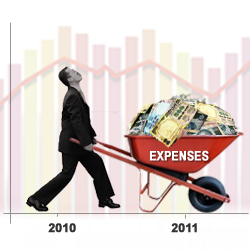
If a company wants to artificially improve its financial performance, it usually manipulates either revenues or expenses. In the previous Stock Shastra article, we discussed how companies inflate revenues and the warning signs investors should watch for. In this article, we focus on how companies manipulate expenses and the red flags that may indicate such practices.
Before understanding these techniques, it is important to first understand how expenses are normally recorded in financial statements.
The two-step process for recording expenses..
Companies account for their cost/expenditure in a two-step fashion.
Step 1 – Recording the expenditure as an asset
This happens when the company spends money but has not yet received the related benefit. Since the benefit is expected in the future, the expenditure is recorded as an asset on the balance sheet. In accounting terms, this is called capitalization.
For example, if a company purchases a two-year insurance policy, the full amount initially represents a future benefit and is shown as an asset.
Step 2 – Recording the expenditure as an expense
As the benefit gets consumed over time, the cost is gradually shifted from the balance sheet to the Profit and Loss statement and recorded as an expense.
Continuing the insurance example, after one year, half the insurance cost would be recorded as an expense and the remaining half would still stay as an asset. After the second year, the entire amount would be expensed.
So how do companies manipulate expenses?
The answer is simple: management influences the speed at which these two steps occur.
If earnings are expected to weaken, companies may delay moving costs from the balance sheet to the Profit and Loss statement. By keeping expenses “frozen” as assets for longer, current profits appear higher while the actual expense gets pushed into future periods.
In short, companies shift present expenses into the future to artificially inflate current earnings.
The different techniques to shift current expenses to a later period…
There are four common ways companies manipulate expenses:
- Improperly capitalizing normal operating expenses
- Amortizing costs too slowly
- Failing to write down impaired assets
- Failing to record expenses for doubtful receivables and devalued investments
1) Improperly capitalizing operating expenses on the balance sheet:
In this case, management performs only the first accounting step and avoids the second. Regular operating expenses are wrongly treated as assets instead of being recorded as expenses.
Common examples include:
- Marketing expenses
- Software development costs
- Research and development expenses
A well-known example is WorldCom.
During the telecom boom of the 1990s, WorldCom entered into agreements with telecom carriers and paid large “line costs” for network usage. When growth slowed after the dot-com crash, investors began scrutinizing these rising costs.
To maintain profitability, WorldCom capitalized a large portion of these operating expenses instead of recording them in the Profit and Loss statement. This understated expenses and overstated profits between 2000 and 2002.
Similarly, companies sometimes capitalize software development or R&D expenses too early — even before the project becomes commercially viable. This can temporarily inflate profits.
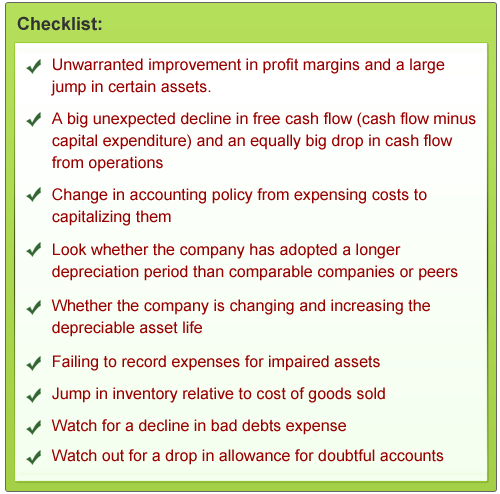
So, what are the red flags to identify such companies?
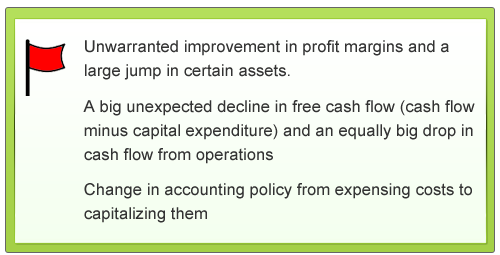
2) Amortizing costs too slowly:
Some assets provide benefits over several years. Machinery, equipment, and long-term assets are therefore depreciated or amortized gradually over their useful lives.
Expense manipulation occurs when companies deliberately slow down this process.
Instead of recognizing the cost at a reasonable pace, management stretches the depreciation or amortization period. As a result, annual expenses fall and profits look artificially higher.
In terms of the two-step process, companies delay the second step by moving expenses too slowly from the balance sheet to the Profit and Loss statement.
One way to identify this is by comparing depreciation policies with similar companies in the industry.

3) Failing to write down assets with impaired value:
Consider a company that buys equipment expected to last 10 years. If the equipment permanently breaks down in year 5, the remaining value should immediately be recorded as an expense.
However, some companies continue depreciating the asset according to the original schedule even after its value has collapsed.
This means the company fails to recognize the impairment loss and keeps profits artificially elevated.
The same issue can occur with obsolete inventory. If inventory can no longer be sold or has lost significant value, companies should write it down and record the loss immediately.
When companies avoid these write-downs, assets and profits both get overstated.
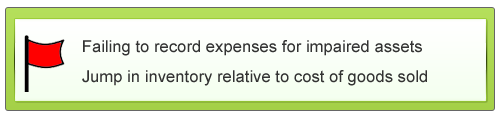
4) Failing to record expenses for uncollectible receivables and devalued investments:
Not all customers pay their dues on time — and some may never pay at all.
Accounting standards therefore require companies to estimate bad debts and record an expense for receivables that may become uncollectible.
Companies that avoid recognizing these losses overstate both profits and asset values.
A similar issue arises when investments lose value but companies delay recognizing the decline.
Such practices create an unrealistic picture of financial strength and profitability.

Summarizing, Expense manipulation is one of the most common ways companies artificially inflate profits. While the methods may vary, the objective remains the same – delaying or hiding expenses to make earnings appear stronger.
Identifying these warning signs requires careful reading of annual reports, accounting notes, and management commentary. Though the process may be time-consuming, it helps investors avoid businesses where reported profits do not reflect economic reality.
Disciplined investing is not just about finding good companies — it is equally about avoiding companies that distort financial performance.
At MoneyWorks4Me, we believe long-term investing should be driven by research, valuation discipline, and financial clarity. Understanding accounting quality and identifying red flags can help investors make more informed and rational decisions over time.
If you liked what you read and would like to put it in to practice Register at MoneyWorks4me.com. You will get amazing FREE features that will enable you to invest in Stocks and Mutual Funds the right way.
Get the Investment Shastra letter
Occasional, practical investing notes from the MoneyWorks4Me desk. No noise, unsubscribe any time.