
Balance Sheets help investors assess the financial strength and overall health of a company. Since the balance sheet plays an important role in shaping investor perception, management teams often try to present the company’s financial position in the most favourable manner possible. One common way this is done is by manipulating the asset side of the Balance Sheet.
In many cases, companies overstate the value of certain assets to make profitability, liquidity, or financial stability appear stronger than they actually are. The assets involved may be regular operating assets such as inventory or receivables, or even less common items such as land, investments, or artwork.
Regardless of the method used, the end result remains the same — an inaccurate picture of the company’s true financial condition and earning power. So, let us understand which assets are most commonly manipulated and how such manipulation usually takes place.
What are the assets that can be overvalued?
Assets are broadly classified into two categories:
- Fixed Assets
- Current Assets
Current assets are those used in the day-to-day operations of a business. These include cash, inventory, and accounts receivable. Among these, the two most commonly manipulated assets are:
- Accounts Receivable
- Inventory
These items appear under Current Assets in the Balance Sheet and often become areas where companies attempt to overstate operational strength or profitability.

So, let’s look at how these assets can be overvalued?
Accounts Receivable/Debtors
Let us revisit Mr. A from our earlier Stock Shastra examples. Mr. A owns a bakery known for producing some of the finest bread in town. Over time, he builds a loyal customer base that purchases products from him regularly.
To strengthen relationships with these customers, Mr. A introduces a credit facility. Instead of making immediate payment every day, select customers are allowed to pay him once every quarter. Even though the cash has not yet been received, the sale has already been made. Therefore, Mr. A records the amount due from customers as an asset on his Balance Sheet under Accounts Receivable.
Now suppose Mr. A realizes that one of his customers — say Mr. X — may not be able to repay the outstanding amount. In such a situation, good accounting practice requires him to reduce the value of receivables and create a separate provision called Provision for Doubtful Debts. So far, the accounting treatment remains fair and reasonable.
However, problems begin when management starts manipulating receivables.
For instance, what if Mr. A records receivables even before an actual sale has taken place? Or what if he deliberately avoids creating provisions for customers who may never repay?
In both cases, the Accounts Receivable balance would continue increasing disproportionately over time.
Typically, such manipulation creates two visible warning signs:
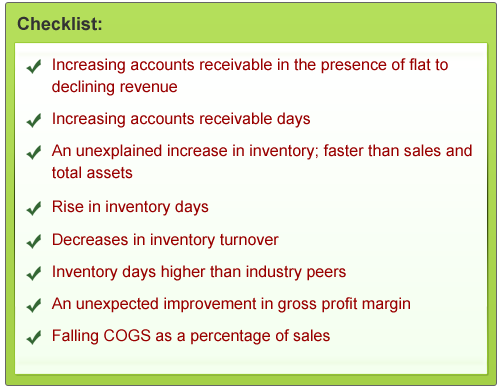
- Accounts receivable starts growing faster than sales
- Debtor Days continue increasing consistently
A rising debtor days figure indicates that customers are taking longer to pay, or in some cases, that the receivables themselves may not be entirely genuine.
The table below illustrates how Mr. A’s financial statements may start appearing under such circumstances.
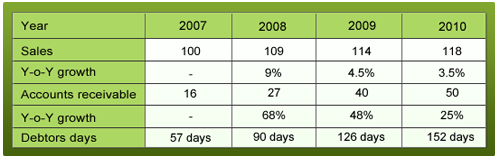
So, by overstating debtors, companies try to report that they have additional cash that is receivable in the future, enhancing their financial position.
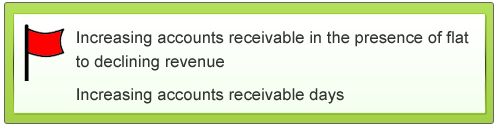
So, what are the warnings/red flags available to us investors against overvalued accounts receivable?
Inventory
Inventory represents goods that have already been manufactured or purchased by a company but have not yet been sold to customers.
Since inventory directly affects the calculation of cost and profits, it is one of the most commonly manipulated items on the Balance Sheet.
When a company overstates the value of inventory, the reported Cost of Goods Sold (COGS) becomes artificially lower once those goods are sold. Lower costs eventually result in inflated profits and stronger-looking financial performance.
Companies generally use multiple approaches to overvalue inventory.
1. Overstating Physical Counts
The simplest way to inflate inventory is to overstate the actual quantity of goods held by the company.
This may involve:
- Recording inventory that does not actually exist
- Inflating the quantity of existing goods
- Including damaged or obsolete goods as usable inventory
By increasing the reported quantity of inventory, the total asset value on the Balance Sheet also rises artificially.
2. Increasing Reported Valuation
In some cases, companies do not manipulate the quantity of inventory but instead inflate its valuation.
Under this method, the inventory physically exists, but management assigns a higher value to it than what is realistically justified.
This can happen through:
- Unrealistically high pricing assumptions
- Failure to write down obsolete inventory
- Incorrect costing methods
- Deliberately overstating the quality or realizable value of goods
As a result, both inventory value and reported profits appear stronger than the actual economic reality.
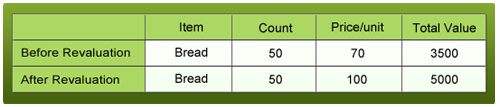
Suppose Mr. A realizes that the bread he bakes is the best in town and has a lot of demand. He thinks the customers will pay more for his product in future. Thus, he increases the bread prices and accordingly revalues his inventory at a higher cost. This is how his inventory for only breads would look like:
3. Delaying an Inventory Write-down
Suppose Mr. A overestimates the demand for bread at his bakery. Over the next few days, customer demand drops sharply and a large portion of the bread remains unsold because buyers start purchasing from another bakery.
Under normal accounting practice, Mr. A should either:
- record the unsold stale bread as a loss, or
- reduce the inventory value to reflect its lower realizable value
After all, stale bread cannot realistically be sold at the same price as fresh bread.
However, if Mr. A deliberately avoids reducing the inventory value, the Balance Sheet would continue showing inventory at an inflated amount despite the actual economic value having fallen significantly.
Similarly, companies may postpone inventory write-downs for:
- obsolete goods
- defective products
- unsold inventory
- slow-moving stock
A write-down reduces the inventory value on the Balance Sheet and records a corresponding loss in the Profit and Loss statement. By delaying this process, companies temporarily avoid recognizing losses and artificially inflate profits.
4. Change in method of calculation
Another way companies can influence reported profits is by changing the inventory accounting method.
There are three commonly used inventory valuation methods:
- FIFO (First In, First Out)
- LIFO (Last In, First Out)
- Average Cost Method
First In, First Out (FIFO)
Under FIFO, the inventory purchased or manufactured first is assumed to be sold first.
As a result, older inventory costs are charged to the Profit and Loss statement, while newer inventory remains on the Balance Sheet.
Last In, Last Out (LIFO)
Under LIFO, the most recently purchased inventory is assumed to be sold first.
This means older inventory remains in stock at the end of the accounting period.
Average Cost Method
Under this method, companies calculate the weighted average cost of all inventory available during the accounting period. This average cost is then used to determine both:
- Cost of Goods Sold (COGS)
- Closing Inventory Value
The choice of inventory accounting method can materially impact reported profits and inventory valuation.
For example, during periods of rising prices:
- LIFO generally results in higher Cost of Goods Sold and lower profits
- FIFO generally results in lower Cost of Goods Sold and higher profits
As a result, companies using FIFO may report stronger profitability compared to those using LIFO under the same operating conditions.
The illustration below highlights how different inventory accounting methods can lead to different profit outcomes.
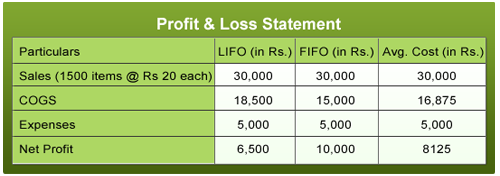
Companies can change inventory valuation methods which could lead to artificially higher/lower profits. For e.g. in the case given above if the company changes from LIFO to FIFO, its profit will be higher. However, companies have to declare a change in such an accounting policy and this can be found in the ‘Notes to Accounts’ section.
So what are the warning signals/red flags to help us identify inventory manipulation?

To summarize, there are various techniques used by companies to manipulate their assets. A company may not publish its entire asset situation in its annual report. However, it is required to report all such details about inventory and debtors in its notes to accounts. Given below is a checklist that summarizes all the warnings available to investors that suggest that a company may be involved in asset manipulation.
If you liked what you read and would like to put it in to practice Register at MoneyWorks4me.com. You will get amazing FREE features that will enable you to invest in Stocks and Mutual Funds the right way.