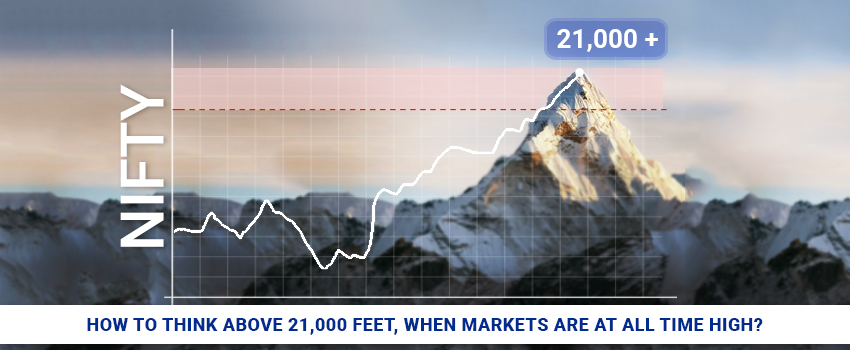
Climbers who ascend beyond 26,000 feet on Mount Everest enter what is known as the “death zone” — an environment where oxygen levels become dangerously low, judgment weakens, and even basic decision-making becomes impaired.
Markets at all-time highs often create a similar psychological environment for investors.
At one end are investors becoming excessively optimistic — chasing SME IPOs, speculative business models, and momentum-driven stories while completely ignoring valuations. At the other end are investors becoming overly fearful — booking profits too early, remaining underinvested, or avoiding equities altogether despite long-term wealth creation opportunities.
In both cases, emotions begin to dominate decision-making.
As Warren Buffett once remarked, some investors simply need to “remember their helmet.” The idea is simple: during extreme environments, survival depends less on excitement and more on discipline, awareness, and composure.
Behavioral Biases Investors Must Remain Vigilant About
1. Recency Bias
Recency bias leads investors to believe that recent market trends will continue indefinitely.
When stocks deliver strong short-term returns, investors often begin extrapolating that performance far into the future. A stock doubling within a year creates the illusion that rapid appreciation is normal and repeatable.
But market history repeatedly shows that short-term performance rarely predicts long-term outcomes with certainty.
Rational investing requires separating temporary momentum from sustainable business fundamentals.
2. Narrative Bias
Markets are often driven by compelling stories.
New technologies, disruptive business models, and popular themes can create powerful narratives that attract investor attention. However, a strong narrative alone does not automatically create a strong investment opportunity.
Narrative bias causes investors to prioritize storytelling over valuation, cash flows, and business quality.
Over time, markets reward businesses that deliver durable economics — not merely exciting headlines.
3. Overconfidence Bias
Bull markets often create the illusion that investing is easy.
As portfolios rise, investors may begin overestimating their ability to predict outcomes, manage risks, or identify winning opportunities consistently. This overconfidence can gradually shift disciplined investing into speculative behavior.
The danger is not confidence itself, but the false belief that risk no longer exists.
Long-term investing success often depends more on risk management and process discipline than on aggressive prediction-making.
4. Herd Mentality
During euphoric markets, following the crowd can feel emotionally comfortable.
When everyone appears to be participating in the same opportunities, resisting the herd becomes psychologically difficult. But herd behavior often causes investors to abandon independent thinking and valuation discipline.
Successful investing rarely comes from blindly participating in market excitement. It comes from making informed decisions based on fundamentals, probabilities, and long-term outcomes.
The Bottom Line
Navigating elevated markets requires both analytical discipline and emotional balance.
Just as climbers in extreme altitudes must remain cautious despite being close to the summit, investors must avoid allowing optimism or fear to impair judgment during market highs.
A quality-at-reasonable-valuation approach remains one of the most reliable ways to navigate uncertain market environments. It anchors decision-making to business fundamentals, cash flows, and long-term earning potential rather than short-term sentiment.
At MoneyWorks4Me, we believe investing with equanimity — calmness, discipline, and process-driven thinking — becomes even more important when markets appear euphoric. Long-term wealth creation is rarely about reacting emotionally to market extremes; it is about remaining rational while others lose balance.
Best Stocks From:
Top 10 Stocks in India Best EV Stocks in India Screener Alpha Cases Best 5G Stocks in India Top AI Stocks in India Best Drone Stocks in India Best Defence Stocks in India Top 10 Infrastructure Stocks in India Best Fintech Stocks in India Best Manufacturing Stocks in India Best Liquor Stocks in India