Most investors focus on price movements and short-term trends. However, long-term wealth creation is driven by discipline, valuation, and the ability to think independently.
Sir John Marks Templeton, one of the pioneers of global investing, built his legacy on these principles. His Templeton Growth Fund delivered ~13.8% CAGR between 1954 and 2004, outperforming the S&P 500’s ~11.1% during the same period—demonstrating the power of a disciplined, value-driven approach.
Sir John Marks Templeton (1912–2008)
Sir John Templeton was an American-born British investor, a pioneer of global mutual funds, and a renowned philanthropist.
One of the most striking examples of his contrarian mindset came during the Great Depression. In the 1930s, he invested $100 in every stock trading below $1 on the New York and American Stock Exchanges—104 companies in total, including 34 that were bankrupt.
Just four years later, he sold the portfolio for over $40,000, generating an extraordinary ~40% CAGR.
Templeton later went on to build some of the world’s most successful global investment funds. His early investments in Japan in the 1960s and his globally diversified approach were far ahead of their time. A $10,000 investment in his fund in 1954 grew to ~$2 million by 1992 (~14.5% CAGR), highlighting the power of long-term compounding.
Templeton on Investing
Like Warren Buffett and Charlie Munger, Templeton rejected technical analysis and focused on fundamentals.
He believed that the best opportunities lie in neglected stocks—companies that others are not even studying. His philosophy centered around “bargain hunting” globally, searching for undervalued opportunities across markets.

- Investing over trading or speculating
Templeton viewed trading and speculation as activities driven by short-term outcomes, often resembling gambling more than investing.
His approach focused on long-term ownership of businesses. The goal was not just to match average returns, but to outperform through patience and disciplined decision-making.
- Do your homework
Templeton emphasized deep research before investing. Understanding a company’s business model, financial strength, and growth potential was essential.
In equity investing, one is effectively buying future earnings or underlying assets. Without this understanding, decisions are based on assumptions rather than analysis.
- Invest in quality stocks available at a discount, place your money on the value and not price
Templeton focused on intrinsic value rather than market price. Prices often fluctuate based on sentiment, especially during bull and bear phases, but value is derived from fundamentals.
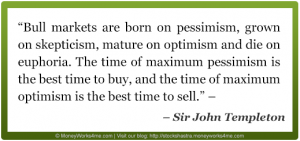
He believed that the best time to buy is when markets are pessimistic—when strong businesses are available at a discount.
Templeton clearly differentiated between investing and speculation. Trading is driven by short-term price movements, while investing focuses on long-term business value.
Frequent buying and selling not only increases the probability of errors but also limits the ability to benefit from compounding. Long-term ownership of fundamentally strong businesses tends to create more sustainable outcomes.
There have been marked examples of his exceptional style of investing:
- It is important to diversify
Templeton was among the first to advocate global diversification. He invested across countries, sectors, and asset classes, recognizing that no single investment works in all environments. Diversification helped manage uncertainty and reduced dependence on any one market or strategy.
- Resist investing on tips or sentiment
Templeton cautioned against investing based on tips, market sentiment, or the pursuit of quick gains. Such decisions are often driven by emotion rather than logic and rarely lead to consistent long-term success.
- Focus on maximizing total real return
Templeton emphasized the importance of real returns—returns adjusted for inflation and taxes. Nominal gains can be misleading if they do not translate into an increase in purchasing power. This is particularly relevant when evaluating fixed income investments.
- Learn from past experience
Mistakes are an inevitable part of investing. Templeton believed that learning from them is more important than avoiding them entirely. Continuously refining one’s approach based on past experience improves long-term outcomes.
- Monitor your investments
Templeton rejected the idea of “buy and forget.” Markets and businesses are constantly evolving, and investments need to be monitored accordingly. Regular evaluation ensures that the original investment rationale remains valid.
- Avoid overconfidence
Overconfidence can lead to poor decision-making and excessive risk-taking. Templeton emphasized humility and continuous learning. Recognizing the limits of one’s knowledge is essential for long-term success.
- Frequent pessimism is not good either
While caution is important, excessive pessimism can lead to missed opportunities. Markets go through cycles, and long-term growth often continues despite short-term volatility.
- Be flexible while investing
Templeton believed in flexibility across asset classes—equities, bonds, and other instruments. No single strategy consistently outperforms, and adapting to changing conditions is necessary.
- Market crashes do happen
Market corrections and crashes are inevitable. Templeton advised against panic selling during such periods. A disciplined approach focuses on staying invested and identifying opportunities rather than reacting emotionally.
- The power of prayer
Templeton believed that reflection and clarity of thought lead to better investment decisions. This underscores the importance of mental discipline and thoughtful analysis.
The Return on your (time) Investment…
To recapitulate, the key takeaways from John Templeton’s investment philosophy:
- Invest in value and not price
- Buy low, sell high
- Focus on real returns
- Do your homework, and subsequently stick to your investments
- Don’t give in to panic selling and market crashes
Templeton’s philosophy is quite in parallel to that of Warren Buffett and Charlie Munger, being a value-contrarian investor himself. Additionally, his focus on diversification and his belief in the power of prayer should prove to be a good confidence builder to the intelligent investor.
The final word remains: Please read the Templeton document carefully before investing!
If you liked what you read and would like to put it in to practice Register at MoneyWorks4me.com. You will get amazing FREE features that will enable you to invest in Stocks and Mutual Funds the right way.