

01
Consistent outperformance
We examine how frequently a fund outperformed its benchmark across different start dates and market conditions.
Mutual funds selected for consistent outperformance
and a clear role in your portfolio.
We distinguish repeatable performance from returns produced by one favourable period-and separately assess how much value the fund added over its benchmark.
We examine how frequently a fund outperformed its benchmark across different start dates and market conditions.
We separately assess the fund's average rolling return and the alpha generated over its relevant benchmark.
We assess the current fund manager's tenure, performance during that tenure and whether the investment approach has remained consistent.
We study holdings to select funds that complement other funds and the Direct Stock portfolio not replicate what is already owned.
Our mutual-fund recommendations follow a disciplined, research-led process-not individual opinions.
We regularly assess and refine this process, while making changes cautiously because no investment approach performs equally well across every period and market.
Assess the frequency and level of outperformance using rolling returns and rolling alpha.
Examine holdings, market-cap exposure and investment approach to understand how the fund differs.
Select a limited number of funds that complement one another and the Direct Stock portfolio.
Track performance, fund-manager continuity, portfolio changes and continued relevance.
We study three-year rolling returns measured monthly over an extended period, with the starting date moving forward by one month for each observation. This gives us multiple performance periods across different entry points, rather than relying on a single convenient start and end date.
We measure the proportion of rolling periods in which the fund delivered a return above its relevant benchmark. A higher frequency indicates that outperformance was more repeatable across different market conditions.
We evaluate the fund’s average rolling return and the alpha over its benchmark. This tells us whether the outperformance was meaningful-not merely frequent but marginal.
Most portfolios have far too many funds and this leads to suboptimal returns. We recommend only as many funds as are genuinely required.
Every fund should contribute something the rest of the portfolio
does not already provide.
Keep the number of funds to what is needed for meaningful diversification.
Avoid funds with similar portfolios, market-cap exposure and investment approaches.
Ensure every fund has a clear role within your complete equity portfolio.
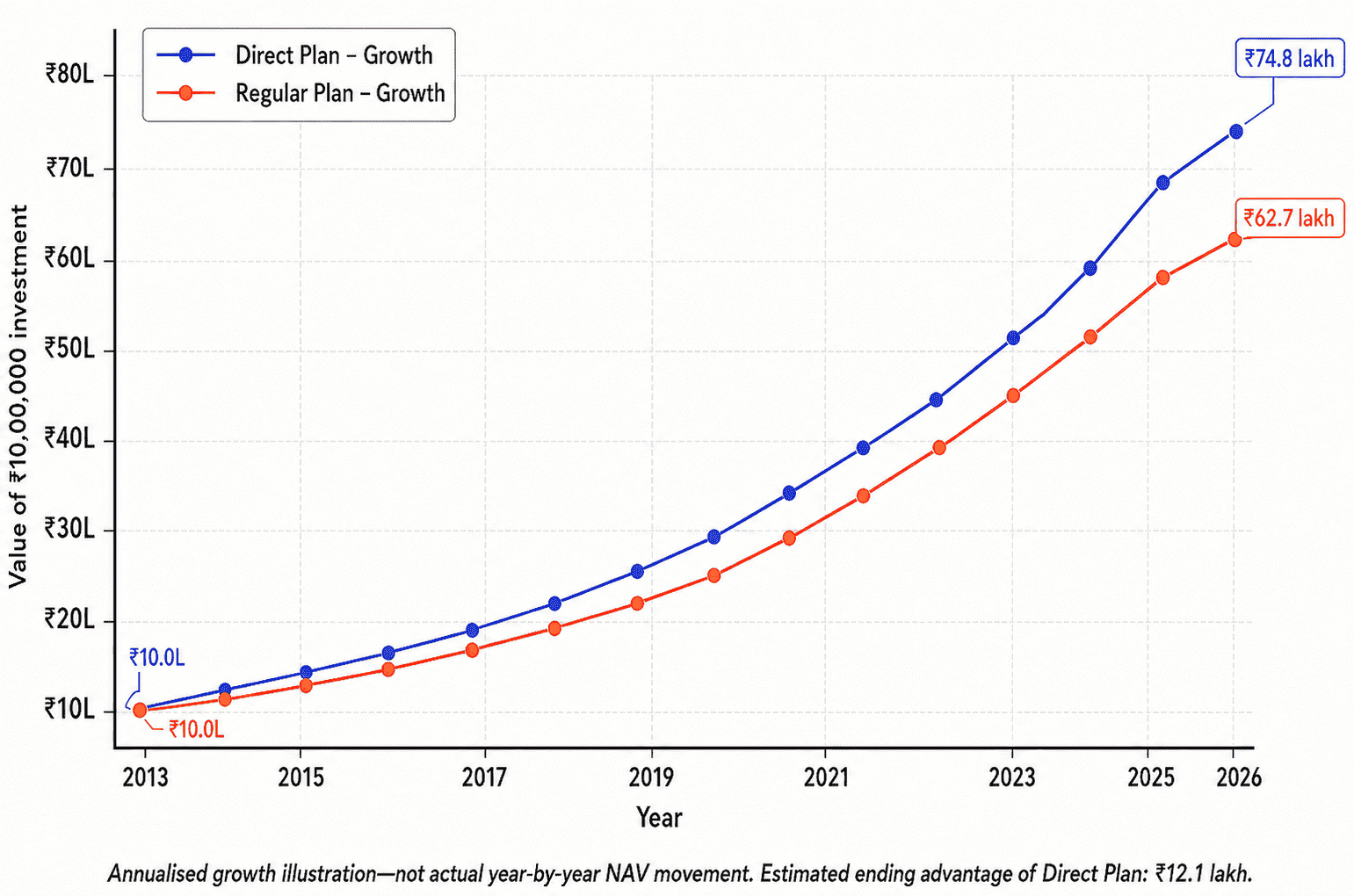
Direct Plans have lower expense ratios than Regular Plans
of the same scheme as they do not include distributor commissions.
.Lower costs leave more of the return available for long-term compounding.
Fund selection and capital deployment are related but separate decisions.
Three-year monthly rolling returns across an extended period help us identify funds that delivered more consistently across different entry dates. This increases the probability of a satisfactory experience for investors deploying money regularly through SIPs.
Before recommending a lump-sum deployment, we assess the level of the market and the underlying portfolio. Capital may be invested immediately or deployed gradually so investors can participate at more favourable levels.
Our intention is to remain invested in a selected fund for at least three years. We do not replace a fund simply because it temporarily falls behind its benchmark or category peers.
A recommendation changes when there is a material divergence from our original understanding of the fund.
We first understand the companies, sectors and market-cap exposures already present in your Direct Stock portfolio. We then identify mutual funds that add opportunities and fund-manager approaches not adequately represented there.
Avoid repeatedly owning the same companies across funds and stocks.
Every scheme should perform a distinct role within the portfolio.
Add a similar-category fund only when its manager invests meaningfully differently.
Judge diversification across the whole equity portfolio not fund names alone.
Speak with a Omega advisor to review your existing portfolio.
Check for overlap and whether it is likely to deliver index and
inflation beating returns.
Omega recommends only as many funds as are genuinely required. The exact number depends on your existing holdings, Direct Stock exposure, goals and the distinct role each scheme performs.
We usually study three-year rolling returns calculated monthly over an extended period. We separately evaluate how often the fund outperformed and how much alpha it generated over its relevant benchmark.
If you save monthly, an SIP is the natural choice. If you already have a sizeable amount and a long investment horizon, investing it as a lump sum is usually sensible because markets rise more often than they fall. Small-cap funds need greater caution. When valuations are high, gradual deployment or waiting may be preferable. When valuations are attractive, either a lump sum or an SIP can work-depending on your ability to handle volatility. The goal is not to catch the market bottom, but to invest at reasonable valuations.
Our intention is to remain invested for at least three years and not replace a fund for temporary underperformance. A recommendation changes only for a fundamental reason, such as a material manager change, altered approach, persistent process-inconsistent performance or increasing overlap.
Yes. Omega can assess performance consistency, benchmark alpha, portfolio overlap, scheme relevance and whether you are invested through Direct or Regular Plans.
No. Mutual fund investments are subject to market risks and returns cannot be guaranteed. Omega’s process is designed to support informed, disciplined decisions, not eliminate investment risk entirely. Read all scheme-related documents carefully.


|
Name of the IA registered
with SEBI: |
The Alchemists Ark Pvt. Ltd. |
|
Logo:
|

|
|
Trade/Brand
Name of IA: |
MoneyWorks4Me Investment Advisers |
|
Brand Logo:
|
 |
|
SEBI Registration Number:
|
INA000013323 Validity – May 16, 2019 – Perpetual |
|
Registration:
|
Non-Individual |
|
BSE Enlistment No:
|
1187 |
|
Address:
|
B-101, Signet Corner Building, Balewadi Phata, Baner, Pune, Maharashtra 411045 |
|
Compliance Officer
Details: |
Name: Shrikant Jagtap Email: shrikant.jagtap@moneyworks4me.com |
Telephone: +919860359463 Address: Same as IA |
|
Grievance Officer
Details: |
Name: Mukta Vaze Email: mukta.vaze@moneyworks4me.com |
Telephone: +919860919463 Address: Same as IA |
|
Principal Officer
Details: |
Name: Atharva Bhide Email: atharva.bhide@moneyworks4me.com |
Telephone: +919175899463 Address: Same as IA |
|
Standard Warning:
|
Investment in securities market are subject to market risks. Read all the related documents carefully before investing. |
|
|
Disclaimer:
|
Registration granted by SEBI, enlistment with exchange and certification from NISM in no way guarantee performance of the intermediary or provide any assurance of returns to investors. |
|