Indian equity benchmarks ended lower on Wednesday, led by heavy selling in pharmaceutical stocks after US President Donald Trump proposed tariffs of up to 200% on generic drug imports into the United States. Sentiments were further dampened by escalating West Asia tensions, which heightened concerns over potential supply disruptions. Markets made a negative start and extended losses throughout the session, amid broad-based selling across sectors. Investors also remained cautious ahead of key corporate earnings announcements due later this week.
Some of the important factors in trade:
Finance Minister says rupee's value against the US dollar is market-determined: Traders took a note of Finance Minister Nirmala Sitharaman’s statement that the rupee's value against the US dollar is market-determined and there is no target or specific band for the domestic currency.
India aims at 10% share in global merchandise exports by 2047: Traders overlooked World Trade Organisation (WTO) report stated that India is aiming to increase its share of global merchandise exports from about 1.8 per cent in 2024 to around 10 per cent by 2047.
Government undertakes several initiatives to diversify export markets: Traders paid no head towards the Ministry of Commerce & Industry has said that several initiatives have been undertaken by the government with an aim to diversify export markets in response to changing global geopolitical and economic conditions.
On the global front: European markets were trading in green, after data showed that UK consumer price inflation slowed in June to its lowest level since March last year. Asian markets closed mixed, after Japan posted a merchandise trade deficit of 406.906 billion yen in June. That missed forecasts for a shortfall of 120.0 billion yen following the 391.8 billion yen deficit in May.
The BSE Sensex ended at 76755.05, down by 715.06 points or 0.92% after trading in a range of 76641.19 and 77384.95. There were 5 stocks advancing against 25 stocks declining on the index. (Provisional)
The only gaining sectoral index on the BSE was FMCG up by 0.41%, while Realty down by 2.62%, IT down by 1.47%, Healthcare down by 1.27%, Bankex down by 1.18%, and TECK down by 0.85% were the top losing indices on BSE. (Provisional)
The top gainers on the Sensex were Power Grid Corporation of India up by 0.70%, Hindustan Unilever up by 0.65%, Titan Company up by 0.61%, NTPC up by 0.55% and Bharti Airtel up by 0.01%. On the flip side, Interglobe Aviation down by 3.60%, Infosys down by 2.30%, State Bank of India down by 2.23%, Kotak Mahindra Bank down by 1.85% and Ultratech Cement down by 1.73% were the top losers. (Provisional)
Meanwhile, the Minister of State for Finance Pankaj Chaudhary has said that India’s debt-to-GDP ratio has eased to 58.2 per cent (provisional) in FY26 as compared to 58.5 per cent in FY25, reflecting an improvement in the country's debt profile. As of March 31, 2026, the Centre's total debt stood at Rs 201.17 lakh crore (provisional).
He noted that the government's debt servicing burden has eased in the post-pandemic period, with the ratio of debt service (interest payment) to revenue receipts declining from 41.6 per cent in FY21 to 37.6 per cent (provisional) in FY26, indicating a stronger capacity to meet interest obligations through revenue receipts. He further highlighted that in BE 2026-27, the effective capital expenditure of Rs 17.15 lakh crore is higher than fresh debt receipts (fiscal deficit) of Rs 16.96 lakh crore of the government. This implies that borrowings are being fully deployed towards asset creation.
The minister said the central government's capital expenditure during FY21-FY26 stood at Rs 44.03 lakh crore. The increase in capital expenditure as a percentage of GDP has led to an increase in infrastructure development, including roads, railways, urban infrastructure, energy and digital connectivity. The increased capex has led to improved logistics efficiency, generated employment and crowded-in private investment. He added that the government continues to prioritise effective capital expenditure through budgetary allocation towards infrastructure and support states and UTs through the Scheme for Special Assistance to States for Capital Investment (SASCI) to incentivise capital expenditure.
The CNX Nifty ended at 23996.25, down by 191.45 points or 0.79% after trading in a range of 23961.40 and 24166.30. There were 11 stocks advancing against 39 stocks declining on the index. (Provisional)
The top gainers on Nifty were Bajaj Auto up by 5.72%, Nestle India up by 3.24%, Tata Consumer Prod. up by 1.43%, Eternal up by 1.01% and Power Grid Corporation of India up by 0.91%. On the flip side, Interglobe Aviation down by 3.54%, JIO Financial Services down by 2.18%, Infosys down by 2.00%, Axis Bank down by 1.96% and Dr. Reddy's Laboratories down by 1.92% were the top losers. (Provisional)
European markets were trading higher; UK’s FTSE 100 increased 98.45 points or 0.92% to 10,684.36, Germany’s DAX gained 197.35 points or 0.78% to 25,208.70 and France’s CAC rose 65.96 points or 0.79% to 8,429.10.
Asian markets closed mixed on Wednesday, as a rebound in memory and semiconductor shares on optimism over AI-driven demand helped offset concerns over an intense escalation in the US-Iran conflict, inflation and US trade policy. Global investors were tracking developments involving Yemen’s Iran-backed Houthi movement after the group threatened a naval blockade targeting Saudi-linked shipping in the Red Sea. They also looked ahead of a flurry of major US tech earnings reports due this week for additional clues on the trajectory of the AI trade. Japan’s Nikkei declined after data showed Japan’s trade balance shifted to a deficit in June as import growth outpaced exports, while the yen slid past 163 per dollar for the first time since 1986. Seoul shares rose after data showed South Korea's semiconductor exports soared 180% year-on-year in the first 20 days of July, underscoring sustained AI-driven demand.
Asian Indices | Last Trade | Change in Points | Change in % |
Shanghai Composite | 3,867.03 | 2.67 | 0.07 |
Hang Seng | 24,892.66 | -239.63 | -0.95 |
Jakarta Composite | 6,334.48 | -5.54 | -0.09 |
KLSE Composite | 1,711.37 | -9.00 | -0.52 |
Nikkei 225 | 66,115.60 | -116.59 | -0.18 |
Straits Times | 5,595.42 | 68.70 | 1.24 |
KOSPI Composite | 6,797.70 | 49.75 | 0.74 |
Taiwan Weighted | 44,825.78 | 592.91 | 1.34 |
Start Research-backed Investing ...Now. Subscribe to Sapphire
MoneyWorks4Me is a SEBI-registered Investment Adviser (IA) dedicated to helping investors build long-term wealth through transparent, research-driven, conflict-free guidance. Founded in 2008, we started our journey as a Research Analyst (RA), providing deep fundamental analysis, intrinsic value insights, and long-term investing frameworks for Indian equities. In 2017, we transitioned to a full-fledged SEBI-registered Investment Adviser, strengthening our commitment to acting as a fiduciary—always putting the investor’s interest first.
To become India’s most trusted, research-powered fiduciary advisory platform—where every investor, regardless of experience, can make calm, confident, and well-reasoned investment decisions.
MoneyWorks4Me ensures this through:

MoneyWorks4Me rating and ranking of funds for SIP is available to subscribers only. Moneyworks4Me is not a rating and ranking agency, however it is required that users have a way of selecting funds and building a Portfolio. The method used by it are described below to enable users to understand the logic behind the rating and ranking Subscriber will find more details on this in the various content made available from time to time. In case you need more please write to besafe@moneyworks4Me.com
MoneyWorks4Me rates and ranks mutual funds based on the following data-driven system:
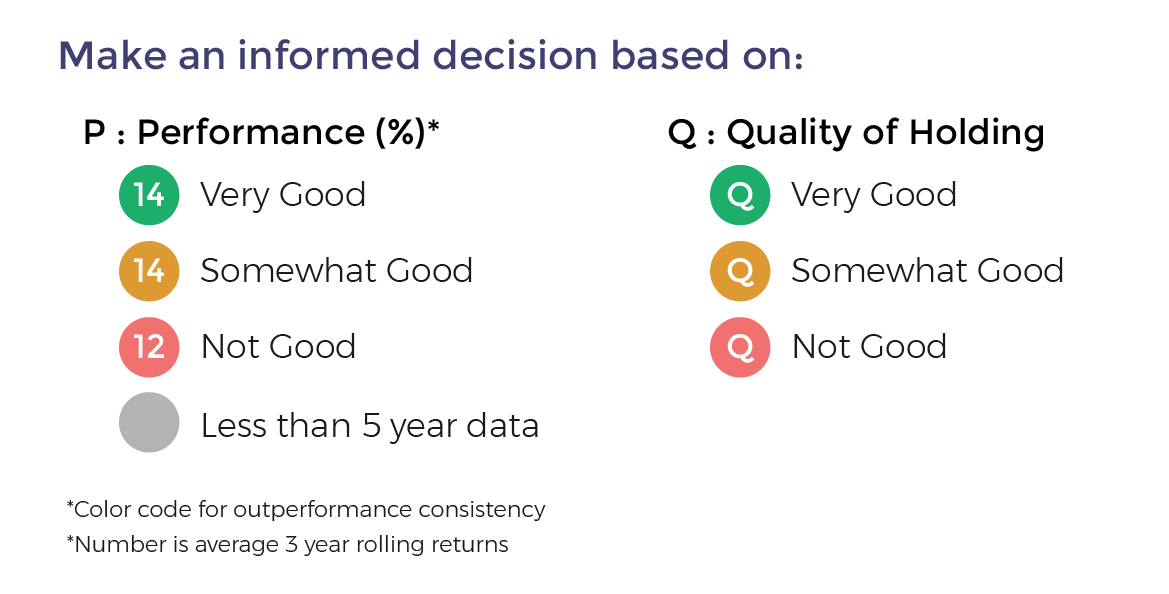
Funds ranking in screeners: Performance Consistency and Quality are two parameters used for ranking funds for SIP. The ranking as follows GG, GO, GR, OG, OO, OR, RG, RO and RR.
With the same color-coded funds, the one with the higher Average 3-year rolling returns (over 5 to 10 years), the number that appears in the Performance tag, ranks higher.
Here is the summary:
The third tag Upside Potential is not relevant for SIP. It is relevant for lumpsum investments in Mutual Funds.
Make an informed decision for Stocks
Invest using an intelligent system with powerful data-driven tools that help you identify opportunities and make informed buy-hold-sell decisions
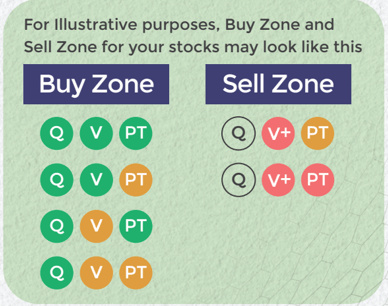
Buy quality Stocks when they are available at reasonable prices and supported by an upward price trend and Sell when they are Overvalued using the Decizen Rating System. Covers 3500+ stocks

|
Name of the IA registered
with SEBI: |
The Alchemists Ark Pvt. Ltd. |
|
Logo:
|

|
|
Trade/Brand
Name of IA: |
MoneyWorks4Me Investment Advisers |
|
Brand Logo:
|
 |
|
SEBI Registration Number:
|
INA000013323 Validity – May 16, 2019 – Perpetual |
|
Registration:
|
Non-Individual |
|
BSE Enlistment No:
|
1187 |
|
Address:
|
B-101, Signet Corner Building, Balewadi Phata, Baner, Pune, Maharashtra 411045 |
|
Compliance Officer
Details: |
Name: Shrikant Jagtap Email: shrikant.jagtap@moneyworks4me.com |
Telephone: +919860359463 Address: Same as IA |
|
Grievance Officer
Details: |
Name: Mukta Vaze Email: mukta.vaze@moneyworks4me.com |
Telephone: +919860919463 Address: Same as IA |
|
Principal Officer
Details: |
Name: Atharva Bhide Email: atharva.bhide@moneyworks4me.com |
Telephone: +919175899463 Address: Same as IA |
|
Standard Warning:
|
Investment in securities market are subject to market risks. Read all the related documents carefully before investing. |
|
|
Disclaimer:
|
Registration granted by SEBI, enlistment with exchange and certification from NISM in no way guarantee performance of the intermediary or provide any assurance of returns to investors. |
|