Indian equity benchmarks ended lower on Thursday, extending losses for the fourth straight session, as a sharp jump in crude oil prices due to escalating tensions in West Asia weighed on investor sentiment. Investor sentiment remained fragile as exchange data showed Foreign Institutional Investors (FIIs) offloaded equities worth Rs 819.20 crore on Wednesday after a day's breather.
Some of the important factors in trade:
RBI net sold $6.104 billion in spot currency market in May amid pressure on Indian rupee: Amid pressure on the Indian rupee, the Reserve Bank of India’s (RBI) monthly bulletin said the central bank was a net seller of $6.104 billion in the spot foreign exchange market in May. On a gross basis, the RBI purchased $22.229 billion and sold $28.333 billion during the month.
Jaishankar holds talks with Rubio on trade, energy, defence, minerals, AI: External Affairs Minister S. Jaishankar has met US Secretary of State Marco Rubio in Manila to discuss key priorities, including trade, tariffs, energy, defence, critical minerals, and artificial intelligence (AI).
Indian economy navigates global uncertainties effectively with recovery in foreign investments: An article published in the Reserve Bank of India's (RBI) July Bulletin has said that the Indian economy has navigated global uncertainties effectively, with a recovery in foreign investments in recent months signalling renewed investor confidence.
Proposed US tariffs on generics could hit India's pharma export market: The Global Trade Research Initiative (GTRI) has cautioned that the proposed steep US tariffs on generic medicines could have a significant impact on India's largest pharmaceutical export market, although the effect is expected to vary across product categories.
Global front: European markets were trading lower amid lingering concerns about global economic growth due to the ongoing U.S.-Iran conflict. Asian markets ended mostly higher as renewed AI optimism helped offset escalating Middle East tensions as well as concerns over surging oil prices.
Finally, the BSE Sensex fell 363.66 points or 0.47% to 76,391.39 and the CNX Nifty was down by 126.65 points or 0.53% to 23,869.60.
The BSE Sensex touched high and low of 76,726.66 and 76,151.98, respectively. There were 11 stocks advancing against 19 stocks declining on the index.
The lone gaining sectoral index on the BSE was Auto up by 0.56%, while Realty down by 1.78%, Telecom down by 1.34%, Power down by 1.25%, Utilities down by 1.12% and Basic Materials down by 1.07% were the top losing indices on BSE.
The top gainers on the Sensex were TCS up by 1.57%, Mahindra & Mahindra up by 1.49%, Eternal up by 1.41%, HCL Technologies up by 0.58% and Sun Pharma up by 0.41%. On the flip side, Interglobe Aviation down by 2.77%, Adani Ports &SEZ down by 2.61%, Bajaj Finance down by 2.06%, Reliance Industries down by 1.52% and Axis Bank down by 1.46% were the top losers.
Meanwhile, an article published in the Reserve Bank of India's (RBI) July Bulletin has said that the Indian economy has navigated global uncertainties effectively, with a recovery in foreign investments in recent months signalling renewed investor confidence. It noted that the global economy continues to face heightened uncertainty due to fragile geopolitical conditions and persistent supply chain pressures.
Despite these challenges, it said India has remained among the world's fastest-growing major economies, sustaining strong economic momentum through June 2026. It noted that Industrial and services sector indicators continued to remain firm, reflecting broad-based strength in economic activity. While the farm sector has experienced an uneven southwest monsoon, it said the impact on food inflation is likely to remain contained, supported by comfortable foodgrain stocks.
The Bulletin also highlighted that India's external trade momentum remained robust, with strong growth in both exports and imports during the first quarter of FY27 (Q1FY27). The recent implementation of the India-UK Comprehensive Economic and Trade Agreement (CETA), along with progress on other bilateral trade agreements, is expected to further strengthen trade. It said India's external vulnerability indicators remain healthy. It added that foreign portfolio investments (FPIs) recorded net inflows in June 2026, supported by policy measures for the debt market and easing geopolitical tensions, indicating a revival in investor confidence. In July (up to July 20), FPIs infused $3.1 billion into the equity and debt segments.
On the inflation front, it noted that headline Consumer Price Index (CPI) inflation rose to 4.4% in June 2026, the highest level in 18 months, from 3.9% in May. This marked the first time since January 2025 that inflation exceeded the RBI's 4% target. The rise in inflation was primarily driven by higher prices in the food and beverages and fuel components, while core inflation remained unchanged. It further said the sequential increases in key food items appeared to be broad-based in July so far (up to July 20).
CNX Nifty touched high and low of 23,990.75 and 23,807.20, respectively. There were 20 stocks advancing against 30 stocks declining on the index.
The top gainers on Nifty were SBI Life Insurance up by 2.89%, Bajaj Auto up by 2.55%, Mahindra & Mahindra up by 1.72%, TCS up by 1.66% and Tata Consumer Products up by 1.39%. On the flip side, Adani Enterprises down by 4.25%, Nestle India down by 3.44%, Shriram Finance down by 3.06%, Adani Ports &SEZ down by 2.11% and Grasim Industries down by 2.06% were the top losers.
European markets were trading lower; UK’s FTSE 100 decreased 9.21 points or 0.09% to 10,707.76, France’s CAC fell 79.89 points or 0.95% to 8,358.00 and Germany’s DAX lost 123.01 points or 0.49% to 25,032.40.
Asian markets ended mostly higher on Thursday ahead of next week's US Federal Reserve meeting, with traders expecting no change in policy rates. Market sentiments were improved further by renewed AI optimism, even as Brent crude oil prices jumped to trade more than $98 per barrel on fears of deeper supply disruptions after Yemen's Iran-aligned Houthis claimed an attack on two Saudi oil tankers transiting the Red Sea. Chinese shares gained as investors rotated funds away from high-valued technology, semiconductor, and AI names into defensive stocks. Japanese shares rose as the yen languished near 40-year lows, despite expectations of faster Bank of Japan rate hikes and potential currency intervention. Furthermore, Seoul stocks soared after Google's parent company, Alphabet reported better-than-expected quarterly revenue driven by strong cloud growth, and lifted its forecast for capital expenditures to support booming AI demand. Investors also cheered by data that showed South Korea's economy grew faster than expected in the second quarter, driven by a semiconductor export boom.
Asian Indices | Last Trade | Change in Points | Change in % |
Shanghai Composite | 3,876.78 | 9.74 | 0.25 |
Hang Seng | 25,210.81 | 318.15 | 1.28 |
Jakarta Composite | 6,315.31 | -19.17 | -0.30 |
KLSE Composite | 1,714.59 | 3.22 | 0.19 |
Nikkei 225 | 66,422.60 | 307.00 | 0.46 |
Straits Times | 5,581.76 | -13.66 | -0.24 |
KOSPI Composite | 7,096.89 | 299.19 | 4.40 |
Taiwan Weighted | 44,850.81 | 25.03 | 0.06 |
Start Research-backed Investing ...Now. Subscribe to Sapphire
MoneyWorks4Me is a SEBI-registered Investment Adviser (IA) dedicated to helping investors build long-term wealth through transparent, research-driven, conflict-free guidance. Founded in 2008, we started our journey as a Research Analyst (RA), providing deep fundamental analysis, intrinsic value insights, and long-term investing frameworks for Indian equities. In 2017, we transitioned to a full-fledged SEBI-registered Investment Adviser, strengthening our commitment to acting as a fiduciary—always putting the investor’s interest first.
To become India’s most trusted, research-powered fiduciary advisory platform—where every investor, regardless of experience, can make calm, confident, and well-reasoned investment decisions.
MoneyWorks4Me ensures this through:

MoneyWorks4Me rating and ranking of funds for SIP is available to subscribers only. Moneyworks4Me is not a rating and ranking agency, however it is required that users have a way of selecting funds and building a Portfolio. The method used by it are described below to enable users to understand the logic behind the rating and ranking Subscriber will find more details on this in the various content made available from time to time. In case you need more please write to besafe@moneyworks4Me.com
MoneyWorks4Me rates and ranks mutual funds based on the following data-driven system:
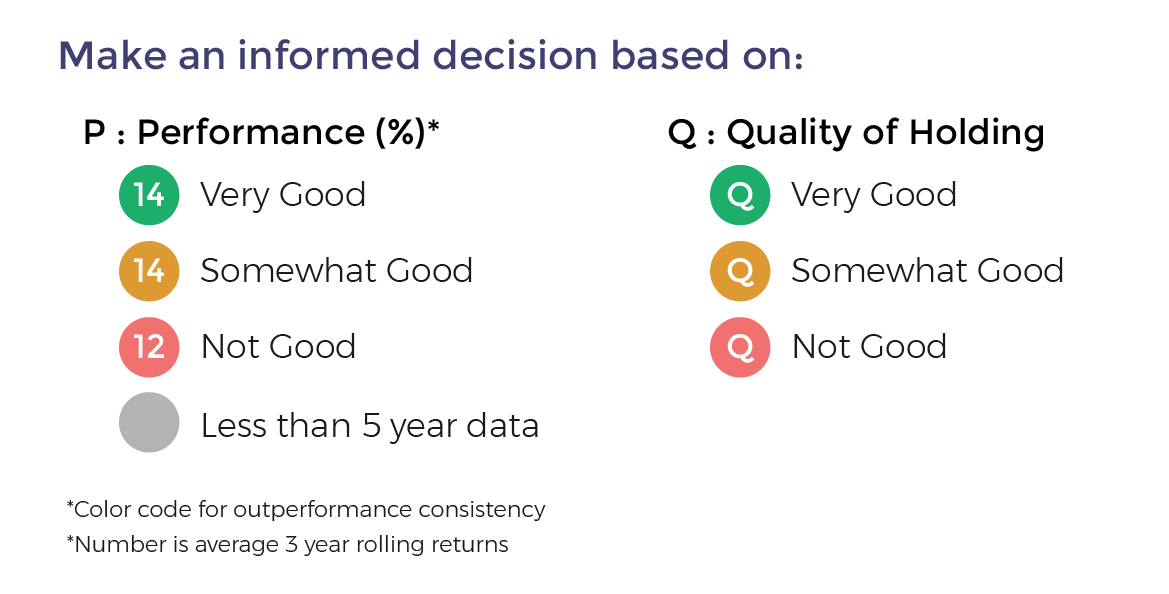
Funds ranking in screeners: Performance Consistency and Quality are two parameters used for ranking funds for SIP. The ranking as follows GG, GO, GR, OG, OO, OR, RG, RO and RR.
With the same color-coded funds, the one with the higher Average 3-year rolling returns (over 5 to 10 years), the number that appears in the Performance tag, ranks higher.
Here is the summary:
The third tag Upside Potential is not relevant for SIP. It is relevant for lumpsum investments in Mutual Funds.
Make an informed decision for Stocks
Invest using an intelligent system with powerful data-driven tools that help you identify opportunities and make informed buy-hold-sell decisions
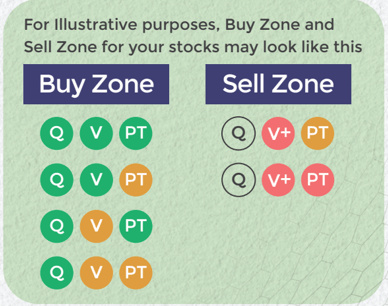
Buy quality Stocks when they are available at reasonable prices and supported by an upward price trend and Sell when they are Overvalued using the Decizen Rating System. Covers 3500+ stocks

|
Name of the IA registered
with SEBI: |
The Alchemists Ark Pvt. Ltd. |
|
Logo:
|

|
|
Trade/Brand
Name of IA: |
MoneyWorks4Me Investment Advisers |
|
Brand Logo:
|
 |
|
SEBI Registration Number:
|
INA000013323 Validity – May 16, 2019 – Perpetual |
|
Registration:
|
Non-Individual |
|
BSE Enlistment No:
|
1187 |
|
Address:
|
B-101, Signet Corner Building, Balewadi Phata, Baner, Pune, Maharashtra 411045 |
|
Compliance Officer
Details: |
Name: Shrikant Jagtap Email: shrikant.jagtap@moneyworks4me.com |
Telephone: +919860359463 Address: Same as IA |
|
Grievance Officer
Details: |
Name: Mukta Vaze Email: mukta.vaze@moneyworks4me.com |
Telephone: +919860919463 Address: Same as IA |
|
Principal Officer
Details: |
Name: Atharva Bhide Email: atharva.bhide@moneyworks4me.com |
Telephone: +919175899463 Address: Same as IA |
|
Standard Warning:
|
Investment in securities market are subject to market risks. Read all the related documents carefully before investing. |
|
|
Disclaimer:
|
Registration granted by SEBI, enlistment with exchange and certification from NISM in no way guarantee performance of the intermediary or provide any assurance of returns to investors. |
|