Many investors hesitate to invest when the Nifty’s TTM P/E ratio appears elevated. Historically, this concern has some merit – investing when valuations are significantly above long-term averages has often resulted in weaker returns over the next 3-5 years.
Currently, the NSE-reported Nifty TTM P/E stands at 31.9x, which at first glance appears expensive and raises concerns about market overheating.
However, we believe the current reported P/E ratio does not fully reflect the true valuation of the market.
1. One Abnormal Quarter Has Distorted the P/E Ratio
The key issue lies in the denominator of the P/E formula:
The trailing earnings used in the calculation include Q1FY21 — a quarter heavily impacted by nationwide lockdowns. Corporate earnings during this period were exceptionally weak and do not represent the normal earning capacity of businesses.
As a result, the denominator (earnings) becomes artificially low, which mechanically pushes the P/E ratio higher even if stock prices themselves have not risen disproportionately.
A more reasonable approach is to value the market using normalized earnings — earnings generated during a more representative business environment such as FY19 or FY20.
Using normalized earnings, our estimate suggests the Nifty P/E is closer to ~25x rather than the reported 31.9x.
2. Market Behaviour Does Not Reflect Bubble Conditions
A P/E ratio near 32x would typically imply excessive optimism or bubble-like market conditions. But market performance over the last five years tells a different story.
Nifty has delivered only around 5% CAGR during this period. Historically, bubbles are usually preceded by extremely strong multi-year returns driven by euphoric participation and aggressive speculation.
That has not been the case here.
This suggests that the elevated reported P/E ratio is influenced more by temporarily depressed earnings than by irrational market pricing.
3. Market Polarization Is Distorting the Nifty P/E Ratio
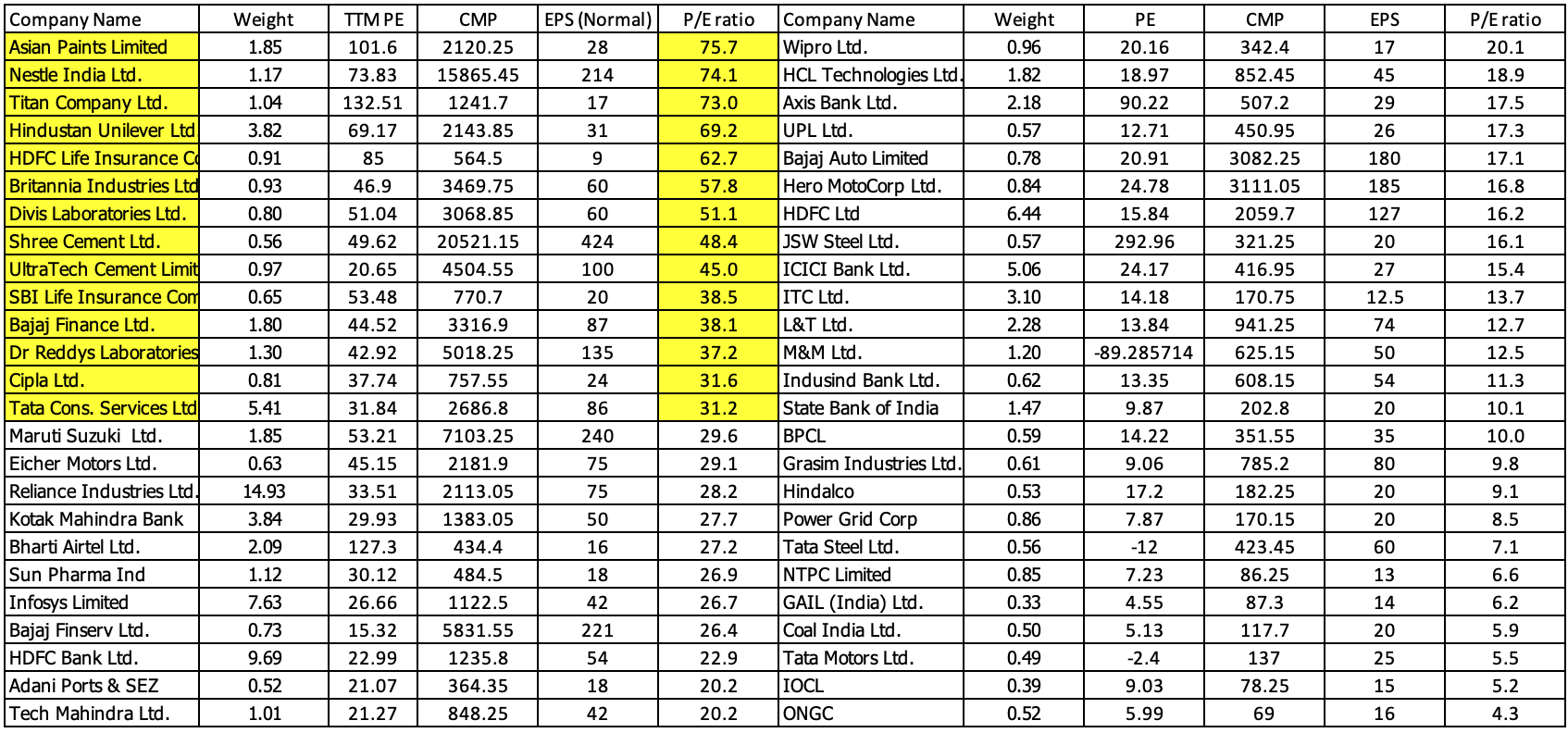
While the normalized Nifty P/E appears closer to 25x rather than the reported 31.9x, the broader market valuation picture becomes even clearer when we look deeper into the index composition.
A significant portion of the elevated valuation is driven by a handful of high-quality, high-valuation businesses. Our analysis shows that the top 15 companies within the Nifty trade at substantially higher P/E multiples compared to the rest of the index.
These companies are skewing the aggregate Nifty valuation upward.
If these 15 stocks are excluded, the remaining 35 companies in the index trade at an average P/E ratio of nearly 16x.
This indicates that large parts of the market are not excessively expensive. In fact, assuming earnings normalize over FY22, a meaningful section of the market appears reasonably valued even today.
The broader takeaway is important: headline index valuations do not always represent the opportunity available beneath the surface. Investors relying only on aggregate market P/E ratios may overlook fairly valued businesses available outside a concentrated group of expensive market leaders.
4. Low Interest Rates Have Changed Valuation Benchmarks
Another important factor influencing valuations globally is the sharp decline in interest rates.
One of the most widely used methods for valuing businesses is the Discounted Cash Flow (DCF) model, where the value of a company is derived by discounting future cash flows to the present.
DCF = \sum \frac{CF_t}{(1+r)^t}
The discount rate used in this framework is closely linked to government bond yields and prevailing interest rates in the economy.
When interest rates fall, future cash flows become more valuable in present terms. This naturally supports higher valuation multiples such as higher P/E ratios. Conversely, higher interest rates reduce the present value of future earnings and typically lead to lower market valuations.
This environment has become particularly relevant today. Extremely low global bond yields — especially in developed markets — have pushed global investors toward equities in search of better returns.
The “There Is No Alternative” (TINA) effect has strengthened this trend. For example, when the US 10-year government bond yields less than 1%, global fund managers are more willing to allocate capital toward equities despite higher valuations.
Additionally, the US Federal Reserve has repeatedly indicated its intention to maintain lower interest rates for an extended period. This liquidity environment has supported equity markets globally and reduced the probability of valuations reverting quickly to long-term historical averages.
Even Warren Buffett has acknowledged that lower interest rates justify relatively higher stock valuations compared to previous decades.
In other words, lower interest rates may structurally support a somewhat higher “normal” market P/E ratio than what investors were accustomed to historically.
What Should Investors Do?
Investors need to remain flexible enough to adapt to changing economic realities while staying disciplined in their investment process.
The key is not to abandon valuation discipline, but to recalibrate expectations rationally.
Avoid chasing extremely expensive stocks purely for short-term momentum, as long-term outcomes from excessive valuations are often disappointing. At the same time, remaining perpetually anchored to older valuation benchmarks may also lead to mediocre returns if interest rates remain structurally lower for an extended period.
This may require modest adjustments in acceptable valuation ranges. For example:
- Instead of buying an average business only at 12x P/E, investors may need to consider opportunities closer to 14x.
- Similarly, strong businesses that historically traded at 18x may reasonably deserve 20–22x multiples in a low interest-rate environment.
However, this flexibility must remain linked to the broader interest rate cycle. As interest rates normalize over time, valuation benchmarks are also likely to revert closer to historical averages. For instance, an Indian 10-year bond yield of 7.5–8% may again justify a Nifty valuation closer to ~17x P/E.
Solution:
We have to be flexible enough to accommodate any change in the economy and rigid enough not to deviate much from our process. One has to focus on what has caused the current environment and tweaks required to sail through this period.
- You don’t have to own those super expensive names for short term gain as the long term outcome is definitely bad. So focus on other stocks instead of looking at broad market P/E ratios.
- Avoid paying up a lot throwing caution to the wind but pay up only marginally versus the past. Because if you don’t do that, your return will remain mediocre as you keep waiting perennially on a low yielding fixed income. So instead of buying an average company at P/E of 12x, one can pay closer to 14x, and instead of 18x for a good company, one can pay 20-22x.
- This has to change as interest rates start going up. The valuation benchmark will shift to earlier assumptions once interest rates return to normal (India 10-Y bond yield of 7.5-8% can be equated with Nifty P/E of 17x)

If you liked what you read and would like to put it in to practice Register at MoneyWorks4me.com. You will get amazing FREE features that will enable you to invest in Stocks and Mutual Funds the right way.
Get the Investment Shastra letter
Occasional, practical investing notes from the MoneyWorks4Me desk. No noise, unsubscribe any time.