
The Indian paint industry is witnessing a fresh wave of competition. Established players continue to expand aggressively, while new entrants are investing heavily to capture market share. This has naturally raised an important question for investors — is the industry becoming overcrowded, or is the opportunity itself becoming larger?
The answer lies in understanding the structure of the paint business. While paints may appear like a simple consumer product, the industry is driven by distribution strength, dealer relationships, branding, and scale economics. These factors make the sector more complex than it appears on the surface.
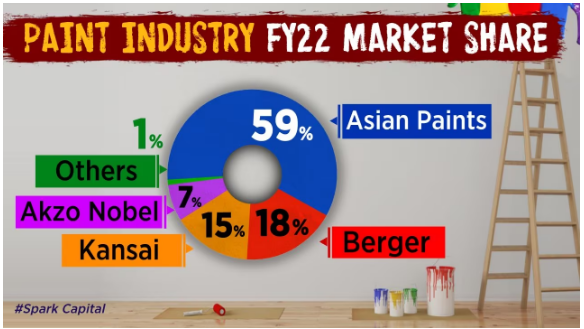
What Are the Players Up To?
The competitive intensity in the industry has increased significantly over the last few years.
Grasim Industries is preparing to enter the decorative paints market through its “Birla Opus” brand with an investment of nearly ₹10,000 crore. The company is building large manufacturing capacities across multiple states along with a dedicated R&D facility in Maharashtra.
JSW Paints is also scaling up aggressively by expanding production capacity and retail reach. The company aims to significantly increase its presence in decorative paints over the next few years.
Existing players are not standing still either. Asian Paints continues to invest heavily in capacity expansion, backward integration, and acquisitions, while Berger Paints is targeting substantial revenue growth through capacity additions.
This aggressive investment cycle suggests that industry participants see a long runway for growth despite rising competition.
Why the Paint frenzy?
The excitement around the paint industry is largely driven by the underpenetrated nature of the Indian market.
India’s per capita paint consumption remains significantly below global averages. In addition, paint realization per liter is also lower compared to international markets. This creates a large headroom for long-term growth as urbanization, housing upgrades, premiumization, and rising disposable income continue to improve demand.
Industry estimates suggest that the Indian paint and coatings market could reach nearly ₹1 lakh crore by 2028, supported by double-digit growth.
For investors, this explains why multiple companies are willing to invest aggressively despite already intense competition. A growing market often allows several players to scale simultaneously without immediate pressure on industry profitability.

What are the industry dynamics?
While the long-term opportunity is attractive, the paint industry also comes with its own operational complexities.
Raw material costs remain an important variable, especially because several paint inputs are linked to crude oil prices. Advertising and branding expenses also form a meaningful part of overall costs, particularly in decorative paints where consumer recall matters significantly.
Another important characteristic of the industry is that nearly 75% of paint demand comes from repainting rather than new construction. As repainting cycles shorten over time, demand visibility improves. However, this also increases the importance of brand visibility, dealer relationships, and execution quality.
The challenge for new entrants is that scale in paints is not built only through manufacturing capacity. The real battle lies in building distribution reach and maintaining dealer relationships.
Consumers often rely on contractors, painters, architects, or interior designers while selecting paints. This makes dealer influence and on-ground execution extremely important. Even innovative painting solutions and technology-led offerings have had limited success in fundamentally changing customer behavior so far.
Companies like Urban Company are attempting to modernize the painting experience through organized services and technology integration. While the long-term outcome remains uncertain, such initiatives indicate how the industry may evolve over time.
Among existing players, Asian Paints continues to hold a strong competitive advantage because of its distribution and logistics network.
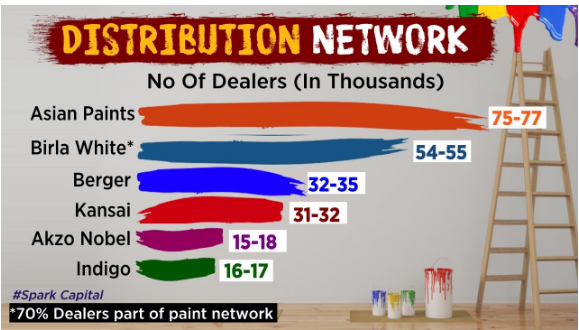
Over several decades, the company built direct relationships with paint dealers by reducing dependence on intermediaries. Its network of more than 70,000 dealers creates a meaningful entry barrier for competitors.
This matters because paint dealers operate with limited shelf space while managing thousands of SKUs, color variants, and mixing systems. New entrants not only need manufacturing capacity, but also significant investments in dealer acquisition, incentives, logistics, and retention.
As competition increases, both incumbents and new entrants are likely to spend heavily on branding, distribution, and dealer engagement. This could create short-term pressure on margins even if industry demand remains strong.
Outlook
Asian Paints and Berger Paints have been the dominant players in the paint industry, delivering a 19% CAGR return over the last 5 years and enjoying premium valuations. However, the entry of new players who have a strong pedigree, umbrella brands, and some even a network may force the somewhat oligopolistic structure of the paint industry to a near monopolistic competition structure. On the supply side industry is expected to add 20% of the current level over the next three to four years. However, on the demand side, the industry’s growth is about 9% to 10% in FY24 existing players face challenges in maintaining their market share and margins. If new players are able to gain market share, re-rating may occur for existing players. The industry might see some exciting changes in the coming years. It’s going to be interesting to see how the industry evolves.
In a nutshell, the Indian paint industry is like a canvas waiting to be painted with new opportunities and challenges. Whether you’re picking paint for your home or investing in paint stocks, keep an eye on the colorful journey ahead!
Check out our peer comparison for the industry and make an informed decision 10-year X-ray.
Best Stocks From:
Undervalued Nifty 50 Nifty 500 – Quality with Price Strength Screener Alpha Cases 5 Stars Rated Stocks from Nifty 500 Business Houses Group

Get the Investment Shastra letter
Occasional, practical investing notes from the MoneyWorks4Me desk. No noise, unsubscribe any time.