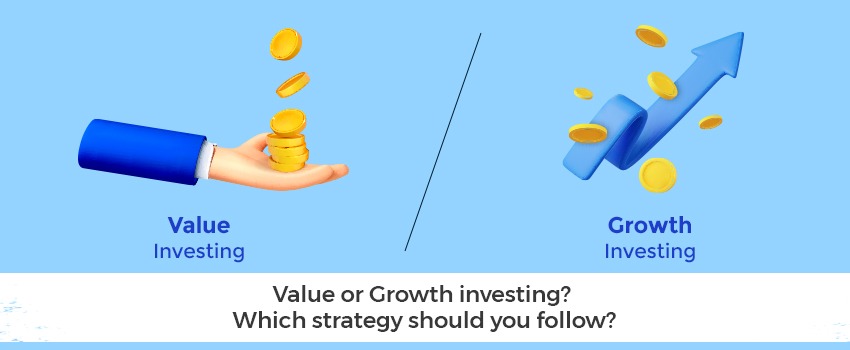
Value Investing vs Growth Investing, a much-asked question. Investing in stocks is not a one-size-fits-all exercise. Over the years, several investing styles have emerged, each designed to suit different goals, risk appetites, and time horizons.
In our previous article, we explored the differences between Fundamental Analysis and Technical Analysis. Today, we take that discussion a step further by examining three popular stock investing strategies that are rooted in fundamental analysis: Value Investing, Growth Investing, and GARP Investing.
Understanding these approaches can help you identify a strategy that aligns with your investment objectives and personality.
What is Value Investing?
Value investing was pioneered by Benjamin Graham and David Dodd in the 1930s and later popularized by Warren Buffett. The philosophy is simple: buy good businesses when they are available at a discount to their intrinsic value.
Value investors often go against prevailing market sentiment. They tend to buy when others are pessimistic and sell when enthusiasm becomes excessive.
Characteristics of Value Investing
A value investor typically looks for companies that:
- Have a business model that makes long-term sense
- Possess a sustainable competitive advantage
- Are led by trustworthy and capable management
- Are available at a meaningful discount to their estimated value
While metrics such as low Price-to-Earnings (P/E) ratios and attractive dividend yields can be useful, the focus remains on understanding the quality and long-term prospects of the business.
Why Margin of Safety Matters
Estimating the intrinsic value of a company is never an exact science. To account for this uncertainty, value investors rely on a concept known as the margin of safety.
By purchasing stocks significantly below their estimated worth, investors reduce the impact of potential errors in their analysis and improve their chances of earning satisfactory long-term returns.
What is Growth Investing?
Growth investing focuses on companies that have the potential to expand their revenues, earnings, and market share at a rate significantly higher than the broader market.
Growth investors are less concerned about current valuations and more focused on future opportunities.
Characteristics of Growth Investing
Growth investors typically seek companies that:
- Can grow substantially faster than their peers
- Operate in rapidly expanding industries
- Continuously reinvest profits into the business
- Generate returns primarily through capital appreciation rather than dividends
Many successful growth companies choose to reinvest earnings to fuel expansion instead of distributing profits to shareholders.
Risks of Growth Investing
The biggest challenge with growth investing is valuation risk.
Since growth investors often prioritize future potential over current price, they may end up paying too much for a stock. If growth expectations are not met, the resulting decline in stock price can be significant.
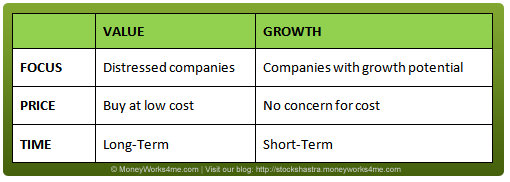
Value and Growth investing – A comparison:
What is GARP Investing?
Recognizing the strengths and weaknesses of both approaches, legendary investor Peter Lynch developed the concept of Growth at a Reasonable Price (GARP).
GARP investing seeks to combine the best elements of value and growth investing.
Instead of chasing expensive growth stocks or focusing solely on cheap stocks, GARP investors look for businesses with strong growth prospects that are still reasonably valued.
Characteristics of GARP Investing
A GARP investor looks for companies that:
- Deliver consistent earnings growth
- Grow faster than the overall market
- Trade at reasonable valuations
- Offer a balance between growth potential and investment risk
This approach attempts to avoid overpaying for growth while still benefiting from expanding businesses.
Which Investing Strategy Should You Choose?
There is no universally perfect investing strategy.
The right approach depends on:
- Your financial goals
- Investment horizon
- Risk tolerance
- Personality and temperament
Some investors are naturally attracted to undervalued opportunities and prefer value investing. Others are comfortable paying higher valuations for businesses with exceptional growth potential. Many investors find that GARP investing offers a practical middle ground.
What matters most is selecting a strategy that you understand and can consistently follow through different market cycles.
Final Thoughts
Value investing, growth investing, and GARP investing have all produced successful investors and impressive long-term results.
However, history suggests that investors who focus on business fundamentals and avoid overpaying for stocks tend to have a higher probability of success.
Whether you prefer value, growth, or a blend of both, a disciplined approach and long-term perspective remain the foundation of successful investing.
Which stock investing strategy would you go for? And which stocks do you think currently are the best value, growth or GARP buys? Do comment and let us know.
If you liked what you read and would like to put it in to practice Register at MoneyWorks4me.com. You will get amazing FREE features that will enable you to invest in Stocks and Mutual Funds the right way.
|
VALUE |
GROWTH |
|
|---|---|---|
|
FOCUS |
Distressed companies |
Companies with growth potential |
|
PRICE |
Buy at low cost |
No concern for cost |
|
TIME |
Long-Term |
Short-Term |