Barometer gauges continue to hold their neck in green despite a tepid start of European counterparts and absence of positive triggers which could further influence markets’ trend. Markets after receiving a positive handover from regional counterparts got off to a positive start and turned upbeat after IMF's forecasted improved growth prospects for India. In a development which should bring some cheer to the policymakers battling to restore faltering growth in Asia's third-largest economy, the International Monetary Fund (IMF) on Tuesday projected India's economy to grow by 5.4% in 2014-15 and 6.4% in 2015-16 on the back of strengthening global growth, improving export competitiveness and implementation of recently approved investment projects.
However, amidst lack of any positive catalyst, barometer gauges failed to add on to gains. Rather prevailing caution ahead of polling for Lok Sabha seats in the second phase of the election, which began in four states today, namely Meghalaya, Nagaland, Manipur and Arunachal Pradesh, underpinned market-participants to adopt a wait and watch approach. Off day's high, While, Sensex has slipped below the crucial 22,400 level, Nifty continues to trade above the psychological 6700 mark. Nonetheless, frenzied buying in Healthcare, Metal and Realty counters aided the up-move of the markets, while profit-booking in Information Technology and Technology counters is restricting this uptrend.
On the global front, European shares got off to tepid start on continued tension over the situation in Ukraine, where the United States accused Russian agents and special forces on Tuesday of stirring separatist unrest.
Closer home, the BSE Sensex is currently trading at 22390.42, up by 46.97 points or 0.21% after trading in a range of 22,479.07 and 22379.95. There were 19 stocks advancing against 11 stocks declining on the index. The overall market breadth on BSE is in the favour of advances which have thumped declines in the ratio of 1485:819; while 106 shares remained unchanged.
The broader indices continued to outperform; the BSE Mid cap index was up by 1.04%, while Small cap index up by 1.24%.
The gaining sectoral indices on the BSE were Healthcare up by 2.03%, Metal up by 1.78%, Realty up by 1.37%, Power and Consumer Durables were up by 0.98%. While, IT down by 1.58%, Teck down by 1.29% and FMCG down by 0.28% were the losing indices on BSE.
The top gainers on the Sensex were Sun Pharma up by 6.30%, Hindalco Inds up by 4.12%, Tata Motors up by 2.67%, Tata Steel up by 2.14% and SBI up by 1.70%. On the flip side, TCS down by 1.88%, Infosys down by 1.62%, ONGC down by 1.60%, Hero Motocorp and Bajaj Auto were down by 0.76%.
Meanwhile, the inflation indexed National Savings Securities have failed to attract retail investors as total mobilisation through these 10-year instruments, which was meant to be a hedge against inflation, has recorded at around Rs 100 crore. The factors like lack of awareness, absence of tax benefits, and a fall in retail inflation can be attributed to the poor response.
In 2013, the Government had issued two inflation-indexed products such as Inflation Indexed Bonds based on the Wholesale Price Index (WPI) and Inflation Indexed National Saving Securities-Cumulative for retail investors based on Consumer Price Index (CPI) inflation. The Government was expecting to mop up around Rs 20,000 crore from these two instruments. Meanwhile, the total mobilisation through both the instruments was around Rs 6,000 crore out of which approximately Rs 5,900 crore was garnered from inflation indexed bonds based on WPI and Rs 100 crore from the securities based on CPI inflation. Money collected through such instruments will be part of the Government’s borrowings plan for Rs 3.68-lakh crore between April and October’ 2014.
Recently, the Reserve Bank of India (RBI) has doubled the maximum limit for investment in inflation-indexed bonds to Rs 10 lakh per annum for individuals. Further, the investment limit for institutions like Hindu undivided family (HUF), Charitable Trusts, Education Endowments and similar institutions that are not profit-seeking in nature has been increased from Rs 5 lakh to Rs 25 lakh per annum.
The absence of tax benefits in the scheme has detracted individuals as there is no benefit available either on the principal investment or interest paid. Further, the declining retail inflation could also be reason for poor retail investors’ response. The CPI inflation in February came down to an over-two-year low of 8.1 percent from 8.79 percent in January.
The CNX Nifty is currently trading at 6,711.30, up by 16.25 points or 0.24% after trading in a range of 6,733.60 and 6,705.10. There were 34 stocks advancing against 16 declining on the index.
The top gainers of the Nifty were Sun Pharma up by 6.19%, Hindalco up by 4.11%, Bank of Baroda up by 3.35%, NMDC up by 2.57% and Tata Motors up by 2.55%. On the flip side, Tech Mahindra down by 2.75%, ONGC down by 2.05%, HCL Tech down by 1.72%, ONGC down by 1.61% and Infosys down by 1.60% were the major losers on the index.
Asian equity indices were trading in green; Hang Seng up by 0.81%, Taiwan Weighted up by 0.48%, Straits Times up by 0.19%, Jakarta Composite up by 0.01% and Shanghai Composite up by 0.20%. While, Nikkei 225 down by 2.01% was the only loser amongst Asian pack.
European markets got off to a tepid start; with CAC 40 declining by 0.25%, FTSE 100 dropping 0.49%, and CAX sliding by 0.21%.
Start Research-backed Investing ...Now. Subscribe to Sapphire
MoneyWorks4Me is a SEBI-registered Investment Adviser (IA) dedicated to helping investors build long-term wealth through transparent, research-driven, conflict-free guidance. Founded in 2008, we started our journey as a Research Analyst (RA), providing deep fundamental analysis, intrinsic value insights, and long-term investing frameworks for Indian equities. In 2017, we transitioned to a full-fledged SEBI-registered Investment Adviser, strengthening our commitment to acting as a fiduciary—always putting the investor’s interest first.
To become India’s most trusted, research-powered fiduciary advisory platform—where every investor, regardless of experience, can make calm, confident, and well-reasoned investment decisions.
MoneyWorks4Me ensures this through:

MoneyWorks4Me rating and ranking of funds for SIP is available to subscribers only. Moneyworks4Me is not a rating and ranking agency, however it is required that users have a way of selecting funds and building a Portfolio. The method used by it are described below to enable users to understand the logic behind the rating and ranking Subscriber will find more details on this in the various content made available from time to time. In case you need more please write to besafe@moneyworks4Me.com
MoneyWorks4Me rates and ranks mutual funds based on the following data-driven system:
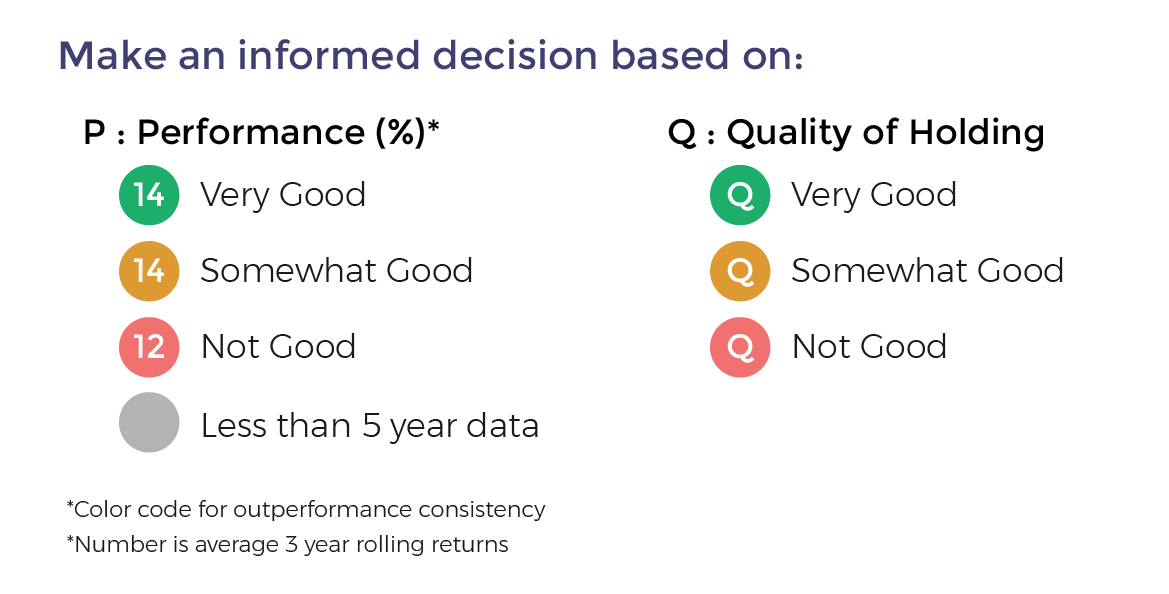
Funds ranking in screeners: Performance Consistency and Quality are two parameters used for ranking funds for SIP. The ranking as follows GG, GO, GR, OG, OO, OR, RG, RO and RR.
With the same color-coded funds, the one with the higher Average 3-year rolling returns (over 5 to 10 years), the number that appears in the Performance tag, ranks higher.
Here is the summary:
The third tag Upside Potential is not relevant for SIP. It is relevant for lumpsum investments in Mutual Funds.
Make an informed decision for Stocks
Invest using an intelligent system with powerful data-driven tools that help you identify opportunities and make informed buy-hold-sell decisions
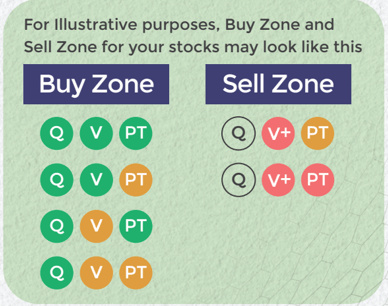
Buy quality Stocks when they are available at reasonable prices and supported by an upward price trend and Sell when they are Overvalued using the Decizen Rating System. Covers 3500+ stocks

|
Name of the IA registered
with SEBI: |
The Alchemists Ark Pvt. Ltd. |
|
Logo:
|

|
|
Trade/Brand
Name of IA: |
MoneyWorks4Me Investment Advisers |
|
Brand Logo:
|
 |
|
SEBI Registration Number:
|
INA000013323 Validity – May 16, 2019 – Perpetual |
|
Registration:
|
Non-Individual |
|
BSE Enlistment No:
|
1187 |
|
Address:
|
B-101, Signet Corner Building, Balewadi Phata, Baner, Pune, Maharashtra 411045 |
|
Compliance Officer
Details: |
Name: Shrikant Jagtap Email: shrikant.jagtap@moneyworks4me.com |
Telephone: +919860359463 Address: Same as IA |
|
Grievance Officer
Details: |
Name: Mukta Vaze Email: mukta.vaze@moneyworks4me.com |
Telephone: +919860919463 Address: Same as IA |
|
Principal Officer
Details: |
Name: Atharva Bhide Email: atharva.bhide@moneyworks4me.com |
Telephone: +919175899463 Address: Same as IA |
|
Standard Warning:
|
Investment in securities market are subject to market risks. Read all the related documents carefully before investing. |
|
|
Disclaimer:
|
Registration granted by SEBI, enlistment with exchange and certification from NISM in no way guarantee performance of the intermediary or provide any assurance of returns to investors. |
|