Reversing gears, Indian equity markets have now slipped into negative territory in absence of positive triggers which could take the markets higher and on concerns over Iraq crisis that has taken oil prices to near 9-month highs. Moreover, Fears of higher inflation were also weighed on equity markets, on account of the railway fare increase. The fare hike might put immediate pressure on stocks of bulk sectors like cement, which transport nearly 40 per cent of their produce through rail and power because it would cost more to transport the coal required for electricity generation. Off day’s low, both Sensex and Nifty were trading below the psychological 25,050 and 7,500 levels respectively, with loss of over three tenths of a percent. However, some support came in from reports that the government is likely to defer implementation of the controversial GAAR provisions by one more year to April 2017 and exempt transactions made up to March 2013 in a bid to improve business sentiment.
Meanwhile, Sugar companies were trading higher after the report that Indian ministers to discuss sugar cane dues on Monday. Moreover, shares of companies related to the Indian Railways network were trading higher after Narendra Modi led government hiked passenger fares by 14.2% and freight tariffs by 6.5%. In scrip specific development, shares of ITC were down over 3% on a report that the government may raise taxes on cigarettes aggressively in the upcoming budget in July 2014. On the other hand, AstraZeneca Pharma India has surged over 4% after the company received a shareholder approval for voluntary delisting of equity shares of the company from the stock exchange.
On the global front, Asian stocks rose after China’s flash manufacturing purchase manager’s index rose to 50.8 from 49.4, according to HSBC. Moreover, US markets scaled fresh highs on Friday following dovish comments by the US Federal Reserve, outweighing worries about the impact of the Iraq crisis on oil prices. Back home, Rupee too gave up early gains as Brent crude oil prices inched near 9-month highs. Traders were seen piling up positions in Auto, Metal and Healthcare while selling was witnessed in FMCG, IT and Teck sector stocks. The market breadth on BSE was positive, out of 2241 stocks traded, 1141 stocks advanced, while 1001 stocks declined on the BSE.
The BSE Sensex is currently trading at 25027.81 down by 77.70 points or 0.31% after trading in a range of 25197.50 and 25023.96. There were 14 stocks advancing against 16 stocks declining on the index.
The broader indices were trading in green; the BSE Mid cap and Small cap index were trading up by 0.26% and 0.29% respectively.
The gaining sectoral indices on the BSE were, Auto up by 0.84%, Metal up by 0.40%, Healthcare up by 0.35%, Consumer Durables up by 0.34% and Oil & Gas up by 0.28%. While, FMCG down by 2.01%, IT down by 0.93%, Teck down by 0.64%, Power down by 0.29% and Realty down by 0.18% were the losing indices on BSE.
The top gainers on the Sensex were Hero MotoCorp up by 2.05%, ONGC up by 1.08%, Tata Motors up by 1.07%, Mahindra & Mahindra up by 1.02% and SSLT up by 0.70%. On the flip side, ITC was down by 3.13%, Infosys was down by 1.51%, Hindustan Unilever was down by 1.17%, Cipla was down by 0.86% and TCS was down by 0.60% were the top losers on the Sensex.
Meanwhile, Foreign direct investment (FDI) in India declined by 26 percent to five-month low at $1.70 billion in the month of April as compared to $2.32 billion in the same month of previous year.
The sectors that received highest inflows during the April include services ($382 million), hotel and tourism ($109 million), metallurgical industries ($72 million) and construction ($ 69 million). Pharma sector witnessed steep fall in foreign investments to $1 million in reported month as against $987 million in April 2013. Country wise, maximum FDI during April was received form Mauritius with $489 million followed by Singapore ($316 billion), Japan ($214 billion), Netherlands ($101 billion) and UK ($43 million).
FDI is considered crucial for India, which requires around $1 trillion in the 12th five year plan (2012-2017) to overhaul its infrastructure sector such as ports, airports and highways to boost growth. Meanwhile, in order to attract maximum FDI into the country, the government has been liberalizing the foreign investment policy. The government has relaxed FDI norms in around 12 sectors which include telecom, tea, pension and petroleum and natural gas among others. In spite of the government various efforts to increase FDI, foreign investment during April has declined, reflecting the need to take more measures to improve the business environment in the country.
The CNX Nifty is currently trading at 7,484.30 down by 27.15 points or 0.36% after trading in a range of 7,534.80 and 7,480.10. There were 25 stocks advancing against 25 declining on the index.
The top gainers of the Nifty were Hero MotoCorp up by 2.18%, ONGC up by 1.10%, M&M up by 1.06%, Lupin up by 1.05% and NMDC up by 1.01%. On the flip side, ITC down by 3.16%, Kotak Bank down by 2.16%, Infosys down by 1.54%, HUL down by 1.28% and HCL Tech down by 1.25% were the major losers on the index.
Most of the Asian equity indices were trading in green; Nikkei 225 soared by 0.07%, Hang Seng increased by 0.29%, KOSPI Index gained by 0.46%, Straits Times improved by 0.09%, Jakarta Composite up by 0.02% and Shanghai Composite was up by 0.03%. On the flip side, FTSE Bursa Malaysia KLCI declined by 0.15% and Taiwan Weighted was down by 0.25%.
Start Research-backed Investing ...Now. Subscribe to Sapphire
MoneyWorks4Me is a SEBI-registered Investment Adviser (IA) dedicated to helping investors build long-term wealth through transparent, research-driven, conflict-free guidance. Founded in 2008, we started our journey as a Research Analyst (RA), providing deep fundamental analysis, intrinsic value insights, and long-term investing frameworks for Indian equities. In 2017, we transitioned to a full-fledged SEBI-registered Investment Adviser, strengthening our commitment to acting as a fiduciary—always putting the investor’s interest first.
To become India’s most trusted, research-powered fiduciary advisory platform—where every investor, regardless of experience, can make calm, confident, and well-reasoned investment decisions.
MoneyWorks4Me ensures this through:

MoneyWorks4Me rating and ranking of funds for SIP is available to subscribers only. Moneyworks4Me is not a rating and ranking agency, however it is required that users have a way of selecting funds and building a Portfolio. The method used by it are described below to enable users to understand the logic behind the rating and ranking Subscriber will find more details on this in the various content made available from time to time. In case you need more please write to besafe@moneyworks4Me.com
MoneyWorks4Me rates and ranks mutual funds based on the following data-driven system:
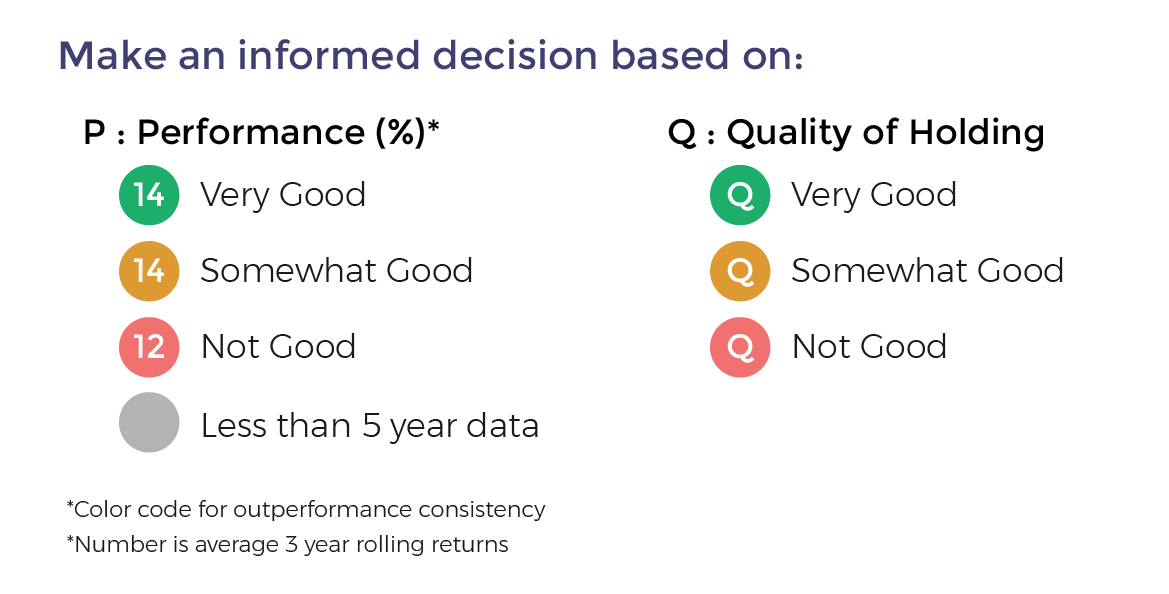
Funds ranking in screeners: Performance Consistency and Quality are two parameters used for ranking funds for SIP. The ranking as follows GG, GO, GR, OG, OO, OR, RG, RO and RR.
With the same color-coded funds, the one with the higher Average 3-year rolling returns (over 5 to 10 years), the number that appears in the Performance tag, ranks higher.
Here is the summary:
The third tag Upside Potential is not relevant for SIP. It is relevant for lumpsum investments in Mutual Funds.
Make an informed decision for Stocks
Invest using an intelligent system with powerful data-driven tools that help you identify opportunities and make informed buy-hold-sell decisions
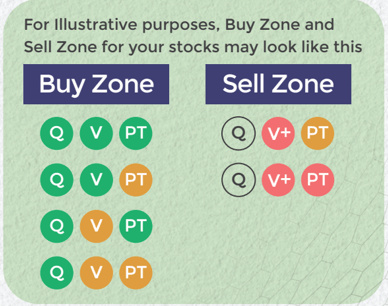
Buy quality Stocks when they are available at reasonable prices and supported by an upward price trend and Sell when they are Overvalued using the Decizen Rating System. Covers 3500+ stocks

|
Name of the IA registered
with SEBI: |
The Alchemists Ark Pvt. Ltd. |
|
Logo:
|

|
|
Trade/Brand
Name of IA: |
MoneyWorks4Me Investment Advisers |
|
Brand Logo:
|
 |
|
SEBI Registration Number:
|
INA000013323 Validity – May 16, 2019 – Perpetual |
|
Registration:
|
Non-Individual |
|
BSE Enlistment No:
|
1187 |
|
Address:
|
B-101, Signet Corner Building, Balewadi Phata, Baner, Pune, Maharashtra 411045 |
|
Compliance Officer
Details: |
Name: Shrikant Jagtap Email: shrikant.jagtap@moneyworks4me.com |
Telephone: +919860359463 Address: Same as IA |
|
Grievance Officer
Details: |
Name: Mukta Vaze Email: mukta.vaze@moneyworks4me.com |
Telephone: +919860919463 Address: Same as IA |
|
Principal Officer
Details: |
Name: Atharva Bhide Email: atharva.bhide@moneyworks4me.com |
Telephone: +919175899463 Address: Same as IA |
|
Standard Warning:
|
Investment in securities market are subject to market risks. Read all the related documents carefully before investing. |
|
|
Disclaimer:
|
Registration granted by SEBI, enlistment with exchange and certification from NISM in no way guarantee performance of the intermediary or provide any assurance of returns to investors. |
|