After slipping off day’s high and erasing all its early gains, local equity markets continued to trade flat with negative bias in absence of any positive trigger which could lift the markets higher. Gains of local equity markets for previous seven trading session, which enticed market-participants to book off their profits, mainly weighed on the sentiment. However, prominent slide was restricted on account of positive global set-up. Globally, Asian pacific shares, encouraged by upbeat corporate results and a record close on Wall Street, while unrest in the Middle East and Ukraine underpinned demand for high-rated bonds. Regional counterparts also gained as an index of Chinese manufacturing activity hit an 18-month high in July to 52.0 from a final reading of 50.7 in June.
Closer home, off day’s high, both Sensex and Nifty were trading below the psychologically crucial 26,150 and 7800 levels respectively, with losses of around one tenth of a percent. However, broader indices showing different trend, kept their head above water, with Small-cap index gaining over half a percent and Midcap index just about trading flat with positive bias.
Sectorally, Metal, Realty and Fast Moving Consumer Goods were mainly restricting the downside of the markets, while those from Oil & Gas, Consumer Durable and Auto counters were endorsing the underlying weakness of markets. Shares in Indian steel makers surged after a surprisingly strong reading on Chinese manufacturing data. The overall market breadth on BSE was in the favour of advances which thumped declines in the ratio of 1027:833; while 40 shares remained unchanged.
The BSE Sensex is currently trading at 26117.82, down by 29.51 points or 0.11% after trading in a range of 26077.70 and 26190.81. There were 13 stocks advancing against 17 stocks declining on the index.
The broader indices were trading in green; the BSE Mid cap index was up by 0.03%, while Small cap index up by 0.40%.
The gaining sectoral indices on the BSE were Metal up by 1.44%, Realty up by 0.84%, FMCG up by 0.30%, PSU up by 0.23%, Capital Goods up by 0.15% while, Oil & Gas down by 0.81%, Consumer Durables down by 0.71%, Auto down by 0.50%, Power down by 0.18% and TECK down by 0.09% were the losing indices on BSE.
The top gainers on the Sensex were Tata Steel up by 1.94%, Sesa Sterlite up by 1.78%, Hindalco up by 1.63%, Mahindra & Mahindra up by 0.94% and BHEL up by 0.92%. On the flip side, GAIL India down by 1.76%, Dr. Reddys Lab down by 1.28%, Tata Motors down by 0.97%, Cipla down by 0.81% and HDFC down by 0.77% were the top losers.
Meanwhile, with the steady momentum in monsoon rains over the last seven days, India’s rainfall deficit reduced by 11 percentage points to 25% from 36% a week ago. The revival in monsoon rains has accelerated the planting of rice, oilseeds, pulses, cotton and coarse grains.
Over the last seven days, 40% of the country has received normal rainfall up from 20% a week ago because of the heavy rain in most regions except northern and northwestern parts. However, monsoon rainfall needs to remain strong for at least another month to minimise rural distress created by six weeks of largely dry weather across the country. The southwest monsoon covered the entire country two days after its normal date July 15.Indian Meteorological Department (IMD) has forecasted heavy rainfall in many parts of country, particularly central and western India in the next three days.
The Central Water Commission has stated that water reservoir position in the country has improved over the previous week amid heavy rainfall in northern and central India regions. In previous week, the situation in water reservoirs was worrisome as they were filled up to only 26% capacity, down sharply from 42% last year, and the 10-year average of 30%. In India, water reservoirs normally fill up rapidly in July and create a water reserve for irrigation, drinking and power generation until the following year's monsoon.
Poor monsoon can impact Indian economic growth as the agriculture sector, which comprises around 15% of the GDP, is mainly depended upon the monsoon rains. Around 55% arable land in the country depends entirely on rain for irrigation. Timely and normal monsoon is essential for rabi season (winter crops) and it also raises the water table and moisture content in the soil. Further, a poor monsoon can impact India’s exports, stoke inflation particularly food inflation and lead to lower demand for products ranging from cars to consumer goods. In 2009, India had faced worst drought in nearly four decades that forced the country to import large amount of food commodities.
The CNX Nifty is currently trading at 7786.10, down by 9.65 points or 0.12% after trading in a range of 7771.65 and 7807.20. There were 27 stocks advancing against 23 stocks declining on the index.
The top gainers on Nifty were Tata Steel up by 2.15%, Bank of Baroda up by 2.09%, HCL Technologies up by 1.92%, Sesa Sterlite up by 1.71% and Hindalco up by 1.52%. On the flip side, Cairn India down by 5.48%, GAIL India down by 1.74%, Dr Reddy’s Lab down by 1.32%, Tata Motors down by 1.18% and Power Grid Corporation down by 1.06% were the top losers.
Most of the Asian markets were trading in green, FTSE Bursa Malaysia KLCI inched higher by 1.08 points or 0.06% to 1,872.91; Straits Times added 9.01 points or 0.27% to 3,349.71; Jakarta Composite gained 10.02 points or 0.20% to 5,103.25; Shanghai Composite rallied by 27.12 points or 1.30% to 2,105.61; Taiwan Weighted advanced 28.18 points or 0.30% to 9,527.54 and Hang Seng too rose by 116.68 points or 0.49% to 24,088.55. On the flip side, Nikkei 225 declined by 44.14 points or 0.29% to 15,284.42 and KOSPI Index down by 1.7 points or 0.08% to 2,026.62 were among the top losers among Asian pack.
Start Research-backed Investing ...Now. Subscribe to Sapphire
MoneyWorks4Me is a SEBI-registered Investment Adviser (IA) dedicated to helping investors build long-term wealth through transparent, research-driven, conflict-free guidance. Founded in 2008, we started our journey as a Research Analyst (RA), providing deep fundamental analysis, intrinsic value insights, and long-term investing frameworks for Indian equities. In 2017, we transitioned to a full-fledged SEBI-registered Investment Adviser, strengthening our commitment to acting as a fiduciary—always putting the investor’s interest first.
To become India’s most trusted, research-powered fiduciary advisory platform—where every investor, regardless of experience, can make calm, confident, and well-reasoned investment decisions.
MoneyWorks4Me ensures this through:

MoneyWorks4Me rating and ranking of funds for SIP is available to subscribers only. Moneyworks4Me is not a rating and ranking agency, however it is required that users have a way of selecting funds and building a Portfolio. The method used by it are described below to enable users to understand the logic behind the rating and ranking Subscriber will find more details on this in the various content made available from time to time. In case you need more please write to besafe@moneyworks4Me.com
MoneyWorks4Me rates and ranks mutual funds based on the following data-driven system:
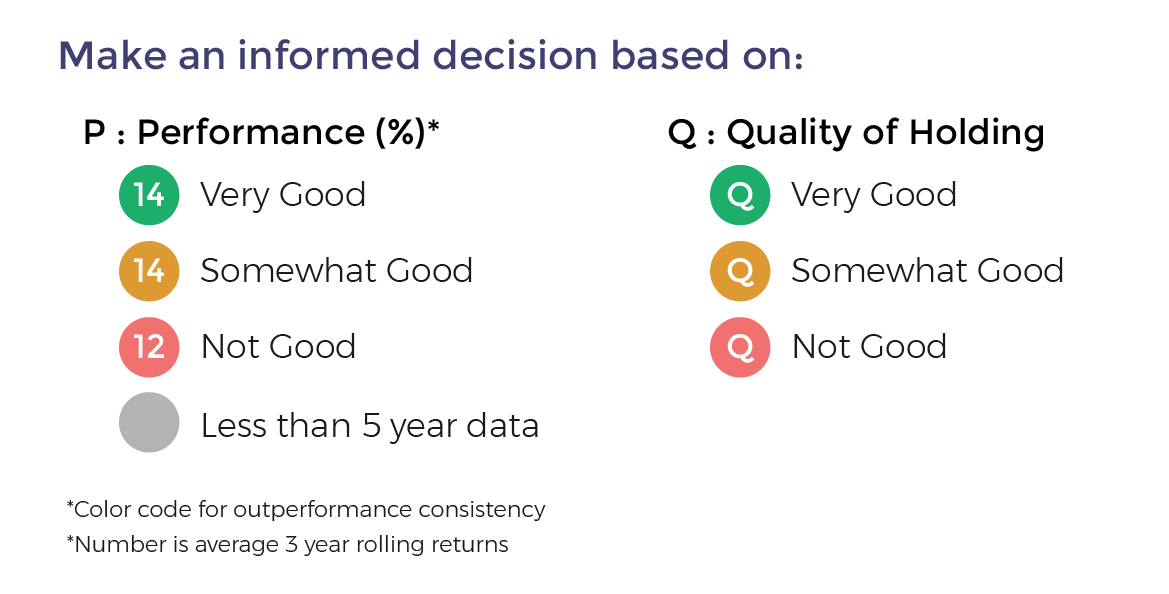
Funds ranking in screeners: Performance Consistency and Quality are two parameters used for ranking funds for SIP. The ranking as follows GG, GO, GR, OG, OO, OR, RG, RO and RR.
With the same color-coded funds, the one with the higher Average 3-year rolling returns (over 5 to 10 years), the number that appears in the Performance tag, ranks higher.
Here is the summary:
The third tag Upside Potential is not relevant for SIP. It is relevant for lumpsum investments in Mutual Funds.
Make an informed decision for Stocks
Invest using an intelligent system with powerful data-driven tools that help you identify opportunities and make informed buy-hold-sell decisions
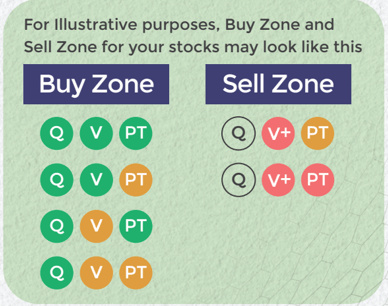
Buy quality Stocks when they are available at reasonable prices and supported by an upward price trend and Sell when they are Overvalued using the Decizen Rating System. Covers 3500+ stocks

|
Name of the IA registered
with SEBI: |
The Alchemists Ark Pvt. Ltd. |
|
Logo:
|

|
|
Trade/Brand
Name of IA: |
MoneyWorks4Me Investment Advisers |
|
Brand Logo:
|
 |
|
SEBI Registration Number:
|
INA000013323 Validity – May 16, 2019 – Perpetual |
|
Registration:
|
Non-Individual |
|
BSE Enlistment No:
|
1187 |
|
Address:
|
B-101, Signet Corner Building, Balewadi Phata, Baner, Pune, Maharashtra 411045 |
|
Compliance Officer
Details: |
Name: Shrikant Jagtap Email: shrikant.jagtap@moneyworks4me.com |
Telephone: +919860359463 Address: Same as IA |
|
Grievance Officer
Details: |
Name: Mukta Vaze Email: mukta.vaze@moneyworks4me.com |
Telephone: +919860919463 Address: Same as IA |
|
Principal Officer
Details: |
Name: Atharva Bhide Email: atharva.bhide@moneyworks4me.com |
Telephone: +919175899463 Address: Same as IA |
|
Standard Warning:
|
Investment in securities market are subject to market risks. Read all the related documents carefully before investing. |
|
|
Disclaimer:
|
Registration granted by SEBI, enlistment with exchange and certification from NISM in no way guarantee performance of the intermediary or provide any assurance of returns to investors. |
|