Tuesday’s session turned out to be a fabulous day of trade for the Indian equity markets, where frontline gauges garnered gains of around a percent. Sentiments remained jubilant since begining of the trade but hectic buying activity which took place during last leg of trade mainly drove the markets higher, with frontline gauges ending at intraday high levels, recapturing their crucial 29,500 (Sensex) and 8,900 (Nifty) bastions. Sentiments remained up-beat on reports that foreign institutional investors were net buyers in Indian equities worth Rs 2,020 crore on January 23, 2015, as per provisional stock exchange data.
Some support also came in with chief economic advisor Arvind Subramanian’s statement that the central bank may further ease the interest rates as improvement on price front has opened the space for monetary easing. Also, Prime Minister Narendra Modi wooing US investors has promised a predictable tax regime. He has also flagged US concerns over trade barriers, intellectual property rights and sought consistency and simplicity in regulatory and tax regime for ease of doing business with India. Some support also came after Finance Minister Arun Jaitley underscored fiscal deficit targets for current year, which was once termed as ‘difficult’ is likely to be achieved. The government has pegged fiscal deficit target at 4.1% of the GDP for the current year.
On the global front, European markets made a dismal start with CAC, DAX and FTSE were trading in the red in early deals as mixed corporate updates from firms, including Siemens and Ericsson, tempered investors’ appetite for stocks after an eight-day rally. Asian markets ended mostly in the green amid optimism that the actions of Greece’s new government may indicate the nation not leaving the euro currency bloc.
Back home, sentiment was also buoyed by optimism over upcoming Budget and quarterly earnings amid positive domestic factors. Meanwhile, banking stocks continued to remain on buyers’ radar as Reserve Bank is expected to come out with more monetary easing in the coming months if inflation remains in the comfortable zone. Moreover, capital goods shares gained on hopes of order inflows after the breakthrough in the Indo-US treaty for civilian nuclear projects.
The NSE’s 50-share broadly followed index Nifty ended higher by over seventy points to end above its psychological 8,900 support level, while Bombay Stock Exchange’s Sensitive Index -- Sensex edged higher by over two hundred and ninety points to surpass the psychological 29,550 mark. The broader markets too traded in-line with benchmarks and ended the session with a gain of over half a percent. The market breadth remained in favour of advances, as there were 1419 shares on the gaining side against 1510 shares on the losing side while 113 shares remain unchanged.
Finally, the BSE Sensex surged by 292.20 points or 1.00%, to 29571.04, while the CNX Nifty soared by 74.90 points or 0.85% to 8,910.50.
The BSE Sensex touched a high and a low of 29618.59 and 29286.09, respectively. The BSE Mid cap index was up by 0.79%, while the Small cap index was up by 0.51%.
The top gainers on the Sensex were Axis Bank up by 4.83%, Cipla up by 4.62%, ICICI Bank up by 3.58%, ITC up by 3.01% and HDFC Bank up by 2.98%. On the flip side, Dr. Reddys Lab down by 4.01%, Infosys down by 3.53%, Mahindra & Mahindra down by 2.81%, Coal India down by 2.77% and Hindustan Unilever down by 2.18% were the top losers.
On the BSE Sectoral front Bankex up by 2.30%, Capital Goods up by 1.84%, Auto up by 1.24%, FMCG up by 1.14%, Realty up by 1.03% were the top gainers, while IT down by 1.66%, TECK down by 1.07%, Metal down by 0.60% and PSU down by 0.12% were the top losing indices on BSE.
Meanwhile, in an encouraging development for the economy, Finance Minister Arun Jaitley underscored fiscal deficit targets for current year, which was once termed as 'difficult' is likely to be achieved. The government has pegged fiscal deficit target at 4.1% of the GDP for the current year. Notably, reflecting a worrisome financial situation, the government's fiscal deficit at the end of November touched almost 99% of the target for the entire year. The fiscal deficit, difference between the government's expenditure and revenues, stood at Rs 5.25 lakh crore, just short of the Rs.5.31 lakh crore target for the entire year.
The minister also pointed to manufacturing sector showing signs of turnaround. After contracting 4.2% in October, industrial production increased at a five-month high of 3.8% in November. The Index of Industrial Production (IIP), which had contracted 1.3% in November 2013, rose 2.2% in the first eight months of this financial year, against only 0.1 per cent in the corresponding period of 2013-14.
He asserted that despite the revenue being challenging due to slow manufacturing industry, the economy was turning around and sufficient enough to achieve fiscal deficit targets.
The minister, while pointing to the plight of others nations like Brazil, South Africa, China and Europe, highlighted that India was performing relatively well. He pointed that while China which maintained a growth rate of over 9% over 3 decades was looking at new normal, India's growth after witnessing depressing slowdown in last 2-3 years, was looking up.
The CNX Nifty touched a high and low of 8,925.05 and 8,825.45 respectively.
The top gainers on Nifty were Axis Bank up by 4.97%, Cipla up by 4.26%, ICICI Bank up by 3.53%, ITC up by 3.21% and Asian Paints up by 3.18%. On the flip side, Dr. Reddy's Laboratories down by 4.44%, Cairn India down by 3.66%, Infosys down by 3.50%, Mahindra & Mahindra down by 3.04% and Coal India down by 2.71% were the top losers.
European Markets were trading in the red; France's CAC was down by 0.62%, Germany's DAX was down by 0.51% and UK's FTSE 100 was down by 0.28%.
The Asian equity benchmarks ended mostly in green on Tuesday, while Chinese stocks fell for the first time in six days, led by financial and commodity companies, after industrial profits slumped. Japan’s exports grew the most in a year in December, helped by a weak yen and a pick-up in overseas demand led by the United States, an encouraging sign for the recession-hit economy even as doubts persist about the strength of global consumption. The 12.9% year-on-year rise in exports marked a fourth straight month of growth, supported by shipments of cars to the United States and of electronics parts to China. A recovery in exports, which has been a soft spot in the world’s third-largest economy, could be a source of comfort for Prime Minister Shinzo Abe, who is battling to re-kindle growth after an April sales tax hike drove Japan into a recession. Imports rose less than expected, leaving Japan with a trade deficit for a record 30th month in a row. Japan’s (corporate services price index) CSPI remained unchanged at a seasonally adjusted annual rate of 3.6%, from 3.6% in the preceding month. Singaporean Industrial Production rose to an annual rate of -1.9%, from -2.1% in the preceding month whose figure was revised up from -2.8%.
Asian Indices | Last Trade | Change in Points | Change in % |
Shanghai Composite | 3,352.96 | -30.22 | -0.89 |
Hang Seng | 24,807.28 | -102.62 | -0.41 |
Jakarta Composite | 5,277.15 | 17.12 | 0.33 |
KLSE Composite | 1,803.17 | 6.73 | 0.37 |
Nikkei 225 | 17,768.30 | 299.78 | 1.72 |
Straits Times | 3,412.20 | 13.68 | 0.40 |
KOSPI Composite | 1,952.40 | 16.72 | 0.86 |
Taiwan Weighted | 9,521.59 | 43.92 | 0.46 |
Start Research-backed Investing ...Now. Subscribe to Sapphire
MoneyWorks4Me is a SEBI-registered Investment Adviser (IA) dedicated to helping investors build long-term wealth through transparent, research-driven, conflict-free guidance. Founded in 2008, we started our journey as a Research Analyst (RA), providing deep fundamental analysis, intrinsic value insights, and long-term investing frameworks for Indian equities. In 2017, we transitioned to a full-fledged SEBI-registered Investment Adviser, strengthening our commitment to acting as a fiduciary—always putting the investor’s interest first.
To become India’s most trusted, research-powered fiduciary advisory platform—where every investor, regardless of experience, can make calm, confident, and well-reasoned investment decisions.
MoneyWorks4Me ensures this through:

MoneyWorks4Me rating and ranking of funds for SIP is available to subscribers only. Moneyworks4Me is not a rating and ranking agency, however it is required that users have a way of selecting funds and building a Portfolio. The method used by it are described below to enable users to understand the logic behind the rating and ranking Subscriber will find more details on this in the various content made available from time to time. In case you need more please write to besafe@moneyworks4Me.com
MoneyWorks4Me rates and ranks mutual funds based on the following data-driven system:
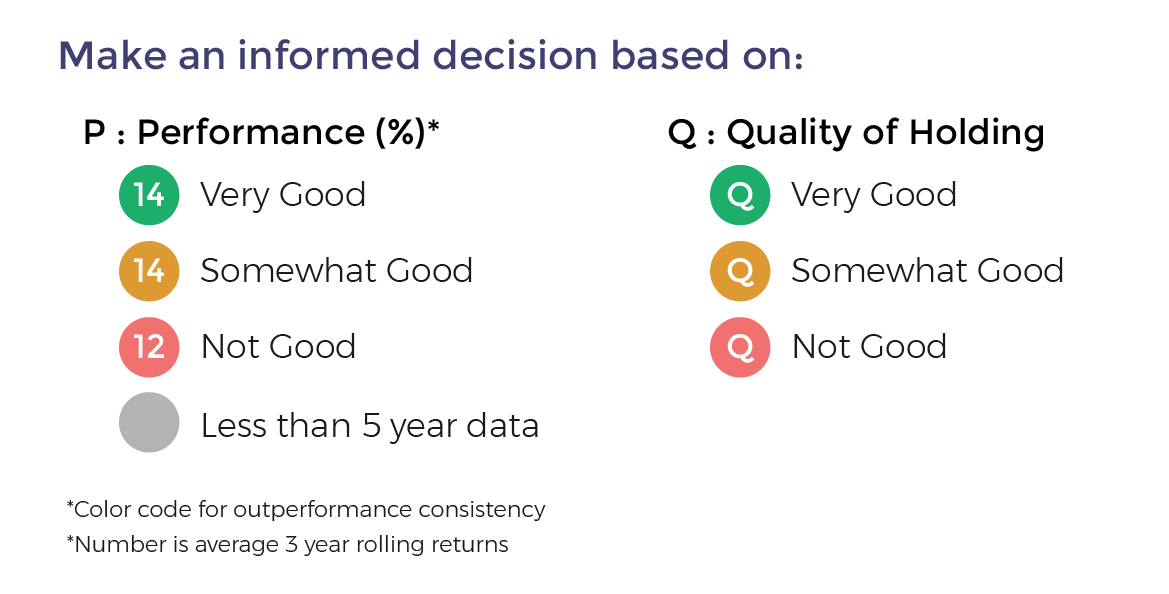
Funds ranking in screeners: Performance Consistency and Quality are two parameters used for ranking funds for SIP. The ranking as follows GG, GO, GR, OG, OO, OR, RG, RO and RR.
With the same color-coded funds, the one with the higher Average 3-year rolling returns (over 5 to 10 years), the number that appears in the Performance tag, ranks higher.
Here is the summary:
The third tag Upside Potential is not relevant for SIP. It is relevant for lumpsum investments in Mutual Funds.
Make an informed decision for Stocks
Invest using an intelligent system with powerful data-driven tools that help you identify opportunities and make informed buy-hold-sell decisions
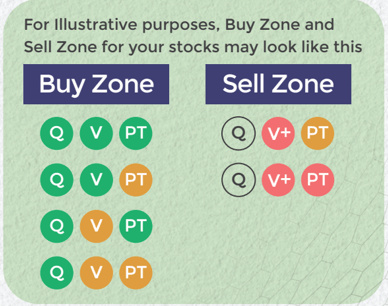
Buy quality Stocks when they are available at reasonable prices and supported by an upward price trend and Sell when they are Overvalued using the Decizen Rating System. Covers 3500+ stocks

|
Name of the IA registered
with SEBI: |
The Alchemists Ark Pvt. Ltd. |
|
Logo:
|

|
|
Trade/Brand
Name of IA: |
MoneyWorks4Me Investment Advisers |
|
Brand Logo:
|
 |
|
SEBI Registration Number:
|
INA000013323 Validity – May 16, 2019 – Perpetual |
|
Registration:
|
Non-Individual |
|
BSE Enlistment No:
|
1187 |
|
Address:
|
B-101, Signet Corner Building, Balewadi Phata, Baner, Pune, Maharashtra 411045 |
|
Compliance Officer
Details: |
Name: Shrikant Jagtap Email: shrikant.jagtap@moneyworks4me.com |
Telephone: +919860359463 Address: Same as IA |
|
Grievance Officer
Details: |
Name: Mukta Vaze Email: mukta.vaze@moneyworks4me.com |
Telephone: +919860919463 Address: Same as IA |
|
Principal Officer
Details: |
Name: Atharva Bhide Email: atharva.bhide@moneyworks4me.com |
Telephone: +919175899463 Address: Same as IA |
|
Standard Warning:
|
Investment in securities market are subject to market risks. Read all the related documents carefully before investing. |
|
|
Disclaimer:
|
Registration granted by SEBI, enlistment with exchange and certification from NISM in no way guarantee performance of the intermediary or provide any assurance of returns to investors. |
|