Tuesday’s session turned out to be a nasty one for the Indian equity benchmarks which tumbled like a ‘house of cards’ and went on to breach various key technical levels in the over a percent freefall. Sentiments turned pessimistic after the Reserve Bank of India (RBI) kept its key policy rates unchanged, opting to wait for the government’s annual budget statement at the end of February for further easing. Sentiments weakened further with Moody’s Investors Service’s report that RBI’s target to bring down retail inflation at 5 per cent by March 2017 will face some risks from monsoon uncertainty and execution of seventh Pay Panel recommendations, while macro-economic factors will be critical for sustaining growth. Market participants remained worried that the union budget might increase effective corporate tax rate by doing away with a host of tax exemptions. Depreciation in Indian rupee too weighed down sentiments. The rupee depreciated by 12 paise to trade at 67.96 against the US dollar at the time of equity markets closing. Investors failed to draw any solace from report that Core sector output returning to positive territory in December 2015 by registering a 0.9 per cent growth after shrinking (-) 1.3 per cent in November last year.
On the global front, Asian equity markets ended mostly in red after US crude oil prices fell as much as seven per cent on Monday, pressured by weak manufacturing reports from the world’s two biggest economies- the United States and China. Japanese shares slipped as investors locked in profits from large gains made following the Bank of Japan’s surprise decision late last week to adopt negative interest rates. Furthermore, European equities fell sharply in early trade as crude oil prices slipped again on oversupply concerns and companies such as oil major BP disappointed on the earnings front.
Back home, after getting positive start, Indian benchmark indices showed signs of consolidation in early trade and entered into negative territory in noon session. But, the sentiments got spooked in late afternoon trades following the sell-off in European markets. Thereafter, the frontline indices lost the plot and kept tumbling down the hill without any stoppage. The sharp cut dragged key indices to intraday lows of around 24,450 and 7,430 levels post which some short covering helped the indices to settle off the day’s lows. The indices barely managed to show signs of stabilizing in the second half of the session as the downward drift halted only with the session’s close after suffering gargantuan losses. Eventually the NSE’s 50-share broadly followed index Nifty, took a cut of over a percent to settle above the crucial 7,450 support level while Bombay Stock Exchange’s Sensitive Index Sensex slipped by over two fifty points and closed below the psychological 24,550 mark. Moreover, the broader markets too failed to show any kind of fervor and settled with large cuts of over a percent.
On the sectoral front, the high beta sectors like Metal, Oil & Gas and PSU witnessed brutal assaults as they got clobbered by 4.33%, 2.59% and 2.45% respectively. While counters like Power and Realty too suffered severe pounding. There were no gainers on the BSE sectoral front. The market breadth remained awful as there were 859 shares on the gaining side against 1843 shares on the losing side, while 106 shares remained unchanged.
Finally, the BSE Sensex declined by 285.83 points or 1.15% to 24539.00, while the CNX Nifty lost 100.40 points or 1.33% to 7,455.55.
The BSE Sensex touched a high and a low 24928.75 and 24460.53, respectively. The broader indices ended in red, with the BSE Mid cap index ending down by 1.74%, while Small cap index ending lower by 1.25%.
The top losing sectoral indices on the BSE were Metal down by 4.33%, Oil & Gas down by 2.59%, PSU down by 2.45%, Power down by 2.42% and Realty down by 1.71%, while there were no gainers in the sectoral space.
The top gainers on the Sensex were Bharti Airtel up by 1.92%, Bajaj Auto up by 1.48%, Infosys up by 0.30%, Lupin up by 0.28% and Wipro up by 0.01%. On the flip side, Tata Steel down by 7.18%, NTPC down by 4.28%, Sun Pharma Inds. down by 4.12%, BHEL down by 3.99% and Cipla down by 3.98% were the top losers.
Meanwhile, Pointing to a low growth in industrial activity, eight core sectors -- coal, crude oil, natural gas, refinery products, fertiliser, steel, cement and electricity, which comprise nearly 38% of the weight of items included in the Index of Industrial Production (IIP), posted tepid growth of 0.9% in December 2015 from 3.2 per cent in the same month of previous year on the back of decline in production of crude oil, natural gas and steel sectors. The December production numbers are, however, better than those in November which witnessed the worst performance in seven months with the output of eight sectors contracting by 1.3 per cent.
According to the data released by the ministry of Commerce and Industry, the combined Index of Eight Core Industries stands at 175.7 in December, 2015, which was 0.9% higher compared to the index of December, 2014. Its cumulative growth during April to December, 2015-16 was 1.9%.
Crude Oil production having weight of 5.22%, decreased by 4.1% in December, 2015 over December, 2014, due to lower global prices that has squeezed out investments from oil exploration and production activities. Its cumulative index during April to December, 2015-16 decreased by 0.8% over the corresponding period of previous year. The Natural gas production with the overall weight of 1.71% contracted 6.1% in December, 2015. Its cumulative index during April to December, 2015-16 declined by 2.7% over the corresponding period of previous year. Steel production having weight of 6.68% declined 4.4% in December, 2015. Its cumulative index during April to December, 2015-16 declined by 1.9% over the corresponding period of previous year. With the trend in global prices weighing upon the viability of domestic production, the contraction in steel output may persist in the near term, and continue to act as a drag upon core sector growth.
Meanwhile, Coal production having 4.38% weight increased by 6.1% in December, 2015 over December, 2014. Its cumulative index during April to December, 2015-16 increased by 4.6% over corresponding period of previous year. Petroleum Refinery production having weight 5.94% increased 2.1% in December, 2015. Its cumulative index during April to December, 2015-16 increased by 2.4% over the corresponding period of previous year. Fertilizer production having 1.25% weight increased 13.1% in December, 2015. Its cumulative index during April to December, 2015-16 increased by 10.1% over the corresponding period of previous year.
Cement production having weight of 2.41% increased by 3.2% in December, 2015. Its cumulative index during April to December, 2015-16 increased by 2.2% over the corresponding period of previous year. Electricity generation having weight of 10.32% increased 2.7% in December, 2015. Its cumulative index during April to December, 2015-16 increased 4.0 % over the corresponding period of previous year.
The sluggish performance of the eight core infrastructure industries has continued in the month after hitting seven-month low levels of negative (-) 1.3 per cent in November. The poor growth indicates that industrial production would remain subdued and a stable recovery would take more time to materialise. The slow growth could also push down GDP growth projects for the 2015-16 financial year. The government is hoping for growth to stabilize in the balance period of the fiscal to achieve targeted growth levels.
The CNX Nifty touched a high and low 7,576.30 and 7,428.05 respectively.
The top gainers on Nifty were Bharti Airtel up by 1.92%, Bajaj Auto up by 1.43%, Lupin up by 0.44%, Dr. Reddy's Laboratories up by 0.14% and Hindustan Unilever up by 0.06%. On the flip side, Vedanta down by 8.45%, Tata Steel down by 7.66%, Cairn India down by 5.26%, NTPC down by 4.96% and Tech Mahindra down by 4.77% were the top losers.
European markets were trading in red; Germany’s DAX declined 142.15 points or 1.46% to 9,615.73, UK’s FTSE 100 tumbled 104.84 points or 1.73% to 5,955.26 and France’s CAC was down by 86.67 points or 1.97% to 4,305.66.
Asian equity markets ended mostly in red on Tuesday after US crude oil prices fell as much as 7 percent on Monday, pressured by weak manufacturing reports, a US forecast calling for warm weather through mid-February and doubts about the possibility of a coordinated cutback on production. Factory activity in the world’s two biggest economies - the United States and China - slowed in January, a discouraging trend for the global economy. Japanese shares slipped on Tuesday as investors locked in profits from large gains made following the Bank of Japan's surprise decision late last week to adopt negative interest rates. However, Chinese shares bucked the weak sentiment across the region after the People's Bank of China guided the yuan to its highest fix in almost a month and pumped more money into the financial system to avoid a possible cash crunch ahead of next week's Lunar New Year holidays.
| Asian Indices | Last Trade | Change in Points | Change in % |
| Shanghai Composite | 3,296.26 | -242.92 | -6.86 |
| Hang Seng | 21,327.12 | -587.28 | -2.68 |
| Jakarta Composite | 4,525.92 | -67.09 | -1.46 |
| KLSE Composite | 1,653.37 | -39.14 | -2.31 |
| Nikkei 225 | 18,450.98 | -582.73 | -3.06 |
| Straits Times | 2,835.97 | -46.76 | -1.62 |
| KOSPI Composite | 1,918.76 | -42.55 | -2.17 |
| Taiwan Weighted | 8,114.26 | -223.80 | -2.68 |
Start Research-backed Investing ...Now. Subscribe to Sapphire
MoneyWorks4Me is a SEBI-registered Investment Adviser (IA) dedicated to helping investors build long-term wealth through transparent, research-driven, conflict-free guidance. Founded in 2008, we started our journey as a Research Analyst (RA), providing deep fundamental analysis, intrinsic value insights, and long-term investing frameworks for Indian equities. In 2017, we transitioned to a full-fledged SEBI-registered Investment Adviser, strengthening our commitment to acting as a fiduciary—always putting the investor’s interest first.
To become India’s most trusted, research-powered fiduciary advisory platform—where every investor, regardless of experience, can make calm, confident, and well-reasoned investment decisions.
MoneyWorks4Me ensures this through:

MoneyWorks4Me rating and ranking of funds for SIP is available to subscribers only. Moneyworks4Me is not a rating and ranking agency, however it is required that users have a way of selecting funds and building a Portfolio. The method used by it are described below to enable users to understand the logic behind the rating and ranking Subscriber will find more details on this in the various content made available from time to time. In case you need more please write to besafe@moneyworks4Me.com
MoneyWorks4Me rates and ranks mutual funds based on the following data-driven system:
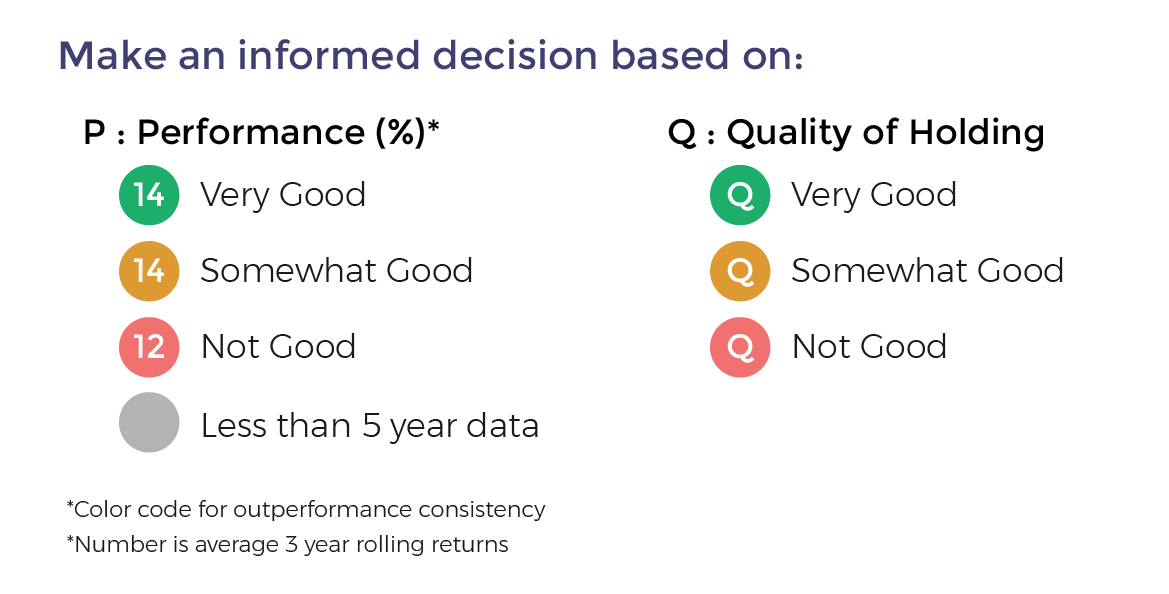
Funds ranking in screeners: Performance Consistency and Quality are two parameters used for ranking funds for SIP. The ranking as follows GG, GO, GR, OG, OO, OR, RG, RO and RR.
With the same color-coded funds, the one with the higher Average 3-year rolling returns (over 5 to 10 years), the number that appears in the Performance tag, ranks higher.
Here is the summary:
The third tag Upside Potential is not relevant for SIP. It is relevant for lumpsum investments in Mutual Funds.
Make an informed decision for Stocks
Invest using an intelligent system with powerful data-driven tools that help you identify opportunities and make informed buy-hold-sell decisions
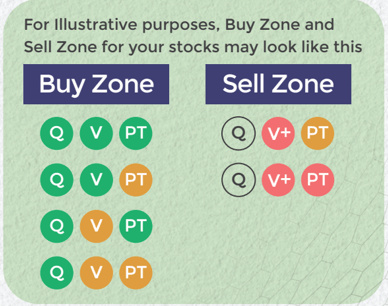
Buy quality Stocks when they are available at reasonable prices and supported by an upward price trend and Sell when they are Overvalued using the Decizen Rating System. Covers 3500+ stocks

|
Name of the IA registered
with SEBI: |
The Alchemists Ark Pvt. Ltd. |
|
Logo:
|

|
|
Trade/Brand
Name of IA: |
MoneyWorks4Me Investment Advisers |
|
Brand Logo:
|
 |
|
SEBI Registration Number:
|
INA000013323 Validity – May 16, 2019 – Perpetual |
|
Registration:
|
Non-Individual |
|
BSE Enlistment No:
|
1187 |
|
Address:
|
B-101, Signet Corner Building, Balewadi Phata, Baner, Pune, Maharashtra 411045 |
|
Compliance Officer
Details: |
Name: Shrikant Jagtap Email: shrikant.jagtap@moneyworks4me.com |
Telephone: +919860359463 Address: Same as IA |
|
Grievance Officer
Details: |
Name: Mukta Vaze Email: mukta.vaze@moneyworks4me.com |
Telephone: +919860919463 Address: Same as IA |
|
Principal Officer
Details: |
Name: Atharva Bhide Email: atharva.bhide@moneyworks4me.com |
Telephone: +919175899463 Address: Same as IA |
|
Standard Warning:
|
Investment in securities market are subject to market risks. Read all the related documents carefully before investing. |
|
|
Disclaimer:
|
Registration granted by SEBI, enlistment with exchange and certification from NISM in no way guarantee performance of the intermediary or provide any assurance of returns to investors. |
|