Stock markets in India went on to reverse its course after hitting highs of the day in late morning trades as the benchmark equity indices got brutally pounded by over a percentage point in Friday afternoon trades. The frontline gauges’ continue to search for fresh supports as their south bound journey is showing little signs of coming to a halt amid depressing cues from domestic money markets along with global risk aversion from riskier asset classes like equities. The psychological 5,100 (Nifty) and 16,800 (Sensex) levels though are turning out to be important support levels for the key indices. Sentiments were undermined by the discouraging cues from money markets were the beleaguered rupee extended its streak of depreciation and went on to breach the historical lows hit recently amid increased demand for the greenback. Apart from the global reasons, the rupee, which plunged to 57.23 against the US dollar, was also being weighed down by deep concerns about India's fiscal and economic challenges, and doubts about slowing policy reforms. The frontline gauges also traded on a weak note following the pessimistic European market opening. The markets in Europe extended their downtrend amid growing uncertainty over global economic growth prospects while reports showing global rating agency Moody's downgraded 15 banks in the US augmented the selling pressure on equities globally. Meanwhile, Asian markets too exhibited somber trends as investors in the region remained influenced by disappointing cues from overnight US markets while weak manufacturing activity indications from the US, Europe and China stoked worries about global economic slowdown. On the domestic front, investors have gone on to overlook the reports from Meteorological Department indicating that India’s crucial monsoon rains are still expected to be average in 2012, despite the scanty rainfall in the first three weeks of June which had raised concerns over farm output in the major producer and consumer of food stuffs. Apart from bleak cues from the money market, stocks from the cement sector traded on a somber note with majors like JP Associates, ACC and Ambuja Cement plunging between 3-5% as competition commission of India (CCI) imposed a penalty of around Rs 6,000 crore on 11 cement companies for forming price cartel. The penalty accounts for 50% of their net profit for the fiscal years ending in March 2010 and March 2011. On the BSE sectoral space, across the board selling pressure was evident with the Metal counter getting pummeled by over two percent. Moreover, the falls in Capital Goods and Power sectors of around one and half a percent each also exerted pressure on the bourses.
Moreover, the broader markets traded on weak note with moderate cuts of under half a percent and performed relatively better than their larger peers. The bourses sank on high volumes of over Rs 0.8 lakh crore while the market breadth on BSE was in favor of declines in the ratio of 1373:1039 while 119 scrips remained unchanged.
The BSE Sensex is currently trading at 16,831.36 down by 201.20 points or 1.18% after trading as high as 16,984.10 and as low as 16,826.77. There were 5 stocks advancing against 25 declines on the index.
The broader indices were trading on a negative note; the BSE Mid cap index dipped 0.47% and Small cap index shed 0.30%.
On the BSE sectoral space there were no gainers, while Metal down 2.15%, Capital Goods down 1.51%, Power down 1.41%, Bankex down 1.14% and Oil & Gas down 1.08% were the major laggards in the space.
Cipla up 1.03%, Maruti Suzuki up 0.89%, TCS up 0.55%, Hero Moto up 0.48% and Bajaj Auto up 0.47% were the major gainers on the Sensex, while Hindalco down 3.13%, Tata Steel down 2.75%, Tata Power down 2.23%, HDFC down 1.81% and L&T down 1.77% were the major losers in the index.
Meanwhile, in an attempt to pave way for setting up of new bourses and also to permit the exchanges to get listed on other bourses, the Securities and Exchange Board of India (SEBI), India’s capital market regulator, has unveiled new norms for ownership and governance of stock exchanges and other market infrastructure institutions. The fresh rules mandates every recognized stock exchange to have a minimum networth of Rs 100 crore at all times and at least 51 percent of stake has to be held by public.
As per the new norms, while, no Indian entity, either individually or together with persons acting in concert, would be allowed to acquire or hold more than 5 percent stake directly or indirectly in a stock exchange, however stock exchanges, depositories, banks, insurance companies and public financial institutions from India are allowed to acquire or hold up to 15 percent stake. With regards to non Indian entities, the SEBI notification underscores that individual shareholding would be capped at 5 percent for all non-Indian entities without any exemptions, and their collective holding cannot exceed 49 percent.
Moreover, of this 49 percent stake, the holding through foreign direct investment (FDI) route would be capped at 26 percent and that through foreign institutional investments (FII) will be at 23 percent. The new rules further restrict FIIs to acquire shares of a recognized stock exchange otherwise than through secondary market. For a stock exchange that is not listed, an FII may acquire shares through transactions outside of a recognized stock exchange provided it is not an initial allotment of shares; and for listed bourses, the FIIs can transact through the exchange where the shares are listed.
At a time when there are only two national level bourses viz. Bombay Stock Exchange (BSE) and National Stock Exchange (NSE) which operate in the country, the new norms are expected to pave the way for setting up many such new stock exchanges. With regards to MCX-SX, which is currently permitted only in the currency segment, the exchange is awaiting SEBI’s consent to begin trade in the equity segment.
In a recent development, SEBI has made up its mind to prescribe minimum listing standards for companies in the wake of losses to equity investors due to the poor quality of initial public offerings (IPOs) and increasing number of companies being suspended from stock exchanges. The market regulator is mulling over setting up a committee of experts to assess the feasibility of a single clearing corporation (CC) or allow inter-operability among multiple CCs.
The S&P CNX Nifty is currently trading at 5,109.30, lower by 55.70 points or 1.08% after trading as high as 5,148.15 and as low as 5,097.30. There were 9 stocks advancing against 41 declines on the index.
The top gainers on the Nifty were Maruti up 1.44%, Cipla up 1.13%, Hero Moto up 0.77%, Bajaj Auto up 0.76% and TCS up 0.40%.
JP Associates down 5.03%, ACC down 3.96%, Ambuja Cement down 3.46%, Hindalco down 3.34% and Tata Steel down 2.84% were the major losers on the index.
In the Asian space, Hang Seng plunged 1.41%, Jakarta Composite declined 0.84%, Nikkei 225 shed 0.29%, Straits Times Index fell 0.53%, KOSPI Composite Index got lacerated by 2.21% and Taiwan Weighted slumped 0.78%.
On the other hand only KLSE Composite rose 0.37%.
Stock markets in China remained closed on Friday owing to a public holiday for Dragon Boat Festival.
The European markets got off to a weak start as France’s CAC 40 sank 0.77%, Germany’s DAX shed 1.04% and the United Kingdom’s FTSE 100 plunged 0.94%.
Start Research-backed Investing ...Now. Subscribe to Sapphire
MoneyWorks4Me is a SEBI-registered Investment Adviser (IA) dedicated to helping investors build long-term wealth through transparent, research-driven, conflict-free guidance. Founded in 2008, we started our journey as a Research Analyst (RA), providing deep fundamental analysis, intrinsic value insights, and long-term investing frameworks for Indian equities. In 2017, we transitioned to a full-fledged SEBI-registered Investment Adviser, strengthening our commitment to acting as a fiduciary—always putting the investor’s interest first.
To become India’s most trusted, research-powered fiduciary advisory platform—where every investor, regardless of experience, can make calm, confident, and well-reasoned investment decisions.
MoneyWorks4Me ensures this through:

MoneyWorks4Me rating and ranking of funds for SIP is available to subscribers only. Moneyworks4Me is not a rating and ranking agency, however it is required that users have a way of selecting funds and building a Portfolio. The method used by it are described below to enable users to understand the logic behind the rating and ranking Subscriber will find more details on this in the various content made available from time to time. In case you need more please write to besafe@moneyworks4Me.com
MoneyWorks4Me rates and ranks mutual funds based on the following data-driven system:
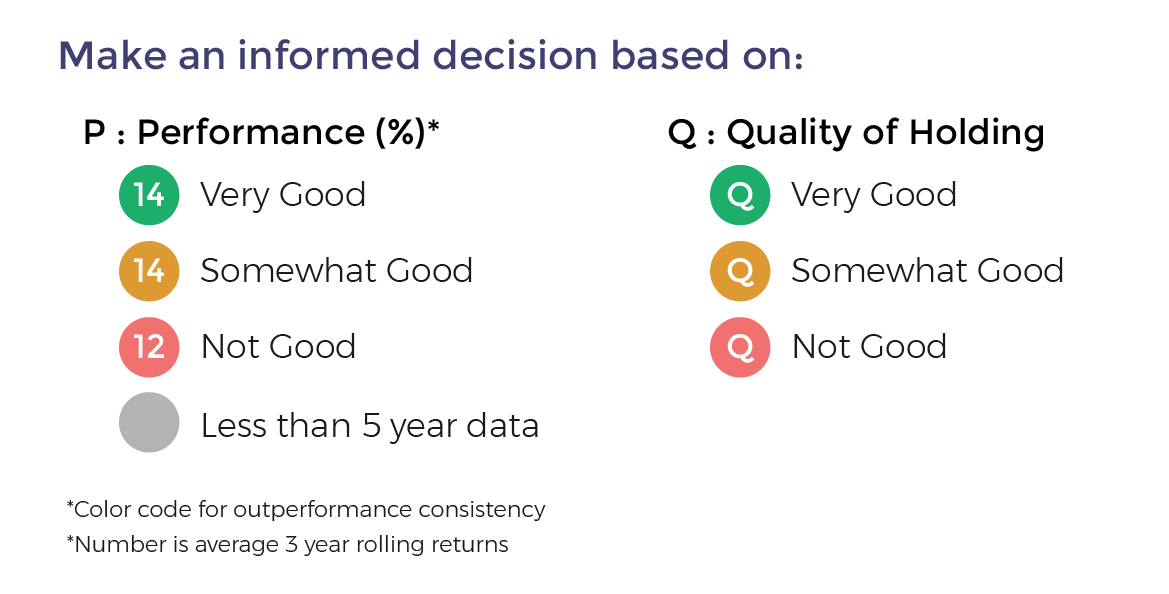
Funds ranking in screeners: Performance Consistency and Quality are two parameters used for ranking funds for SIP. The ranking as follows GG, GO, GR, OG, OO, OR, RG, RO and RR.
With the same color-coded funds, the one with the higher Average 3-year rolling returns (over 5 to 10 years), the number that appears in the Performance tag, ranks higher.
Here is the summary:
The third tag Upside Potential is not relevant for SIP. It is relevant for lumpsum investments in Mutual Funds.
Make an informed decision for Stocks
Invest using an intelligent system with powerful data-driven tools that help you identify opportunities and make informed buy-hold-sell decisions
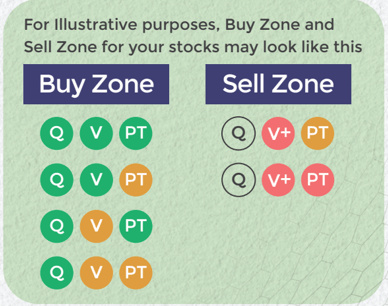
Buy quality Stocks when they are available at reasonable prices and supported by an upward price trend and Sell when they are Overvalued using the Decizen Rating System. Covers 3500+ stocks

|
Name of the IA registered
with SEBI: |
The Alchemists Ark Pvt. Ltd. |
|
Logo:
|

|
|
Trade/Brand
Name of IA: |
MoneyWorks4Me Investment Advisers |
|
Brand Logo:
|
 |
|
SEBI Registration Number:
|
INA000013323 Validity – May 16, 2019 – Perpetual |
|
Registration:
|
Non-Individual |
|
BSE Enlistment No:
|
1187 |
|
Address:
|
B-101, Signet Corner Building, Balewadi Phata, Baner, Pune, Maharashtra 411045 |
|
Compliance Officer
Details: |
Name: Shrikant Jagtap Email: shrikant.jagtap@moneyworks4me.com |
Telephone: +919860359463 Address: Same as IA |
|
Grievance Officer
Details: |
Name: Mukta Vaze Email: mukta.vaze@moneyworks4me.com |
Telephone: +919860919463 Address: Same as IA |
|
Principal Officer
Details: |
Name: Atharva Bhide Email: atharva.bhide@moneyworks4me.com |
Telephone: +919175899463 Address: Same as IA |
|
Standard Warning:
|
Investment in securities market are subject to market risks. Read all the related documents carefully before investing. |
|
|
Disclaimer:
|
Registration granted by SEBI, enlistment with exchange and certification from NISM in no way guarantee performance of the intermediary or provide any assurance of returns to investors. |
|