Stock markets in India pruned most of their gains after hitting intraday highs in early morning session and are trading on a flat note in Tuesday afternoon trades. The frontline indices gyrated in a tight range since in the positive territory, below crucial levels. The psychological 5,300 (Nifty) and 17,500 (Sensex) levels proved as difficult nuts to crack for the frontline indices which drifted lower immediately after crossing those levels. Local markets largely were outperformed by their Asian counterparts which traded on an optimistic note amid hopes that world’s major central banks including those in the Europe, the US and China would employ monetary easing measures to support their respective flagging economy. The European markets too traded on a flat note after reports showed manufacturing around the world shrank largely because of the onerous financial trouble in European Union, however, they traded with a positive bias on hopes of central banks’ policy action to bolster growth. Back home, the upside was capped as investors remained worried over monsoons prospects as it got delayed by two weeks. Moreover, the upside in automobile sector shares was capped after reports showed weak buyer sentiment due to high petrol prices and interest rates continued to affect automobile June sales and it is unlikely to improve until the festival season that begins in September. Further, stocks from the Cement sector too remained subdued after majors like ACC and Ambuja Cement reported a modest growth in production at 1.97 million tonnes and 1.78 million tonnes respectively, in June. However, stocks like Bharti Airtel and Idea Cellular from the telecom sector rallied substantially after Telecom Disputes Settlement and Appellate Tribunal (TDSAT) gave a split verdict on a challenge by mobile phone operators seeking to overturn a government order requiring them to stop offering 3G services beyond their licensed zones through mutual roaming pacts. Besides, cues from the money markets were supportive as Indian rupee appreciated to its strongest level in nearly a month and traded at sub 55 levels against the US dollar. On the BSE sectoral space, profit booking was only evident in the IT and defensive FMCG sectors as investors were busy piling up positions in the defensive Consumer Durables and rate sensitive Bankex pockets which surged over 2% and 1% respectively.
Moreover, the broader markets continued to trade on a positive note with notable gains of around half a percent and outperformed their larger peers. The bourses rose on weak volumes of over Rs 0.6 lakh crore on the third day of a new F&O series while the market breadth on BSE was in favor of advances.
The BSE Sensex is currently trading at 17,447.38 up by 48.40 points or 0.28% after trading as high as 17,526.82 and as low as 17,431.88. There were 18 stocks advancing against 12 declines on the index.
The broader indices were trading on a positive note; the BSE Mid cap index advanced 0.41% and Small cap index climbed 0.56%.
On the BSE sectoral space, Consumer Durables up 2.08%, Bankex up 1.03%, Realty up 1.02%, PSU up 0.95% and Oil & Gas up 0.84% were the major gainers, while IT down 0.68% and FMCG down 0.67% were the only laggards in the space.
Bharti Airtel up 3.23%, GAIL up 2.42%, ONGC up 1.75%, Hindalco up 1.57% and ICICI Bank up 1.33% were the major gainers on the Sensex, while TCS down 1.53%, BHEL down 1.38%, HUL down 1.15%, ITC down 1.02% and Hero Moto down 0.96% were the major losers in the index.
Meanwhile, overhauling India’s tax administration for a transparent, less discretionary and inspector raj free regime is the need of the hour and the premier industry body Associated Chambers of Commerce and Industry of India (ASSOCHAM) has urged Prime Minister Manmohan Singh, who has also taken over the finance portfolio, to look in this regard. Looking at the ongoing flip-flop over the contentious taxation issues, the industry body has also urged government to defer implementation of General Anti-Avoidance Rules (GAAR) provisions until 2015.
The apex chamber opined that the recent dilly dallying over GAAR provisions has created a bad perception about Indian tax laws among global investors. The body also highlighted that introduction of goods and services tax (GST) would be a landmark that can bring drastic changes in the tax administration.
Citing that the implementation of GAAR provisions will have serious implications for the tax-payers and investors - both domestic and global, ASSOCHAM suggested government that no rush job should be done since India can ill afford to send a signal suggesting there is no stability in taxation policies. The final draft of GAAR provisions must be placed before Parliament only after exhaustive evaluation of every parameter of GAAR after holding consultations with industry, tax planners, legal professionals and tax administrators.
Moreover, the premier industry body, which represents the interests of industry and trade, interfaces with Government on policy issues, highlighted that since the process of consultation and detailed evaluation would be a big exercise, the duration of one year for implementing its provisions will not be sufficient. Thus stating that implementation of GAAR is wrongly timed; ASSOCHAM advocated the idea of putting off the proposal well beyond April, 2013, at least up to 2015.
At a time when the benchmark equity indices in India are already struggling to gain momentum due to a host of domestic as well as global concerns, India can hardly afford to scare away foreign funds and investors, which have been the main driving force for local bourses. Calling foreign institutional investors (FIIs) a highly sensitive tribe of investors, ASSOCHAM pointed towards perceptions made and destroyed by FIIs about countries in short times and said the negative perception will feed on itself and influence the credit rating agencies, which has been seen already in case of India.
Former Finance Minister Pranab Mukherjee, who is now seen by many as the frontrunner in the race of becoming President of India, in his Union Budget 2012-13 had proposed the GAAR provisions to curtail tax evasion. The provisions had invoked sharp criticism from the foreign and domestic investors, following which the government constituted a high-level committee to look into their concerns.
According to some estimates, Indian markets had lost around Rs 1 lakh crore or about $20 billion worth of investments from the overseas funds and ultra-rich foreign individuals over the three month period between March and May on new taxation proposals and the government's recent white paper on Black Money. General Anti-Avoidance Rule (GAAR) remained the buzzword over last three months in the financial circles and though not many knew about the nitty-gritty’s of it, most witnessed how talks surrounding its implementation from April 1, 2012 rattled foreign institutional investors (FII), which in turn triggered a free-fall off sorts in Indian stock markets.
The S&P CNX Nifty is currently trading at 5,289.35, higher by 10.75 points or 0.20% after trading as high as 5,317.00 and as low as 5,286.90. There were 30 stocks advancing against 20 declines on the index.
The top gainers on the Nifty were Bharti Airtel up 3.14%, DLF up 2.37%, GAIL up 2.35%, ONGC up 1.99% and Ranbaxy up 1.79%.
BHEL down 1.87%, TCS down 1.86%, ACC down 1.77%, HUL down 1.34% and ITC down 1.14% were the major losers on the index.
In the Asian space, Shanghai Composite rose 0.08%, Hang Seng soared 1.15%, Jakarta Composite surged 1%, KLSE Composite advanced 0.33%, Nikkei 225 climbed 0.70%, Straits Times Index ascended 0.79%, KOSPI Composite Index amassed 0.87% and Taiwan Weighted jumped 1%.
The European markets got off to a positive start as France’s CAC 40 rose 0.31%, Germany’s DAX added 0.22% and the United Kingdom’s FTSE 100 gained 0.06%.
Start Research-backed Investing ...Now. Subscribe to Sapphire
MoneyWorks4Me is a SEBI-registered Investment Adviser (IA) dedicated to helping investors build long-term wealth through transparent, research-driven, conflict-free guidance. Founded in 2008, we started our journey as a Research Analyst (RA), providing deep fundamental analysis, intrinsic value insights, and long-term investing frameworks for Indian equities. In 2017, we transitioned to a full-fledged SEBI-registered Investment Adviser, strengthening our commitment to acting as a fiduciary—always putting the investor’s interest first.
To become India’s most trusted, research-powered fiduciary advisory platform—where every investor, regardless of experience, can make calm, confident, and well-reasoned investment decisions.
MoneyWorks4Me ensures this through:

MoneyWorks4Me rating and ranking of funds for SIP is available to subscribers only. Moneyworks4Me is not a rating and ranking agency, however it is required that users have a way of selecting funds and building a Portfolio. The method used by it are described below to enable users to understand the logic behind the rating and ranking Subscriber will find more details on this in the various content made available from time to time. In case you need more please write to besafe@moneyworks4Me.com
MoneyWorks4Me rates and ranks mutual funds based on the following data-driven system:
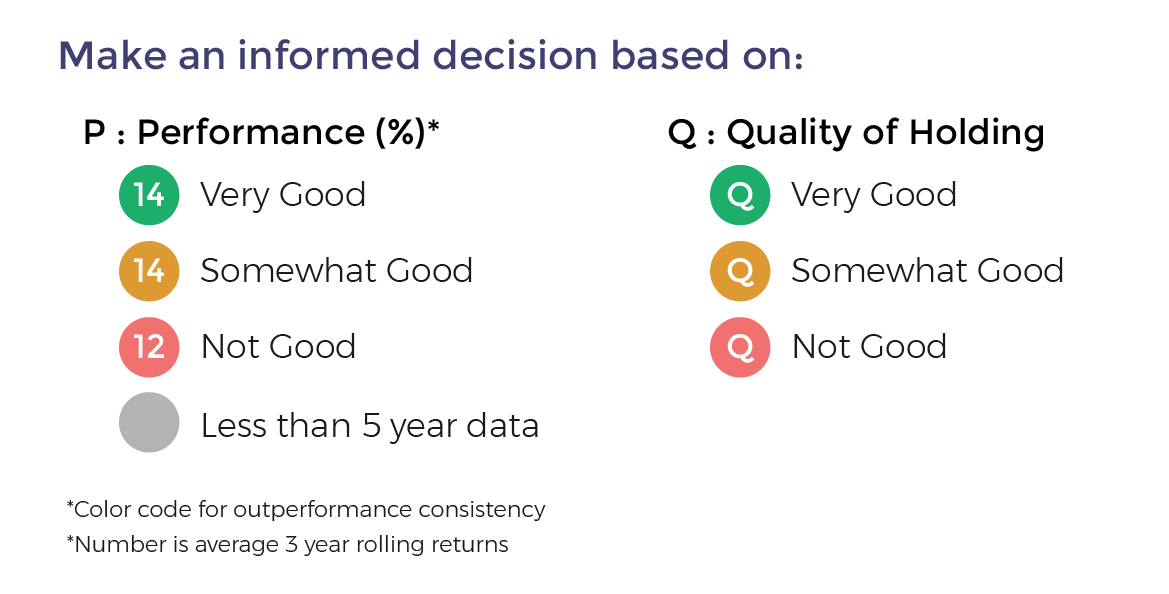
Funds ranking in screeners: Performance Consistency and Quality are two parameters used for ranking funds for SIP. The ranking as follows GG, GO, GR, OG, OO, OR, RG, RO and RR.
With the same color-coded funds, the one with the higher Average 3-year rolling returns (over 5 to 10 years), the number that appears in the Performance tag, ranks higher.
Here is the summary:
The third tag Upside Potential is not relevant for SIP. It is relevant for lumpsum investments in Mutual Funds.
Make an informed decision for Stocks
Invest using an intelligent system with powerful data-driven tools that help you identify opportunities and make informed buy-hold-sell decisions
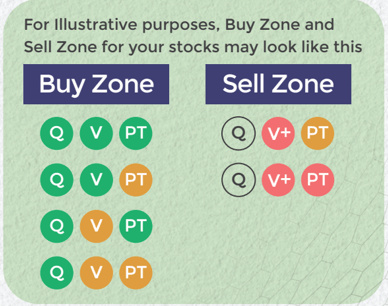
Buy quality Stocks when they are available at reasonable prices and supported by an upward price trend and Sell when they are Overvalued using the Decizen Rating System. Covers 3500+ stocks

|
Name of the IA registered
with SEBI: |
The Alchemists Ark Pvt. Ltd. |
|
Logo:
|

|
|
Trade/Brand
Name of IA: |
MoneyWorks4Me Investment Advisers |
|
Brand Logo:
|
 |
|
SEBI Registration Number:
|
INA000013323 Validity – May 16, 2019 – Perpetual |
|
Registration:
|
Non-Individual |
|
BSE Enlistment No:
|
1187 |
|
Address:
|
B-101, Signet Corner Building, Balewadi Phata, Baner, Pune, Maharashtra 411045 |
|
Compliance Officer
Details: |
Name: Shrikant Jagtap Email: shrikant.jagtap@moneyworks4me.com |
Telephone: +919860359463 Address: Same as IA |
|
Grievance Officer
Details: |
Name: Mukta Vaze Email: mukta.vaze@moneyworks4me.com |
Telephone: +919860919463 Address: Same as IA |
|
Principal Officer
Details: |
Name: Atharva Bhide Email: atharva.bhide@moneyworks4me.com |
Telephone: +919175899463 Address: Same as IA |
|
Standard Warning:
|
Investment in securities market are subject to market risks. Read all the related documents carefully before investing. |
|
|
Disclaimer:
|
Registration granted by SEBI, enlistment with exchange and certification from NISM in no way guarantee performance of the intermediary or provide any assurance of returns to investors. |
|