Indian equity markets have made a cautious start and are trading in red in early deals tracking weak global cues, as traders remain concerned about the Department for Promotion of Industry and Internal Trade’s (DPIIT) latest data showing that foreign direct investment (FDI) in India declined for the first time in the last six years in 2018-19, falling by 1 per cent to $44.37 billion as compared to $44.85 billion in 2017-18. According to the data, FDI inflows in telecommunication, construction development, pharmaceuticals and power sectors declined significantly in 2018-19. Decline in foreign inflows could put pressure on the country's balance of payments and may also impact the value of the rupee. However, losses remain capped with a global study showing that India has moved up one place to rank as the world’s 43rd most competitive economy on the back of its robust economic growth, a large labour force and its huge market size, while Singapore has toppled the US to grab the top position. Investors took note of the report stating that amid concerns about sluggish steel demand and dumping threat from China, domestic steel may register a growth of 6-8 per cent in the current financial year, experts said on May 28.
On the global front, the US markets ended lower on Tuesday amid lingering concerns about the economic impact of the ongoing trade dispute between the US and China. Asian markets are trading mostly in red on Wednesday, as investors remained cautious, awaiting new developments between Beijing and Washington amid the ongoing trade tensions.
Back home, a private report indicated that India can attract FDI to a ratio of 1.5 per cent to 2 per cent of its GDP by further improving on ease of doing business and building infrastructure. In scrip specific developments, NTPC gained on eyeing to produce 310 billion units of power in FY20 and Hindustan Copper surged on getting nod to raise borrowing limits to Rs 2,500 crore.
The BSE Sensex is currently trading at 39681.26, down by 68.47 points or 0.17% after trading in a range of 39644.36 and 39750.00. There were 13 stocks advancing against 18 stocks declining on the index.
The broader indices were trading in red; the BSE Mid cap index slipped 0.35%, while Small cap index was down by 0.15%.
The top gaining sectoral indices on the BSE were IT up by 0.77%, Utilities up by 0.73%, TECK up by 0.55% and Power was up by 0.29%, while PSU down by 0.72%, Bankex down by 0.64%, Auto down by 0.62%, Metal down by 0.58% and Basic Materials was down by 0.54% were the top losing indices on BSE.
The top gainers on the Sensex were Power Grid Corporation up by 1.56%, TCS up by 1.32%, HCL Tech up by 1.10%, Yes Bank up by 0.85% and Infosys was up by 0.53%. On the flip side, Vedanta down by 2.31%, SBI down by 2.22%, ICICI Bank down by 1.54%, Tata Motors down by 1.49% and ONGC was down by 1.46% were the top losers.
Meanwhile, the Department for Promotion of Industry and Internal Trade (DPIIT) in its latest data has showed that foreign direct investment (FDI) in India declined for the first time in the last six years in 2018-19, falling by 1% to $44.37 billion as compared to $44.85 billion recorded in 2017-18. Last time it was in 2012-13 when foreign inflows had registered a contraction of 36% to $22.42 billion compared to $35.12 billion in 2011-12. Since 2012-13, the inflows had been continuously growing and reached a record high in 2017-18.
As per the data, FDI inflows in telecommunication, construction development, pharmaceuticals and power sectors declined significantly in 2018-19. FDI in telecommunication dropped to $2.67 billion in 2018-19 from $6.21 billion in 2017-18, in construction development to $213 million ($540 million), in pharmaceuticals to $266 million ($1 billion) and in the power sector to $1.1 billion ($1.62 billion). However, sectors that recorded a growth in FDI includes services ($9.15 billion), computer software and hardware ($6.41 billion), trading ($4.46 billion), and automobile ($2.62 billion).
The country wise, Singapore has replaced Mauritius as the top source of foreign investment into India in the FY19, accounting for $16.22 billion inflows. India has received $8 billion FDI from Mauritius. The other major investors in the country includes Japan, the Netherlands, the UK, the US, Germany, Cyprus, the UAE and France. FDI is important as India would require huge investments in the coming years to overhaul its infrastructure sector to boost growth. Decline in foreign inflows could put pressure on the country's balance of payments and may also impact the value of the rupee.
The CNX Nifty is currently trading at 11912.25, down by 16.50 points or 0.14% after trading in a range of 11903.20 and 11928.15. There were 20 stocks advancing against 30 stocks declining on the index.
The top gainers on Nifty were GAIL India up by 2.84%, Bharti Infratel up by 2.77%, Wipro up by 1.48%, Power Grid Corporation up by 1.31% and TCS was up by 1.25%. On the flip side, Vedanta down by 2.74%, SBI down by 2.18%, Zee Entertainment down by 2.12%, UPL down by 1.71% and ICICI Bank was down by 1.61% were the top losers.
Asian Markets are mostly trading in red; Hang Seng decreased 110.07 points or 0.4% to 27,280.74, Nikkei 225 slipped 245.76 points or 1.16% to 21,014.38, Shanghai Composite declined 3.09 points or 0.11% to 2,906.82, KOSPI fell 31.91 points or 1.56% to 2,016.92, Taiwan Weighted dropped 24.06 points or 0.23% to 10,288.25 and Straits Times was down by 8.44 points or 0.27% to 3,156.88. On the flip side, only Jakarta Composite was up by 61.89 points or 1.03% to 6,095.03.
Start Research-backed Investing ...Now. Subscribe to Sapphire
MoneyWorks4Me is a SEBI-registered Investment Adviser (IA) dedicated to helping investors build long-term wealth through transparent, research-driven, conflict-free guidance. Founded in 2008, we started our journey as a Research Analyst (RA), providing deep fundamental analysis, intrinsic value insights, and long-term investing frameworks for Indian equities. In 2017, we transitioned to a full-fledged SEBI-registered Investment Adviser, strengthening our commitment to acting as a fiduciary—always putting the investor’s interest first.
To become India’s most trusted, research-powered fiduciary advisory platform—where every investor, regardless of experience, can make calm, confident, and well-reasoned investment decisions.
MoneyWorks4Me ensures this through:

MoneyWorks4Me rating and ranking of funds for SIP is available to subscribers only. Moneyworks4Me is not a rating and ranking agency, however it is required that users have a way of selecting funds and building a Portfolio. The method used by it are described below to enable users to understand the logic behind the rating and ranking Subscriber will find more details on this in the various content made available from time to time. In case you need more please write to besafe@moneyworks4Me.com
MoneyWorks4Me rates and ranks mutual funds based on the following data-driven system:
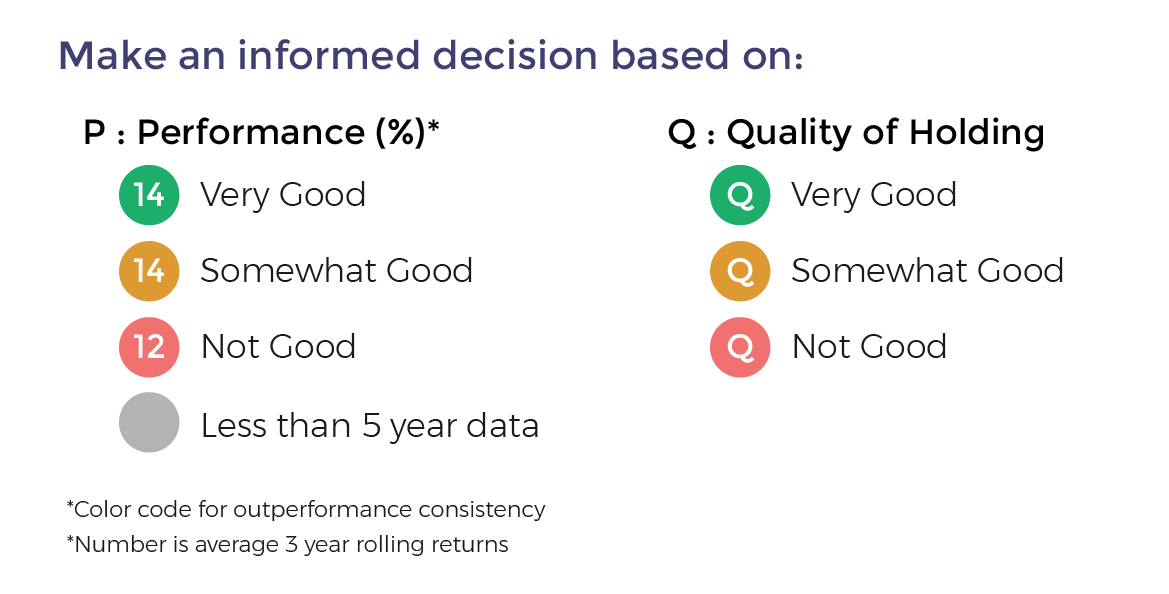
Funds ranking in screeners: Performance Consistency and Quality are two parameters used for ranking funds for SIP. The ranking as follows GG, GO, GR, OG, OO, OR, RG, RO and RR.
With the same color-coded funds, the one with the higher Average 3-year rolling returns (over 5 to 10 years), the number that appears in the Performance tag, ranks higher.
Here is the summary:
The third tag Upside Potential is not relevant for SIP. It is relevant for lumpsum investments in Mutual Funds.
Make an informed decision for Stocks
Invest using an intelligent system with powerful data-driven tools that help you identify opportunities and make informed buy-hold-sell decisions
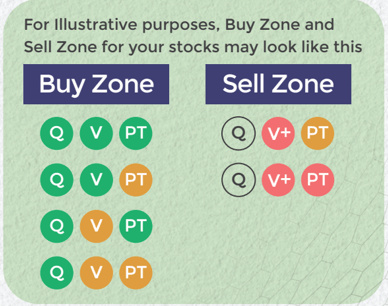
Buy quality Stocks when they are available at reasonable prices and supported by an upward price trend and Sell when they are Overvalued using the Decizen Rating System. Covers 3500+ stocks

|
Name of the IA registered
with SEBI: |
The Alchemists Ark Pvt. Ltd. |
|
Logo:
|

|
|
Trade/Brand
Name of IA: |
MoneyWorks4Me Investment Advisers |
|
Brand Logo:
|
 |
|
SEBI Registration Number:
|
INA000013323 Validity – May 16, 2019 – Perpetual |
|
Registration:
|
Non-Individual |
|
BSE Enlistment No:
|
1187 |
|
Address:
|
B-101, Signet Corner Building, Balewadi Phata, Baner, Pune, Maharashtra 411045 |
|
Compliance Officer
Details: |
Name: Shrikant Jagtap Email: shrikant.jagtap@moneyworks4me.com |
Telephone: +919860359463 Address: Same as IA |
|
Grievance Officer
Details: |
Name: Mukta Vaze Email: mukta.vaze@moneyworks4me.com |
Telephone: +919860919463 Address: Same as IA |
|
Principal Officer
Details: |
Name: Atharva Bhide Email: atharva.bhide@moneyworks4me.com |
Telephone: +919175899463 Address: Same as IA |
|
Standard Warning:
|
Investment in securities market are subject to market risks. Read all the related documents carefully before investing. |
|
|
Disclaimer:
|
Registration granted by SEBI, enlistment with exchange and certification from NISM in no way guarantee performance of the intermediary or provide any assurance of returns to investors. |
|