After day’s halt, Indian equities once again ended the day’s trade in red trend. Indices did not once break out in green and remained firmly placed in the red territory throughout the day. Traders failed to take support from key macroeconomic data. The broader indices, the BSE Mid cap index ended in red territory, while Small cap index ended in green. Banking and Oil & Gas sector’s stock witnessed selling pressure.
Markets made negative start and remained lower following overnight sell-off on Wall Street as well as weakness in Asian counterparts amid a hotter than expected increase in US wholesale inflation. The US producer price index rose 0.6 per cent against expectations of a 0.3 per cent rise, sending the US-10-year treasury yield higher by 10 bps to 4.29 per cent. Foreign fund outflows also dented sentiments. Foreign institutional investors (FIIs) net sold shares worth Rs 1,356.29 crore on March 14, provisional data from the NSE showed. Traders overlooked the Confederation of Indian Industry’s (CII) report that new unicorns are likely to add $1 trillion to the Indian economy, which would reach $7 trillion size by 2030, and add 50 million new jobs. Startup firms valued over $1 billion are categorised as unicorns. In afternoon session, markets continued to trade lower, as traders were cautious with report by global rating agency Moody’s asserting that the large of number scheduled elections in various countries in 2024 increases risks of shifts in policy and policy effectiveness. It argued while elections rarely immediately affect sovereign credit ratings, they can result in credit positive or negative developments – like changes in the policymaking process and legislative composition – which according to it ultimately alter a sovereign’s economic and fiscal trajectories. Indices remained under selling pressure till the end of the session. Sentiments were downbeat, as the commerce ministry said that India's merchandise trade deficit widened to $18.71 billion in February from $17.49 billion in January. The trade deficit stood at $16.57 billion in February 2023. While the trade deficit widened in February, exports rose by 11.9 percent to $41.40 billion, while imports increased by 12.2 percent on a year-on basis to $60.11 billion.
On the global front, European markets were trading higher as traders pared their expectations for a U.S. rate cut in June and braced for more hawkish signals from a Federal Reserve meeting next week. Asian markets ended mostly in red after a sharper-than-expected jump in US wholesale prices dealt a blow to hopes for interest rate cuts, while the uncertainty also sent bitcoin tumbling. Back home, the US embassy has said that in this first trilateral technology meeting, the United States, Republic of Korea, and India discussed opportunities to cooperate on semiconductor supply chains, telecommunications and digital public infrastructure, artificial intelligence, quantum, space, advanced materials, clean energy and critical minerals.
The BSE Sensex ended at 72,643.43, down by 453.85 points or 0.62% after trading in a range of 72,484.82 and 72,998.07. There were 6 stocks advancing against 24 stocks declining on the index. (Provisional)
The broader indices ended mixed; the BSE Mid cap index declined 0.51%, while Small cap index was up by 0.25%. (Provisional)
The few gaining sectoral indices on the BSE were Telecom up by 1.04%, Basic Materials up by 0.30% and FMCG was up by 0.02%, while Oil & Gas down by 2.24%, Energy down by 1.95%, PSU down by 1.78%, Auto down by 1.74% and Capital Goods was down by 1.25% were the top losing indices on BSE. (Provisional)
The top gainers on the Sensex were Bharti Airtel up by 2.10%, Bajaj Finance up by 1.01%, Bajaj Finserv up by 0.37%, TCS up by 0.31% and Indusind Bank up by 0.30%. On the flip side, Mahindra & Mahindra down by 4.75%, Tata Motors down by 2.23%, Larsen & Toubro down by 1.97%, NTPC down by 1.94% and HCL Tech down by 1.73% were the top losers. (Provisional)
Meanwhile, G20 Sherpa Amitabh Kant has said that the Indian startup movement must be driven by Indian financing and cannot depend on foreign funding. He said the nation needs to create a fund of funds to support young deep tech startups. He said all upcoming startups have to be driven by Artificial Intelligence (AI). He added startups should focus on corporate governance for growth, otherwise, they will land up in a debacle.
Kant, who was the former NITI Aayog CEO, said ‘In the quest for great innovation and disruption, startups lose out on corporate governance. The key to India's success of becoming the number one nation of startups is its ability to do good corporate governance and to ensure that Indian insurance companies, pension funds, and others, should all invest in our startup movement’. He further said that India cannot grow on the back of foreign money coming in all the time.
He also said ‘India's startup movement must be driven by India's financing’. He said ‘We must be very clear about being the number one startup nation in the world. There is no reason that anything should hold us back because we have created a digital movement that is more powerful than anything else in the world’. He noted that women are outperforming men in every walk of life, and if India wants to be a $35 trillion economy by 2047, it cannot do so without women’s participation.
The CNX Nifty ended at 22,023.35, down by 123.30 points or 0.56% after trading in a range of 21,931.70 and 22,120.90. There were 14 stocks advancing against 36 stocks declining on the index. (Provisional)
The top gainers on Nifty were UPL up by 2.82%, Bharti Airtel up by 2.13%, Bajaj Finance up by 1.83%, HDFC Life Insurance up by 1.62% and Adani Enterprises up by 1.45%. On the flip side, Mahindra & Mahindra down by 4.82%, BPCL down by 3.66%, Coal India down by 2.91%, Tata Motors down by 2.26% and Larsen & Toubro down by 1.97% were the top losers. (Provisional)
European markets were trading higher; UK’s FTSE 100 increased 13.78 points or 0.18% to 7,756.93, France’s CAC rose 22.75 points or 0.28% to 8,184.17 and Germany’s DAX was up by 49.31 points or 0.27% to 17,991.35.
Asian markets settled mostly down on Friday due to uncertainty over rate cut in June monetary policy after hotter-than-expected the US inflation producer inflation data. The US producer price inflation rose 0.6% in February from last month, Labor Department data showed, that was higher than market expectations of a 0.3% uptick. Meanwhile, Australian markets declined amid expectations that the Reserve Bank of Australia might maintain its hawkish stance at a policy meeting next week. Japanese shares fell tracking Wall Street’s decline overnight and anxiety ahead of next week's Bank of Japan policy meeting. The Bank of Japan is widely expected to put an end to its negative interest rates and yield curve control policies. Hong Kong shares settled down after data showed China's house prices continued to fall in February. However, Chinese shares gained as PBoC left its key policy rate unchanged and withdrew cash from a medium-term policy loan operation for the first time in 16 months.
| Asian Indices | Last Trade | Change in Points | Change in % |
| Shanghai Composite | 3,054.64 | 16.41 | 0.54 |
| Hang Seng | 16,720.89 | -240.77 | -1.44 |
| Jakarta Composite | 7,328.05 | -105.27 | -1.44 |
| KLSE Composite | 1,552.83 | 9.08 | 0.59 |
| Nikkei 225 | 38,707.64 | -99.74 | -0.26 |
| Straits Times | 3,172.96 | -13.44 | -0.42 |
| KOSPI Composite | 2,666.84 | -51.92 | -1.95 |
| Taiwan Weighted | 19,682.50 | -255.42 | -1.30 |
Start Research-backed Investing ...Now. Subscribe to Sapphire
MoneyWorks4Me is a SEBI-registered Investment Adviser (IA) dedicated to helping investors build long-term wealth through transparent, research-driven, conflict-free guidance. Founded in 2008, we started our journey as a Research Analyst (RA), providing deep fundamental analysis, intrinsic value insights, and long-term investing frameworks for Indian equities. In 2017, we transitioned to a full-fledged SEBI-registered Investment Adviser, strengthening our commitment to acting as a fiduciary—always putting the investor’s interest first.
To become India’s most trusted, research-powered fiduciary advisory platform—where every investor, regardless of experience, can make calm, confident, and well-reasoned investment decisions.
MoneyWorks4Me ensures this through:

MoneyWorks4Me rating and ranking of funds for SIP is available to subscribers only. Moneyworks4Me is not a rating and ranking agency, however it is required that users have a way of selecting funds and building a Portfolio. The method used by it are described below to enable users to understand the logic behind the rating and ranking Subscriber will find more details on this in the various content made available from time to time. In case you need more please write to besafe@moneyworks4Me.com
MoneyWorks4Me rates and ranks mutual funds based on the following data-driven system:
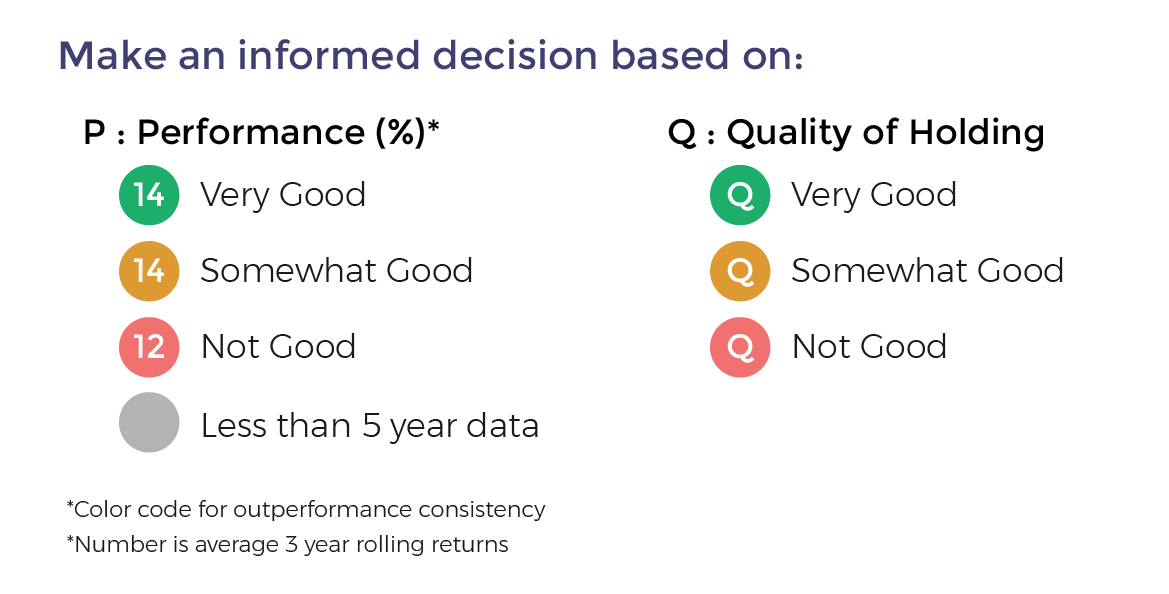
Funds ranking in screeners: Performance Consistency and Quality are two parameters used for ranking funds for SIP. The ranking as follows GG, GO, GR, OG, OO, OR, RG, RO and RR.
With the same color-coded funds, the one with the higher Average 3-year rolling returns (over 5 to 10 years), the number that appears in the Performance tag, ranks higher.
Here is the summary:
The third tag Upside Potential is not relevant for SIP. It is relevant for lumpsum investments in Mutual Funds.
Make an informed decision for Stocks
Invest using an intelligent system with powerful data-driven tools that help you identify opportunities and make informed buy-hold-sell decisions
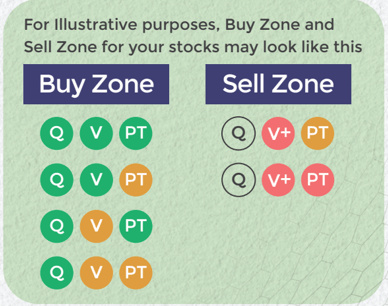
Buy quality Stocks when they are available at reasonable prices and supported by an upward price trend and Sell when they are Overvalued using the Decizen Rating System. Covers 3500+ stocks

|
Name of the IA registered
with SEBI: |
The Alchemists Ark Pvt. Ltd. |
|
Logo:
|

|
|
Trade/Brand
Name of IA: |
MoneyWorks4Me Investment Advisers |
|
Brand Logo:
|
 |
|
SEBI Registration Number:
|
INA000013323 Validity – May 16, 2019 – Perpetual |
|
Registration:
|
Non-Individual |
|
BSE Enlistment No:
|
1187 |
|
Address:
|
B-101, Signet Corner Building, Balewadi Phata, Baner, Pune, Maharashtra 411045 |
|
Compliance Officer
Details: |
Name: Shrikant Jagtap Email: shrikant.jagtap@moneyworks4me.com |
Telephone: +919860359463 Address: Same as IA |
|
Grievance Officer
Details: |
Name: Mukta Vaze Email: mukta.vaze@moneyworks4me.com |
Telephone: +919860919463 Address: Same as IA |
|
Principal Officer
Details: |
Name: Atharva Bhide Email: atharva.bhide@moneyworks4me.com |
Telephone: +919175899463 Address: Same as IA |
|
Standard Warning:
|
Investment in securities market are subject to market risks. Read all the related documents carefully before investing. |
|
|
Disclaimer:
|
Registration granted by SEBI, enlistment with exchange and certification from NISM in no way guarantee performance of the intermediary or provide any assurance of returns to investors. |
|