Indian stocks markets showed a volte-face on the first day of a new trading week as what started on a promising note ended as a dismal show. The optimism in domestic markets petered out completely by the end of trade and the benchmarks even drifted in to the negative territory to complete a hat-trick of negative closes despite getting off to a gap-up opening. Marketmen were optimistic for most part of the session as global sentiments remained upbeat and most markets in Asia rallied by around two percentage points underpinned by renewed hopes that decisive actions to save the Euro-zone nations from bankruptcy are underway and the damage emanating from the Euro zone debt crisis will be limited. However, the sanguinity in local markets was under check as profit booking in metal and rate sensitive Real Estate counters exerted downside pressure on the frontline indices and dragged them even below to the psychological 5,150 (Nifty) and 17,100 (Sensex) levels. Discouraging earnings announcement by heavyweights including M&M, LIC housing, RCom and disappointing WPI inflation numbers played the major role in pounding investors’ morale. October WPI figures showed that India's inflation rate edged closer to double digit mark in October, defying financial market forecasts and aggressive monetary tightening measures by RBI. The headline inflation was largely unchanged but was above the 9% mark for the eleventh straight month despite thirteen rate hikes by Indian central bank since March 2010. Investors’ sentiment were further dented by the end of trade as European markets dipped into the red terrain ahead of an auction of up to 3 billion euros of five-year Italian bonds that is likely to test investors' appetite for the country’s debt and could set the equity market's near-term direction.
Earlier on Dalal Street, the benchmark got off to a boisterous opening on hopes that new heads of governments in Greece and Italy will take actions in order to tackle the Euro-zone’s debt crisis. However, the bourses failed to capitalize on the early momentum and slipped to lower levels after worse than expected inflation data discouraged investors from taking large bets. The frontline indices kept losing momentum through the session and finally dipped into the negative terrain in the last leg of trade. Eventually the NSE’s 50-share broadly followed index Nifty, slipped by about half a percent to settle below the crucial 5,150 support level while Bombay Stock Exchange’s Sensitive Index Sensex deposed seventy four points and closed slightly above the psychological 17,100 mark. Moreover, the broader markets too succumbed to the selling pressure and went home with large cuts of over one and half a percent. On the BSE sectoral space, the high beta Realty index remained the top laggard in the space and settled with over two and half a percent laceration followed by the Metal and Consumer Durable pockets which went home with over two percent cuts. However, export driven software and technology counters remained the top gainers in the space with gains of around three fourth of a percent as optimism over easing Euro-zone tensions, lured investors. The defensive Healthcare index too did its bit in preventing the markets from drifting to lower levels. The markets plunged on weaker volumes of over Rs 1.2 lakh crore while the turnover for NSE F&O segment too remained on the lower side as compared to Friday at over 1 lakh core. The market breadth remained pessimistic as there were 865 shares on the gaining side against 1985 shares on the losing side while 94 shares remained unchanged.
Finally, the BSE Sensex lost 74.08 points or 0.43% to settle at 17,118.74, while the S&P CNX Nifty declined by 20.50 points or 0.40% to close 5,148.35.
The BSE Sensex touched a high and a low of 17,391.99 and 17,094.43 respectively. The BSE Mid cap and Small cap index down by 1.60% and 1.76% respectively.
The major gainers on the Sensex were Bharti Airtel up 2.48%, Hero MotoCorp up 1.67%, HDFC Bank up 1.45%, Sun Pharma up 1.30% and Wipro up 1.27%. While, Mahindra & Mahindra down 5.73%, Tata Steel down 4.03%, Maruti Suzuki down 2.96%, SBI down 2.48% and DLF down 2.30% were the major losers on the index.
The top gainers on the BSE sectoral space were TECk up 0.76%, IT up 0.68% and Health Care (HC) up 0.45%. While Realty down 2.56%, Metal down 2.16%, and Consumer Durables (CD) down 2.06%, Auto down 1.99% and Power down 1.86% were the major losers on the BSE sectoral space.
Meanwhile, India’s headline inflation measured by Wholesale Price Index (WPI) for the month of October saw marginally increase to 9.73% as compared to 9.72% in September; the headline inflation has been outriding above 9.7% mark since last three weeks. The marginal increase in prices of fuel and power (0.7%) and food articles (1.83%) on sequential basis are the main reasons for surge in inflation. However, primary articles and manufactured products saw marginal decline, they fell to 11.40% and 7.66% in October, compared to 11.84% and 7.69% in September.
According to the data released by the ministry of commerce and industry, the WPI for 'All Commodities' for the month October 2011 rose by 0.6% to 156.8 (Provisional) from 155.8 (Provisional) for the previous month. Build up inflation in the financial year so far was 4.88% compared to a buildup of 4.84% in the corresponding period of the previous year.
On the month on month basis the primary articles rose by 1.0 % to 204.3 (Provisional) from 202.2 (Provisional) for the previous month. The index for ‘Food Articles’ group rose by 2.2 % to 200.9 (Provisional) from 196.5 (Provisional) for the previous month due to higher prices of fish-inland (12%), gram (10%), condiments & spices (6%), fruits & vegetables (5 %), egg (3%), urad, masur, rice and arhar (2% each) and ragi, pork, moong, tea and milk (1% each). However, the prices of fish-marine (7%), poultry chicken and bajra (5% each), maize and jowar (4% each), barley and coffee (2% each) and wheat (1%) declined.
The index for ‘Non-Food Articles’ group declined by 3.0 % to 178.9 (Provisional) from 184.4 (Provisional) for the previous month due to lower prices of safflower (19%), castor seed (12%), soyabean (9%), flowers (8%), sunflower, raw jute, raw cotton and coir fibre (6% each), groundnut seed (4%), raw silk and copra (3% each) and rape & mustard seed and niger seed (1% each). However, the prices of gingelly seed (10%), gaur seed and linseed (3%) and fodder (1%) moved up.
The index for ‘Minerals’ group rose by 0.3 % to 307.0 (Provisional) from 306.1 (Provisional) for the previous month due to higher prices of steatite (15%), magnesite (7%), barytes (5%) and crude petroleum (3%). However, the prices of copper ore (12%), chromite (5%), bauxite and zinc concentrate (3% each), manganese ore (2%) and sillimanite and iron ore (1% each) declined.
The index for the Fuel and Power, which has weight of almost 15% in the WPI, rose by 1.0 % to 170.0 (Provisional) from 168.4 (Provisional) for the previous month due to higher prices of bitumen (5%), furnace oil (4%), naphtha and aviation turbine fuel (3% each), petrol and light diesel oil (2% each) and electricity (agricultural), electricity (domestic), electricity (commercial) and electricity (railway traction) (1% each). However, the prices of electricity (industry) (1%) declined.
The index for Manufactured Products, which has weight of almost 65% in the WPI, rose by 0.4 % to 139.1 (Provisional) from 138.6 (Provisional) for the previous month. Under this segment of WPI, the index for ‘Food Products’, the index for ‘Paper & Paper Products’, the index for ‘Leather & Leather Products’, the index for ‘Rubber & Plastic Products’, saw increase in prices during October compared to last month. However, the index for ‘Beverages, Tobacco & Tobacco Products’, the index for ‘Textiles’ registered decline in prices in October compared to month of September.
The current rate of inflation is serious matter of concern across all segments of economy. The latest inflation data is making a strong case for Reserve Bank of India (RBI) to maintain its anti-inflationary stance and there is good possibility that RBI may go for 14th hike in its short term lending and borrowing rates. The RBI has increased its key policy rates by 375 basis points in last 18 months to tame inflation, however has failed to do so.
On the other hand, the increased interest rate has affected the Indian Banking System, which saw an almost 33.46% increase in its bad loans during second quarter of 2011-12. The gross non-performing assets of 37 listed Indian Banks increased to 1.06 lakh crore in June to September 2011 compared to Rs 79,078 in June to September 2010. This huge surge in gross NPA of Indian banks is mainly because of the non-stop hike in RBI’s key policy rates.
However on many occasions, RBI has hinted that, it may take pause in interest rate hike cycle only if inflation moderates from December. However, latest data indicates that the inflation is less likely to show any sign of moderation from its current rate.
The S&P CNX Nifty touched a high and low of 5,228.90 and 5,140.55, respectively.
The top gainers on the Nifty were Ranbaxy up 3.34%, Bharti Airtel up 2.38%, Hero MotoCorp up 1.71%, HDFC Bank up 1.59% and Dr Reddy up 1.58%. On the flip side, Reliance Infra down 7.55%, Reliance Power down 6.85%, M&M down 6.11%, Tata Steel down 3.80% and Maruti Suzuki down 3.28% were the top losers on the index.
The European markets were trading in red. France's CAC 40 down 0.83%, Britain's FTSE 100 down by 0.09%, and Germany's DAX down by 0.27%.
Expanding their previous session’s rally, Asian markets exhibited a joyful day of trade on Monday and major indices in the region snapped the session with a gain of over 1-2 percent as Italy’s new leader promised to pull the debt-ridden country back from the edge of a fiscal catastrophe that has endangered to tear the euro-zone. Italian lawmakers on Saturday approved a package of economic reforms that Berlusconi set as the precondition for his resignation amid global market turmoil.
Moreover, investors also cheered the Japanese Gross Domestic Product (GDP) data which grew for the first time in four quarters, recovering from the devastating earthquake-cum-tsunami in March on the back of strong exports and domestic consumer spending. The country’s GDP grew at an annualized pace of 6% in the three months ending September 30, the fastest pace in one-and-a-half-year. Economists had forecast an increase of 5.9%. On a quarter-on-quarter basis, Japan’s GDP grew by 1.5% in the fiscal third quarter.
Asian Indices | Last Trade | Change in Points | Change in % |
Shanghai Composite | 2,528.71 | 47.63 | 1.92 |
Hang Seng | 19,508.18 | 371.01 | 1.94 |
Jakarta Composite | 3,833.04 | 54.16 | 1.43 |
KLSE Composite | 1,478.87 | 10.12 | 0.69 |
Nikkei 225 | 8,603.70 | 89.23 | 1.05 |
Straits Times | 2,830.14 | 39.20 | 1.40 |
Seoul Composite | 1,902.81 | 39.36 | 2.11 |
Taiwan Weighted | 7,525.65 | 158.36 | 2.15 |
Start Research-backed Investing ...Now. Subscribe to Sapphire
MoneyWorks4Me is a SEBI-registered Investment Adviser (IA) dedicated to helping investors build long-term wealth through transparent, research-driven, conflict-free guidance. Founded in 2008, we started our journey as a Research Analyst (RA), providing deep fundamental analysis, intrinsic value insights, and long-term investing frameworks for Indian equities. In 2017, we transitioned to a full-fledged SEBI-registered Investment Adviser, strengthening our commitment to acting as a fiduciary—always putting the investor’s interest first.
To become India’s most trusted, research-powered fiduciary advisory platform—where every investor, regardless of experience, can make calm, confident, and well-reasoned investment decisions.
MoneyWorks4Me ensures this through:

MoneyWorks4Me rating and ranking of funds for SIP is available to subscribers only. Moneyworks4Me is not a rating and ranking agency, however it is required that users have a way of selecting funds and building a Portfolio. The method used by it are described below to enable users to understand the logic behind the rating and ranking Subscriber will find more details on this in the various content made available from time to time. In case you need more please write to besafe@moneyworks4Me.com
MoneyWorks4Me rates and ranks mutual funds based on the following data-driven system:
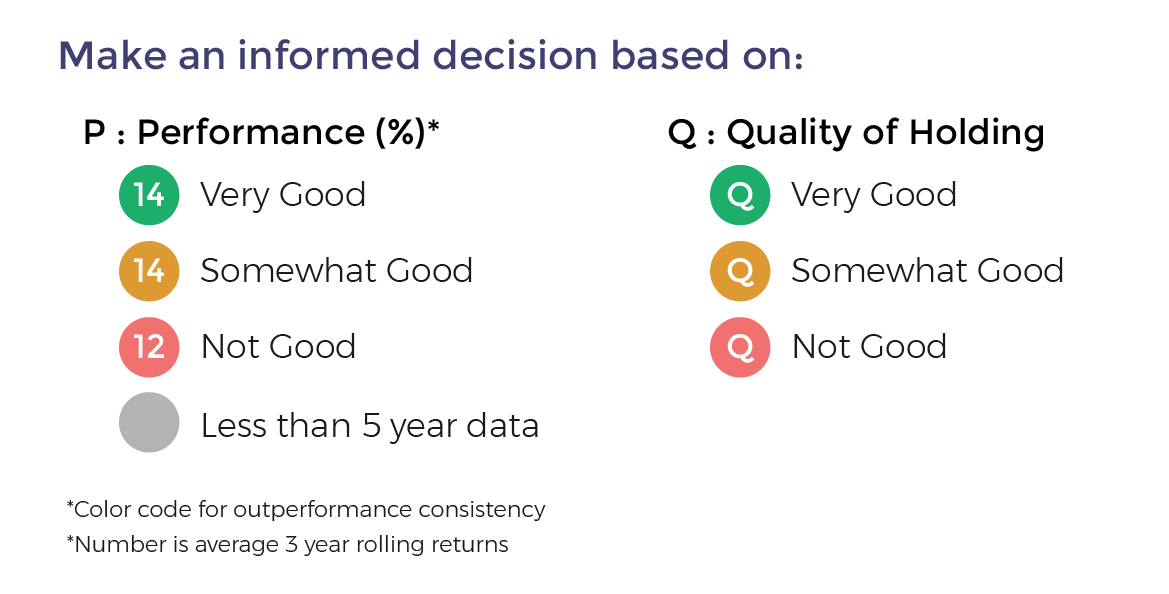
Funds ranking in screeners: Performance Consistency and Quality are two parameters used for ranking funds for SIP. The ranking as follows GG, GO, GR, OG, OO, OR, RG, RO and RR.
With the same color-coded funds, the one with the higher Average 3-year rolling returns (over 5 to 10 years), the number that appears in the Performance tag, ranks higher.
Here is the summary:
The third tag Upside Potential is not relevant for SIP. It is relevant for lumpsum investments in Mutual Funds.
Make an informed decision for Stocks
Invest using an intelligent system with powerful data-driven tools that help you identify opportunities and make informed buy-hold-sell decisions
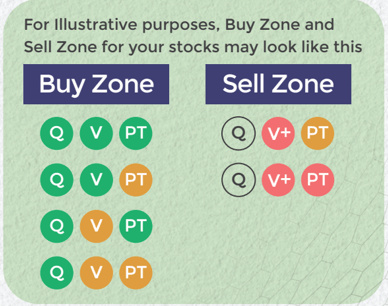
Buy quality Stocks when they are available at reasonable prices and supported by an upward price trend and Sell when they are Overvalued using the Decizen Rating System. Covers 3500+ stocks

|
Name of the IA registered
with SEBI: |
The Alchemists Ark Pvt. Ltd. |
|
Logo:
|

|
|
Trade/Brand
Name of IA: |
MoneyWorks4Me Investment Advisers |
|
Brand Logo:
|
 |
|
SEBI Registration Number:
|
INA000013323 Validity – May 16, 2019 – Perpetual |
|
Registration:
|
Non-Individual |
|
BSE Enlistment No:
|
1187 |
|
Address:
|
B-101, Signet Corner Building, Balewadi Phata, Baner, Pune, Maharashtra 411045 |
|
Compliance Officer
Details: |
Name: Shrikant Jagtap Email: shrikant.jagtap@moneyworks4me.com |
Telephone: +919860359463 Address: Same as IA |
|
Grievance Officer
Details: |
Name: Mukta Vaze Email: mukta.vaze@moneyworks4me.com |
Telephone: +919860919463 Address: Same as IA |
|
Principal Officer
Details: |
Name: Atharva Bhide Email: atharva.bhide@moneyworks4me.com |
Telephone: +919175899463 Address: Same as IA |
|
Standard Warning:
|
Investment in securities market are subject to market risks. Read all the related documents carefully before investing. |
|
|
Disclaimer:
|
Registration granted by SEBI, enlistment with exchange and certification from NISM in no way guarantee performance of the intermediary or provide any assurance of returns to investors. |
|