Indian equity markets closed in negative territory on Friday amid renewed concerns over the Strait of Hormuz. Sentiment remained downbeat after Iran reportedly struck ‘hostile targets’ in the strategic waterway and stated that its agreement with Oman to manage maritime traffic would not fully reopen the vital global trade route.
The BSE Sensex closed over half a percent lower, dragged down by losses in banking stocks where ICICI Bank was down by over three percent. Selling in financial stocks, too dampened traders' sentiment as the Reserve Bank of India issued draft amendment directions on credit facilities for non-bank lenders (NBFCs). The draft amendment direction proposes a ban on revolving credit facilities by these NBFCs.
Similarly, the Nifty 50 ended over quarter a percent cut as financial stocks and banking heavyweight witnessed selling pressure. However, buying in IT and auto stocks provided some support to Nifty. Auto stocks reported a decent sales number for the month of July.
Some of the important factors in trade:
Govt's capital expenditure push encourages private sector investment: Traders overlooked Finance Minister Nirmala Sitharaman's statement that the government's sustained capital expenditure push over the years has encouraged private sector investment, with companies now taking on greater risks to capitalise on India's growth momentum.
India makes no commitment on US ethanol imports for fuel blending under trade talks: Traders took note of report that the commerce and industry ministry has clarified that no concessions or commitments have been made regarding the import of ethanol from the United States (US) for fuel blending as part of the ongoing India-US trade negotiations.
Auto stocks remained in watch: Federation of Automobile Dealers Associations (FADA) has said that India’s total automobile retail sales surged 25.89 per cent year-on-year to 25,91,138 units in July 2026 as compared with 20,58,325 units in the corresponding month last year.
On the global front: European markets were trading in green, as investors kept an eye on oil prices and awaited the U.S. jobs report later in the day. Asian markets closed mostly lower amid uncertainty over a potential U.S.-Iran agreement to reopen the Strait of Hormuz.
The BSE Sensex ended at 78499.17, down by 455.59 points or 0.58% after trading in a range of 78377.07 and 78757.40. There were 14 stocks advancing against 16 stocks declining on the index. (Provisional)
The top gaining sectoral indices on the BSE were Auto up by 1.33%, IT up by 1.16%, TECK up by 0.75%, Healthcare up by 0.50% and Telecom up by 0.40%, while Consumer Durables down by 0.90%, Oil & Gas down by 0.63%, Bankex down by 0.61%, Realty down by 0.44%, and Energy down by 0.28% were top losing indices on BSE. (Provisional)
The top gainers on the Sensex were TCS up by 3.53%, Mahindra & Mahindra up by 2.53%, State Bank of India up by 1.03%, Tech Mahindra up by 0.91% and Bharat Electronics up by 0.74%. On the flip side, Bajaj Finance down by 5.90%, Bajaj Finserv down by 4.18%, ICICI Bank down by 3.72%, Trent down by 3.54% and Axis Bank down by 1.20% were the top losers. (Provisional)
Meanwhile, despite higher input cost, Crisil Ratings has said that primary steel makers are likely to maintain operating profitability of Rs 10,500-11,000 per tonne in the current fiscal (FY27), supported by higher global steel prices and effect of the safeguard duty imposed last year. Favourable pricing, coupled with healthy demand growth, is expected to strengthen cash accruals and support capex requirements while sustaining stable credit profiles.
Amid higher coking coal prices and elevated logistics and energy costs, the cost of production for primary steel producers - producers of steel predominantly through BF-BOF (blast furnace-basic oxygen furnace) route is estimated to increase by around Rs 2,000 per tonne this fiscal, to Rs 53,000 - 54,000 per tonne. Crisil added that coking coal, which accounts for nearly 40% of production costs, is expected to become 5-7% costlier amid potential supply disruptions in key exporting regions and sustained demand from major steel producing countries. Besides, higher freight, shipping and insurance costs, along with elevated power and fuel expenses, will further add to cost pressures.
However, the rising cost pressures are expected to offset by higher steel prices, continued protection under the 11.5% safeguard duty and healthy domestic demand growth, keeping profitability steady. Crisil expects domestic steel prices to increase by 6-8% in this fiscal. It added that domestic steel demand is expected to remain healthy, growing 5-7% this fiscal on the high base of fiscal 2026, supported by sustained investments in infrastructure and robust demand from the automotive, engineering and construction sectors.
The CNX Nifty ended at 24570.65, down by 65.35 points or 0.27% after trading in a range of 24522.75 and 24630.40. There were 23 stocks advancing against 27 stocks declining on the index. (Provisional)
The top gainers on Nifty were TCS up by 3.36%, Grasim Industries up by 3.20%, Hindalco Industries up by 3.17%, Mahindra & Mahindra up by 2.82% and HCL Technologies up by 1.62%. On the flip side, Bajaj Finance down by 5.84%, Bajaj Finserv down by 3.70%, Trent down by 3.54%, ICICI Bank down by 2.50% and JIO Financial Services down by 2.39% were the top losers. (Provisional)
European markets were trading higher; Germany’s DAX gained 206.27 points or 0.79% to 26,346.40, UK’s FTSE 100 increased 65.52 points or 0.6% to 10,933.41 and France’s CAC rose 28.59 points or 0.33% to 8,728.30.
Asian markets ended mixed on Friday as investors awaited the crucial US non-farm payrolls report to be released later in the day that could prove pivotal for next month's interest-rate decision by the Federal Reserve. Meanwhile, uncertainty over a possible agreement between the United States and Iran to reopen the Strait of Hormuz also kept markets cautious. Chinese shares gained after customs data showed that China's exports in July grew 23.9% from a year earlier in US dollar value terms, slowing from ?a 27% surge in the previous month, while imports rose 27.5%. Japanese shares declined due to declines in artificial intelligence and chip-related stocks.
Asian Indices | Last Trade | Change in Points | Change in % |
Shanghai Composite | 3,940.04 | 39.69 | 1.02 |
Hang Seng | 25,668.03 | 137.75 | 0.54 |
Jakarta Composite | 6,399.10 | 55.39 | 0.87 |
KLSE Composite | 1,735.75 | -1.40 | -0.08 |
Nikkei 225 | 65,606.71 | -76.55 | -0.12 |
Straits Times | 5,698.43 | 59.44 | 1.05 |
KOSPI Composite | 6,258.77 | -37.61 | -0.60 |
Taiwan Weighted | 44,225.91 | -170.79 | -0.38 |
Start Research-backed Investing ...Now. Subscribe to Sapphire
MoneyWorks4Me is a SEBI-registered Investment Adviser (IA) dedicated to helping investors build long-term wealth through transparent, research-driven, conflict-free guidance. Founded in 2008, we started our journey as a Research Analyst (RA), providing deep fundamental analysis, intrinsic value insights, and long-term investing frameworks for Indian equities. In 2017, we transitioned to a full-fledged SEBI-registered Investment Adviser, strengthening our commitment to acting as a fiduciary—always putting the investor’s interest first.
To become India’s most trusted, research-powered fiduciary advisory platform—where every investor, regardless of experience, can make calm, confident, and well-reasoned investment decisions.
MoneyWorks4Me ensures this through:

MoneyWorks4Me rating and ranking of funds for SIP is available to subscribers only. Moneyworks4Me is not a rating and ranking agency, however it is required that users have a way of selecting funds and building a Portfolio. The method used by it are described below to enable users to understand the logic behind the rating and ranking Subscriber will find more details on this in the various content made available from time to time. In case you need more please write to besafe@moneyworks4Me.com
MoneyWorks4Me rates and ranks mutual funds based on the following data-driven system:
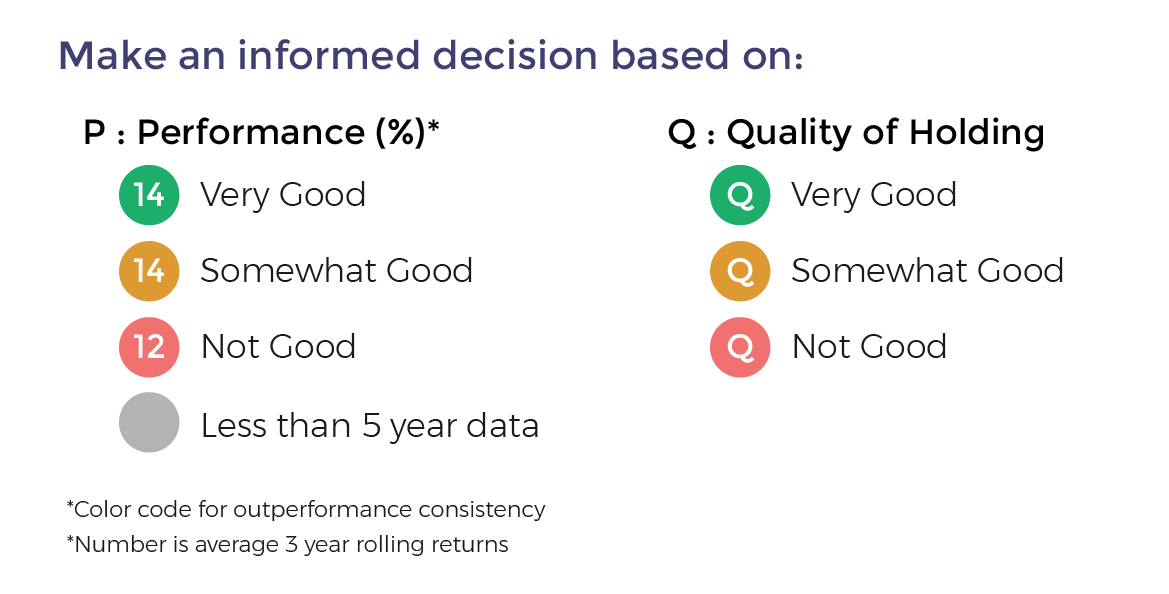
Funds ranking in screeners: Performance Consistency and Quality are two parameters used for ranking funds for SIP. The ranking as follows GG, GO, GR, OG, OO, OR, RG, RO and RR.
With the same color-coded funds, the one with the higher Average 3-year rolling returns (over 5 to 10 years), the number that appears in the Performance tag, ranks higher.
Here is the summary:
The third tag Upside Potential is not relevant for SIP. It is relevant for lumpsum investments in Mutual Funds.
Make an informed decision for Stocks
Invest using an intelligent system with powerful data-driven tools that help you identify opportunities and make informed buy-hold-sell decisions
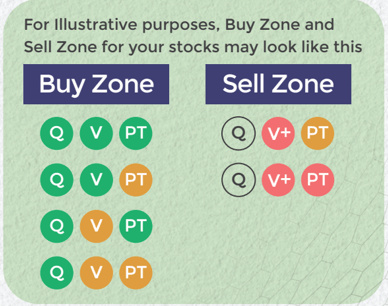
Buy quality Stocks when they are available at reasonable prices and supported by an upward price trend and Sell when they are Overvalued using the Decizen Rating System. Covers 3500+ stocks

|
Name of the IA registered
with SEBI: |
The Alchemists Ark Pvt. Ltd. |
|
Logo:
|

|
|
Trade/Brand
Name of IA: |
MoneyWorks4Me Investment Advisers |
|
Brand Logo:
|
 |
|
SEBI Registration Number:
|
INA000013323 Validity – May 16, 2019 – Perpetual |
|
Registration:
|
Non-Individual |
|
BSE Enlistment No:
|
1187 |
|
Address:
|
B-101, Signet Corner Building, Balewadi Phata, Baner, Pune, Maharashtra 411045 |
|
Compliance Officer
Details: |
Name: Shrikant Jagtap Email: shrikant.jagtap@moneyworks4me.com |
Telephone: +919860359463 Address: Same as IA |
|
Grievance Officer
Details: |
Name: Mukta Vaze Email: mukta.vaze@moneyworks4me.com |
Telephone: +919860919463 Address: Same as IA |
|
Principal Officer
Details: |
Name: Atharva Bhide Email: atharva.bhide@moneyworks4me.com |
Telephone: +919175899463 Address: Same as IA |
|
Standard Warning:
|
Investment in securities market are subject to market risks. Read all the related documents carefully before investing. |
|
|
Disclaimer:
|
Registration granted by SEBI, enlistment with exchange and certification from NISM in no way guarantee performance of the intermediary or provide any assurance of returns to investors. |
|