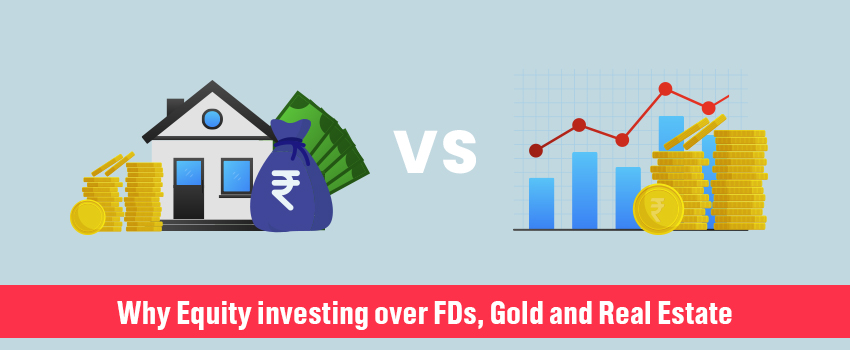
Equity vs FDs, gold and real estate is a comparison most investors eventually face when deciding how to allocate their savings. Traditional assets such as fixed deposits, gold, and real estate are often seen as safe and reliable, which makes them the default choice. However, when the objective shifts from preserving money to building real wealth, the comparison begins to change. The question is no longer about safety alone, but about which asset class can deliver meaningful growth over time.
Understanding equity vs FDs, gold and real estate requires looking at how each asset behaves across long investment horizons, especially after adjusting for inflation and costs.
Equity vs FDs, Gold and Real Estate: The Difference in Wealth Creation
The most important distinction in equity vs FDs, gold and real estate lies in their ability to create wealth.
Equities represent ownership in businesses. As businesses grow, generate profits, and expand, investors benefit from rising valuations and earnings growth. This creates a direct link between economic progress and investment returns.
In contrast, fixed deposits provide fixed returns, gold acts primarily as a store of value, and real estate depends on price appreciation and rental yield. While these assets offer stability, they often lack the ability to compound wealth at a meaningful rate over long periods.
Equity vs FDs: Growth Versus Stability
In the equity vs FDs comparison, the trade-off is between growth and stability.
Fixed deposits offer predictable returns, which makes them suitable for capital preservation. However, these returns are usually close to inflation, which limits real wealth creation.
Equities, despite short-term volatility, have historically delivered higher returns over long periods. This difference becomes significant when compounded over decades.
Equity vs FDs ultimately comes down to whether the objective is to protect capital or to grow it meaningfully.
Equity vs Gold: Store of Value Versus Growth Asset
In the equity vs gold comparison, the distinction lies in purpose.
Gold is traditionally used as a hedge against uncertainty and inflation. It tends to perform well during periods of economic stress but does not generate income or earnings.
Equities, on the other hand, are linked to productive economic activity. Companies create value by generating profits and reinvesting for growth, which drives long-term returns.
Equity vs gold highlights the difference between preserving purchasing power and actively growing wealth.
Equity vs Real Estate: Liquidity and Efficiency
The equity vs real estate comparison often revolves around tangibility versus efficiency.
Real estate is a physical asset that provides stability and, in some cases, rental income. However, it comes with high transaction costs, limited liquidity, and concentration risk.
Equities offer significantly greater liquidity. Investors can enter or exit positions quickly, adjust portfolios easily, and diversify across sectors without large capital requirements.
Equity vs real estate shows how flexibility and efficiency can play a crucial role in long-term investing outcomes.
Diversification Advantage
Diversification is a key factor in managing risk, and this is where equities stand out in the equity vs FDs, gold and real estate comparison.
Through diversified portfolios and mutual funds, investors can gain exposure to a wide range of companies and sectors. This reduces dependence on any single investment.
Traditional assets often lack this flexibility. A single property or a large allocation to gold can create concentration risk.
Equity vs FDs, gold and real estate clearly demonstrates that diversification is easier to achieve within equities.
Inflation Impact
Inflation is one of the biggest risks to long-term wealth.
In the equity vs FDs, gold and real estate comparison, equities have historically provided better protection against inflation. As the economy grows, companies increase prices, revenues rise, and profits expand, which supports stock prices.
Fixed deposits often struggle to beat inflation consistently. Gold may protect purchasing power, but does not generate real growth. Real estate returns can vary significantly depending on location and market cycles.
Equity vs FDs, gold and real estate highlights that inflation protection alone is not enough, growth is equally important.
The Role of Time Horizon
The advantage of equities becomes clearer over longer time horizons.
Short-term volatility is a natural part of equity investing, but its impact reduces as the investment period increases. Over longer durations, the compounding effect of higher returns becomes dominant.
In the equity vs FDs, gold and real estate comparison, equities consistently outperform other asset classes when held over extended periods.
This makes time horizon a critical factor in determining the effectiveness of each investment option.
The Bottom Line
Equity vs FDs, gold and real estate is not just a comparison of returns, but a comparison of purpose.
Traditional assets provide stability and familiarity, but often fall short in creating long-term wealth. Equities, despite volatility, offer growth, diversification, liquidity, and alignment with economic expansion.
For investors aiming to build meaningful wealth over time, equities play a central role in portfolio construction.
At MoneyWorks4Me, the focus is on helping investors build portfolios that combine growth, discipline, and long-term sustainability.
In conclusion, you can easily see who the winner in the long run is. Nevertheless, the debate of equity investing vs. FDs, gold, and real estate investing is never-ending, there is no one-size-fits-all answer. Each option has its advantages and drawbacks, and the right choice depends on your financial goals, risk tolerance, and investment horizon. Equity investments offer the potential for high returns but come with higher volatility and risk. FDs provide safety and stability but may offer lower returns. Gold and real estate can act as hedges against inflation and provide diversification but compound slower than equity.
Diversifying your investment portfolio across these asset classes can help balance your risk and return. Consulting with your investment advisor to create a well-rounded investment strategy that aligns with your specific goals is often the best approach. Ultimately, the key is to strike a balance that suits your individual financial circumstances and long-term objectives.
Regardless of your current life stage, you need to hold equity for creating wealth in the long run. Period. There is no alternative. The extent of equity exposure varies based on the risk-taking ability. At Moneyworks4me, we assist you in building a long-term portfolio that aligns with your financial objectives, enabling you to work towards achieving them.
You can visit our site moneyworks4me.com for investment-related solutions and don’t hesitate to consult with our investment adviser.