 Rushikesh Bhise
This article covers the following:
The notorious scam of 1992, an equivalent of Rs. 20,000 Cr today, committed by Harshad Mehta was brought to light and one of the biggest stock market events in the Indian Stock Market. A systematic stock rigging was done by Harshad Mehta by earlier using bank receipts and later using institutional funds to buy stocks in the Bombay Stock Exchange. It involved who’s who, including politicians.
After almost 28 years of this episode, Harshad Mehta is again the talk of the town after a critically acclaimed web series called Scam 1992: The Harshad Mehta Story based on the book-The Scam: Who Won, who Lost, who Got Away by Sucheta Dalal.
Bull market rally of 1992 and subsequent bust will remain the most memorable episode of greed and money-grubbing for the Indian stock market. For US, it was the Nasdaq Bubble of 2000.
Few large brokers, including Mehta, had the power of snowballing or pounding the stock market by buying or selling in unison through several client accounts, backed by liquidity from banks or short term funds available with brokers.
Harshad Mehta deployed more than Rs 1,000 crore and triggered the biggest bull-run in the relatively closed and low liquidity Indian stock market. The Sensex rose from by a huge percentage from 1990 to 1992, of which Jan’92 to April’92 it rallied from ~2,000 points to 4,467 points. By August it tanked to 2,529 points, wiping out over Rs 100,000 crore in market capitalisation.
There were several companies whose shares were bought and pumped to high levels without fundamentals or future prospects explaining the rise in prices.
Here are a few of the companies popularly associated with Harshad Mehta during his prime which eventually declined to their real values after the crash.
1. ACC (Associated Cement Company)
ACC is India’s foremost manufacturer of cement and concrete and was established in August 1936. The stock price of ACC witnessed an artificially created abnormal price rise. Using bank funds meant for debt securities purchased in the broker’s account, Mehta took the price of ACC from ₹200 to ₹9,000 in a short span of time. The price of ACC had risen to more than 70x of its earnings which is unusual for a company from this sector. The stock tumbled as he sold the stock triggering a market crash.
Today ACC is owned by Ambuja, which is part of Swiss cement major Holcim (now LafargeHolcim) acquired in 2004.
2. Mazda Industries & Leasing
Mazda Industries & Leasing (MILL) was incorporated in Nov.’83. The company was into the business of leasing and hire-purchase, finance of plant and machinery, equipment and vehicles, immovable properties.
In 1987, MILL diversified into activities like setting up an engineering division to manufacture hydraulic systems and further entered in the business of the real estate. In the heady days of early 1992, Mazda became Harshad Mehta’s legendary company and shot up to Rs 1,600 from Rs 20, pushing the index to dizzying heights. It was such a crazy phase that when it was revealed that Mehta had invested in Mazda, the prices of some other companies that had ‘Mazda’ in their name went up too! There was no fundamental story backing such a meteoric rise in stock price.
The stock fell back to Rs. 75 by the end of 1994 in December after the scam was exposed in April. The company is not listed anymore on the exchanges.
3. Apollo Tyres (resembles present-day Apollo Tyres)
Harshad Mehta got a ~5% stake in the company and cornered more shares on behalf of clients. He would later pledge the same in banks to buy more shares of other companies. The stock price of the company was Rs. 28 in Jan 1991, and it rose up to Rs.510 in March 1992, later it crashed 90% from the peak. In 2011, Supreme Court redirected Apollo Tyres to return ~5% Harshad Mehta stake which was bought by the Kanwar family, the promoters, from custodian after the scam was exposed.
In addition to the names above, there are several other names like Tata Iron and Steel, BPL, Videocon, etc. which rose to the peak because of the built-up positive story due to Harshad Mehta’s name attached to it. All of these nosedived as the scam was exposed wiping off the fortunes of all but majorly denting perceptions of retail investors towards markets.
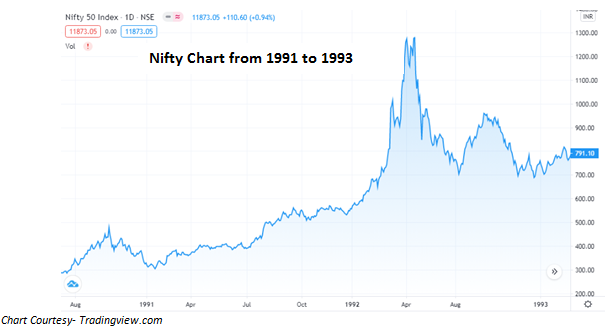

Was Harshad Mehta kind of Bull Run and Crash the first and last?
Bull markets are born on pessimism, grown on scepticism, mature on optimism, and die on euphoria. – John Templeton
Harshad Mehta scam was one such extreme scenario where the stock prices and index were inflated to unprecedented levels without any fundamental reason behind it.
Although there was a positive backdrop from the rollout of LPG reforms- Liberalisation, Privatisation & Globalisation in 1991 that would have justified such a rise in Indian stock markets.
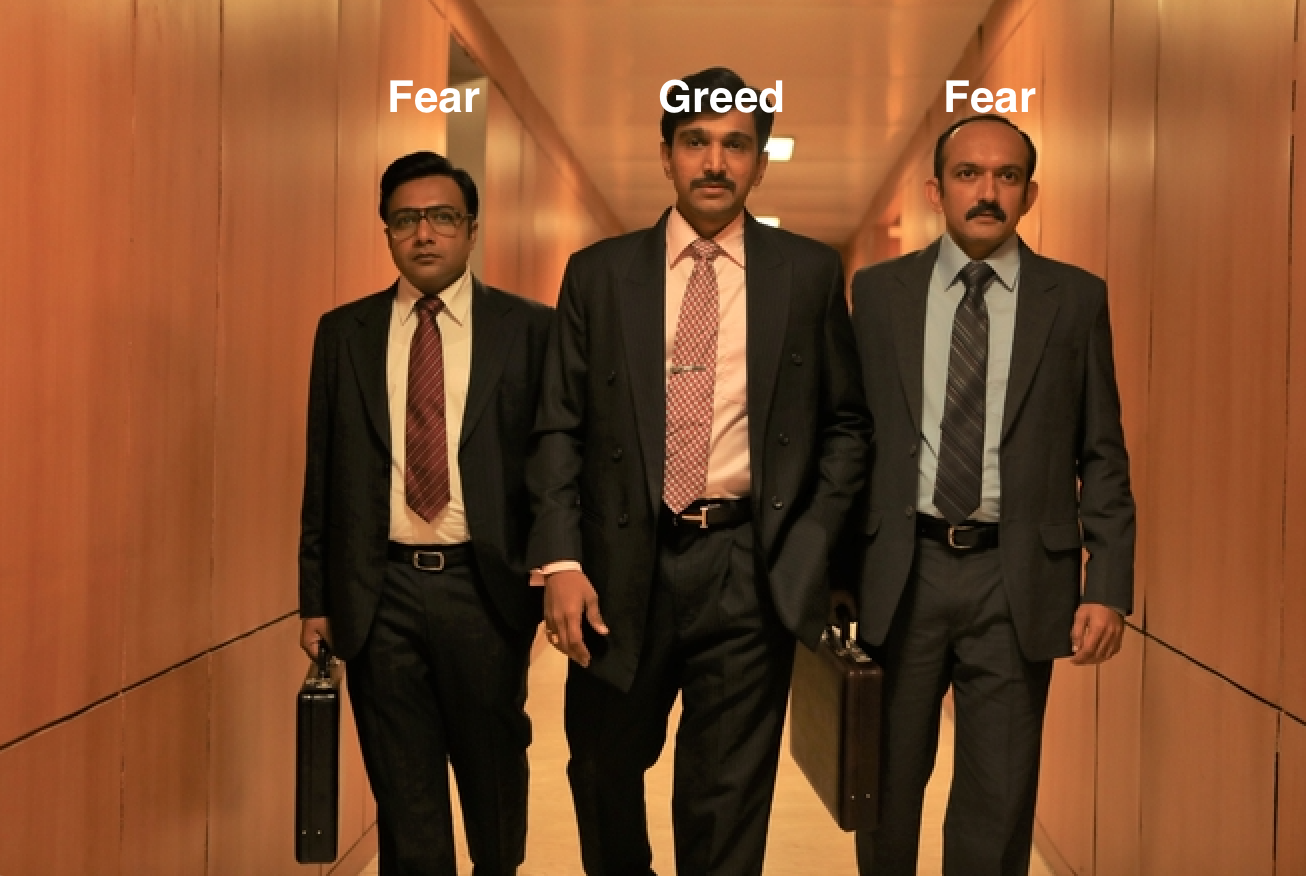
TV Series: 1992 Scam; Movie showed HM was greedy but HM’s partners were Fearful
Even without a scam, the market has shown such irrationality every few years as investors forget risks and extrapolate good days/stories long into the future.
Few such Boom and Bust events which started with fundamental growth but got extrapolated too much into the future. Stock prices rallied too much, too soon to result in bust eventually.
2000 Dot Com Bubble and its effect on Indian IT Companies
The emergence of the internet, move towards digitisation was revolutionary in the late 90s. As corporates globally were moving data to electronic form and storage, India IT services were at the forefront for this transformation experiencing exponential growth. This was further fuelled by the low-interest rates of the Federal Reserve of the US when it bailed out LTCM leading to ample liquidity in the market that found a way into emerging markets including India.
High liquidity and extrapolation of growth long into the future led investors to chase stocks at higher prices irrespective of actual growth in business prospects.
An increase in the fed funds rate led to the reversal of FII funds from emerging markets and Equity in 2000 leading to bust. During this period, business prospects didn’t change much and IT companies kept growing albeit at more reasonable growth versus earlier.
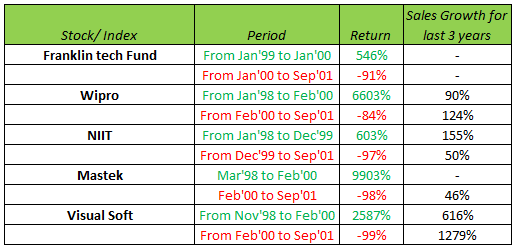
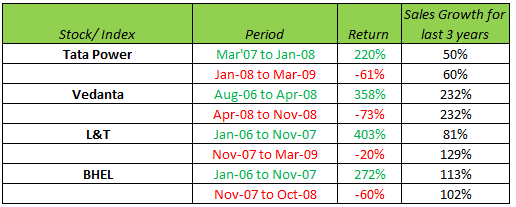
2007 Infra & Utilities Boom and Leading Companies of that Cycle
During 2006-07 China was growing massively, investing in its infrastructure and leading to growth in global commodity prices. Commodity prices growth led to the growth in India’s mining and infrastructure sector.
Higher inflation and low-interest rate incentivized the companies to add more capacity using higher leverage and also individuals to borrow and buy multiple properties.
US Banking crisis from mortgage loan defaults led to liquidity getting sucked out of emerging markets.
NBFC Boom & Bust
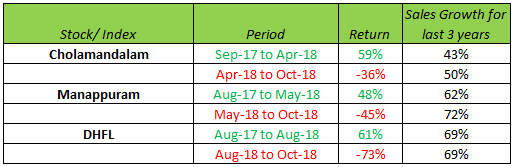
The lower interest rate in short term and lending at the higher interest rate for the long term led to high growth for NBFCs in 2010-18. The assumption of a healthy liquidity environment to remain made NBFC reckless to grow their balance sheet without worrying about rolling over short term debt. But as IL&FS default came to light, risk aversion of bankers and MFs led to the lack of liquidity for NBFCs for rollover of short-term debt and losing the plot for growth. This led to a sharp drop in discretionary consumption as NBFCs are one of the largest financiers for Auto, consumption, and housing.
Next boom? Chemicals? Consumption? We won’t know for sure
Despite slow growth in India, low-interest rates globally led to FII inflow and booming narrow markets. These funds went on buying into quality names for whatever growth versus no/low growth in the rest of the market. Offlate, China’s stringent actions to curb pollution lead to more opportunities for Indian API and Chemicals companies. These improved prospects have led to a steep rise in prices of these stocks, with sales growth lagging stock price growth.
A similar trend in consumption stocks where the consumption story seems to be extrapolated beyond the sales growth of these companies.
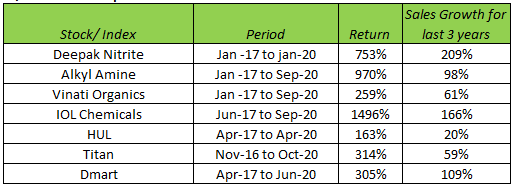
Now, it remains to be seen if the earnings catch up with the stock price. For now, they appear quite extended beyond their current fundamental growth, so worth avoiding until the earning growth catches up.

What do we learn here?
Bull run often starts with few companies doing well. They hold promise for the future and large potential. Consistency of performance and positive surprises in quarterly results makes analysts and investors more confident to extrapolate good days way into the future. Few companies stocks during the Tech Boom of 2000 got so extended that it would need all 7 billion people in the world to use their products PC/servers/eCommerce to justify stock prices.
Even if underlying companies are good and have a decent growth rate, greed leads to overpaying for those stocks. Even good companies can’t fulfill such tall expectations of investors, leading to wealth erosion for investors. This is the story of every cycle we discussed above starting from the dot com bubble to the NBFC liquidity crisis.
You’re dealing with a lot of silly people in the marketplace; it’s like a great big casino and everyone else is boozing. If you can stick with Pepsi, you should be OK. – Warren Buffett
It is wise to keep an eye out for the segment of the market where the growth is extrapolated, and there is a lot of hysteria around it. The stock prices in long run reflect only the business growth, so it’s prudent to avoid/reduce exposure to stocks that have risen significantly versus their sales/profit growth. This will help you avoid wealth destruction when a bubble bursts.
So next time Harshad Mehta comes to market, instead of hero-worship, follow the above rule to escape large wealth erosion.
If you liked what you read and would like to put it in to practice Register at MoneyWorks4me.com. You will get amazing FREE features that will enable you to invest in Stocks and Mutual Funds the right way.


Need help on Investing? And more….Puchho Befikar

Kyunki yeh paise ka mamala hai
Start Chat | Request a Callback | Call 020 6725 8333 | WhatsApp 8055769463


 Ketan Pitrubhakta
 Raymond Moses - Founder, MoneyWorks4me
 Ketan Gujarathi