In India’s vast textile and apparel market, the innerwear industry remains one of its most essential yet understated segments, combining everyday necessity with rising consumer aspirations. Valued at Rs. 61,091 crores in 2023, the Indian innerwear market is expected to reach Rs. 75,466 crores by 2025, growing at an estimated CAGR of 11%. This growth is being driven by increasing brand awareness, premiumisation, and higher spending on comfort and lifestyle products.
The listed market is led by players such as Page Industries (Jockey), Lux Industries, Dollar Industries, and Rupa & Company, while strong unlisted competitors include JG Hosiery (Macho), Dixcy Textiles (Dixcy Scott), and V-Star. While many of these brands have expanded into women’s innerwear and athleisure, men’s innerwear continues to remain the largest contributor to revenue and profitability, making it the primary focus area for industry analysis.
A major structural feature of the Indian innerwear industry is the dominance of the unorganised segment, which still accounts for nearly 60% of the total market. These smaller players may lack brand strength, scale, and widespread distribution, but their presence in lower-income and highly price-sensitive markets creates competitive pressure for larger organised brands, especially in the economy segment.
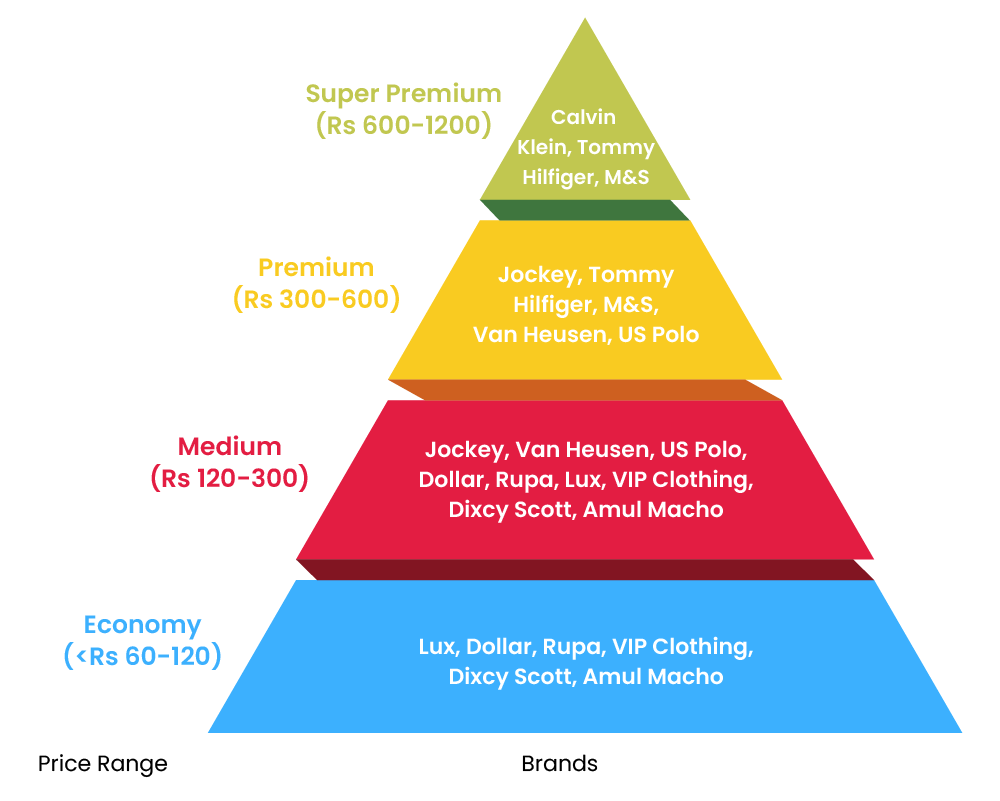
The Indian innerwear market can also be divided across multiple price categories, with each segment catering to different consumer demographics. At the premium end are international brands such as Calvin Klein and Marks & Spencer, where average product pricing exceeds Rs. 600 per item. The premium domestic segment includes brands such as Jockey, US Polo, and Van Heusen, typically priced between Rs. 300 and Rs. 600. Meanwhile, the economy segment is dominated by brands such as VIP, Lux, Rupa, Dollar, and Amul Macho, while the medium segment bridges the gap between premium and economy offerings. Many companies strategically operate across multiple segments through sub-branding, allowing them to target a wider consumer base while balancing affordability with aspiration.
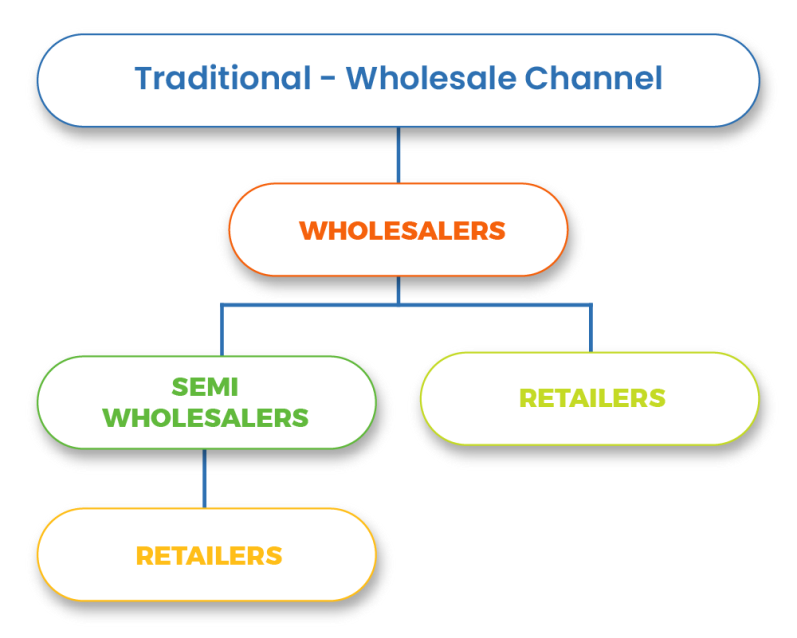
To understand the innerwear industry’s value chain, it is important to first distinguish between wholesalers and distributors. In a wholesale model, wholesalers purchase goods from the company at a fixed price and largely control retailer pricing, giving companies limited visibility into end-level sales. In contrast, the distributor model offers distributors a fixed margin while the company controls retailer margins, allowing far better tracking of retail sales and stronger supply chain control. This distributor-led approach, already common in FMCG, is increasingly expected to become the standard in the innerwear industry as brands seek greater efficiency and visibility.

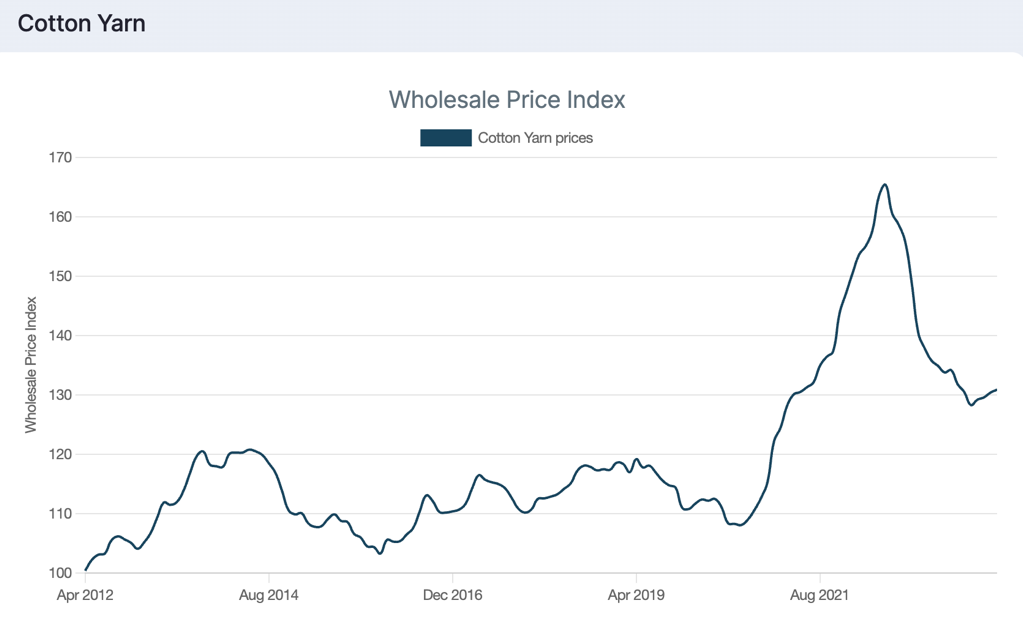
Competition in the economy and medium segments of the innerwear industry remains intense due to the presence of both organised and unorganised players. Unorganised players, often supported by strong local distribution networks, primarily compete on pricing, making it difficult for organised brands to command significant premiums. Their widespread presence in price-sensitive markets also slows product upgradation, as consumers may prioritise affordability over branding or quality improvements.
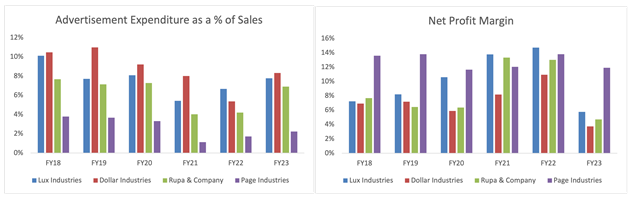
At the same time, organised players compete aggressively for consumer mind share through advertising, celebrity endorsements, and promotional spending. This constant battle for visibility increases operating costs and puts pressure on margins, particularly in crowded segments where differentiation is limited. As a result, brands that can sustainably reduce advertisement spends while maintaining strong recall and customer loyalty often achieve better profitability than peers, as lower customer acquisition costs directly strengthen long-term margins.
An effective distribution strategy allows innerwear companies to capture a larger share of the value they create. Distributor-led models offer greater control over pricing, retailer margins, and end-level sales visibility, enabling companies to manage the value chain more efficiently. In contrast, traditional wholesale-led models provide lower control, as wholesalers largely influence retailer pricing and customer-level execution. This reduces value capture for the company, although regional market share strength and stronger wholesaler relationships may still create marginal advantages for certain players.
Companies can strengthen this further through a pull-based distribution strategy rather than the push-based approach commonly used in the industry. In a pull-based model, inventory movement is aligned more closely with actual consumer demand instead of anticipated stocking, reducing excess inventory across the supply chain. Lower inventory requirements reduce working capital needs for distributors and retailers, improving their return on capital employed. As a result, companies do not need to offer higher margins purely to incentivise channel partners, allowing them to retain a greater share of profitability while creating a more efficient distribution ecosystem.
Competitive Advantage
Competitive advantage in the innerwear industry is determined by a company’s ability to earn sustainably above its cost of capital while also growing faster than peers. However, meaningful differentiation remains limited for most players. Brands such as Lux Industries, Dollar Industries, and Rupa & Company largely operate with similar manufacturing geographies, comparable multi-brand outlet distribution systems, and celebrity-led promotional strategies. In such cases, competitive strength often comes more from scale than from structural differentiation.
Page Industries, the industry leader, has distinguished itself by building advantages across multiple operational layers. Through Jockey’s premium positioning, it operates in a less crowded competitive space. Its use of model-led branding instead of heavy celebrity dependence helps optimise advertising spends, while its strong reliance on Exclusive Brand Outlets and franchise-led distribution gives it tighter control over retail positioning, inventory, and payment cycles. This highlights that in the innerwear industry, sustainable competitive advantage is not created by branding alone, but by superior execution across positioning, cost structure, and distribution control.
Valuation
Valuation in the Indian innerwear industry is influenced less by heavy capital expenditure and more by working capital efficiency, cash conversion cycles, and sustainable growth rates. Since the business is relatively working-capital intensive, companies that can reduce inventory build-up, improve receivable cycles, and strengthen distribution efficiency often generate superior returns on capital. Ultimately, a player’s long-term dominance and valuation premium are closely linked to how effectively it controls its distribution ecosystem, reduces competitive pressures, and improves capital efficiency.
Best Stocks From:
Top 10 Stocks in India Best EV Stocks in India Screener Alpha Cases Best 5G Stocks in India Top AI Stocks in India Best Drone Stocks in India Best Defence Stocks in India Top 10 Infrastructure Stocks in India Best Fintech Stocks in India Best Manufacturing Stocks in India Best Liquor Stocks in India