 Team-MoneyWorks4me
India’s growth story is a captivating story of change, strength, and huge promise. From the shadows of colonialism, India has risen above economic, social, and institutional challenges. And unlike many developed nations facing economic slowdowns, India grows stronger. Healthy government finances and effective governance give India an edge globally.
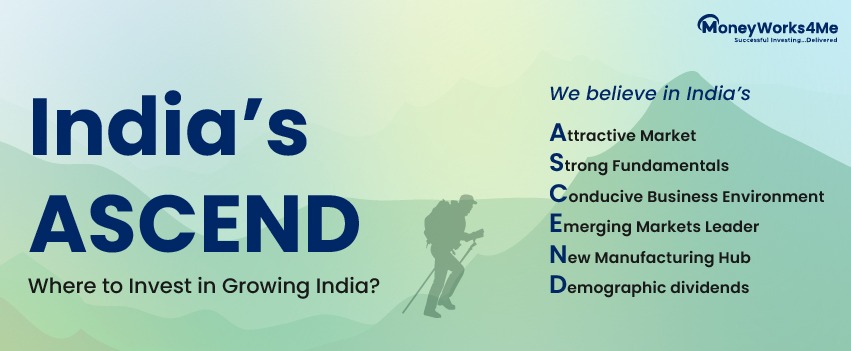
This is the story of India’s ASCEND:
Attractive Market:
- Economic Pyramid Change: The country’s demographics are shifting, with the upper middle-income population expected to double to 152 million by FY30. The most significant change is the reduction in lower-income households, set to decrease by 92 million from 134 million, marking a substantial shift in the income pyramid.
- Consumer Discretionary Growth: This shift in economic strata will likely spur growth in consumer discretionary spending. In emerging markets, $2,000 per capita has been the inflection point for discretionary consumption.
- Product Penetration: India has significant potential to increase penetration in products such as autos and air conditioners, where current levels are below 10%, compared to 15-60% in countries like China.
Strong Fundamentals:
- Healthy Bank Balance Sheets: Indian banks have very healthy balance sheets, with an overall capital adequacy ratio of 14% and gross/net non-performing assets at decadal lows of 3%/1%.
- Improved Fiscal Deficit: India’s FY24 fiscal deficit improved to 5.63% of GDP, narrower than the government’s target of 5.8% and significantly lower than the 9.2% peak during COVID-19.
- High Tax Collections: Tax collections are at multi-year highs, with the Centre’s direct tax revenues budgeted to reach 6.7% of GDP in 2024-25, the highest in three decades.
Conducive Business Environment:
- PLI Scheme Success: The Production-Linked Incentive (PLI) scheme is crucial for realizing India’s vision of becoming a leading manufacturing hub. By November 2023, the scheme had attracted over Rs. 1.03 lakh crore in investment, generated Rs. 3.20 lakh crore in exports, and created over 6 lakh jobs, both directly and indirectly.
- Enhanced Business Environment: The business environment has improved with reduced taxation, optimized logistics costs, and easier financing options.
- Sector Reforms: Power sector reforms, for example, have been implemented to facilitate business and reduce distribution losses, which have significantly decreased from 27% in 2014 to 15.41% in 2022-23.
Emerging Market Leaders:
- Foreign Investment: Foreign Institutional Investors (FIIs) injected $3.63 billion into Indian equities, marking their biggest buying spree since December 2023. Domestic institutions also continued to be net buyers, investing around Rs. 52,467 crore, their highest since March 2020.
- Bond Inclusion: Indian government bonds are set to be included in the JPMorgan Emerging Market local currency debt index from June’24, with expected passive inflows of around $25 billion.
New Manufacturing Hub:
- Focus on Capex: The government’s focus on capital expenditure (Capex) over operational expenditure (Opex) forms a strong foundation for sustainable growth. Capex as a percentage of total expenditure has risen from 8% in 2019 to 20%.
- China +1 Strategy: Recent geopolitical developments have made the China +1 strategy a reality, with global companies setting up operations in India to cater to both domestic demand and export ambitions.
- Rising Exports: Despite global economic uncertainties, India’s exports reached 115 countries out of 238 destinations in 2023-24. Overall exports (goods and services) totalled $ 778.2 billion.
Demographic Dividends:
- Young Workforce: India boasts one of the largest and youngest workforces in the world, with a significant portion of the population under 30, providing a continuous supply of fresh, energetic talent.
- Employable Youth: The employability rate of India’s youth has increased from 33.9% in 2014 to 51.3% in 2024.
- Female Workforce: The female workforce is evolving as more young women with higher education levels enter the job market.
While the macroeconomic data suggests that India’s growth remains strong, investors must still learn how to align their portfolios to benefit from the story.
Join our live Webinar to understand “Where to Invest in Growing India” and create a robust portfolio for the next decade.
What’s your Reaction?
+1
3
+1
+1
1


 Team MW4me