This article covers the following:
Equity investing is often built around a simple principle – buy good businesses and remain invested for the long term. As fundamentally strong companies grow over time, their intrinsic value and share prices generally compound alongside earnings growth, despite temporary periods of market volatility.
Yet, many investors attempt to outperform this approach by timing their entry and exit perfectly. The objective is understandable: avoid market corrections, protect profits, and re-enter investments at lower prices. In theory, this sounds like a superior strategy. In reality, consistently timing the market without the benefit of hindsight is extremely difficult, even for experienced investors.
The Indian equity markets provide a strong example of this challenge. Following the recovery from the dot-com crash of 2000–01, Indian markets entered a powerful bull phase that continued until the end of 2007. However, the global financial crisis of 2008 led to a sharp correction, with markets falling nearly 60% from their peak. Periods like these often tempt investors to believe they could have exited at the top and re-entered at the bottom. But the real question is – can market timing consistently generate superior long-term returns compared to disciplined investing? History suggests that achieving this consistently is far more difficult than it appears.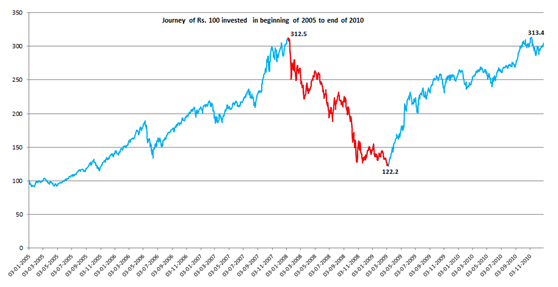
There were two very different ways an investor could have approached the markets during this period. To understand this better, consider the example of two friends – A and B.
After witnessing strong equity returns in 2003 and 2004, both investors decided to enter the stock market in 2005. Each invested Rs. 100,000 into the BSE Sensex with a long-term investment horizon of 5–10 years and an understanding that equity markets would involve periods of volatility along the way.
While both started with the same investment amount, same market conditions, and similar long-term goals, their investment approach eventually differed. One focused on remaining invested through market cycles, while the other attempted to actively time market movements to maximise returns and avoid temporary declines. Their journey highlights an important reality about long-term equity investing – outcomes are often shaped more by behaviour and discipline than by predictions and timing decisions.

First phase- From 2005 to the end of 2007
During the first phase, both the friends invested in the same buy-and-hold fashion. The market experienced a bull run and both of them tripled their money in a matter of 3 years implying 45% CAGR.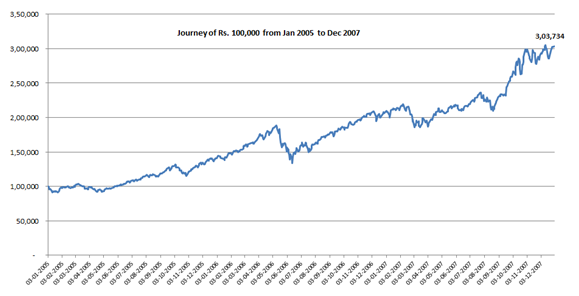
By the end of 2007, the investment value of both friends had grown sharply, with their initial Rs. 100,000 investment rising to nearly Rs. 3.03 lakhs. The strong bull market made equity investing appear relatively easy and significantly boosted their confidence in the power of markets.
However, the next phase tested that confidence far more severely.
Second Phase: 2008 to 2010
The global financial environment began deteriorating as concerns around the US sub-prime crisis intensified. Fears surrounding rising bad loans, weakening financial institutions, and global economic contagion created panic across equity markets worldwide.
As 2008 began, markets witnessed a sharp collapse, with indices falling nearly 30% within a month. This extreme volatility triggered fear among investors and forced many to reconsider their approach toward equity investing.
During this period, Mr. B became increasingly focused on protecting his profits. Believing he could improve returns by anticipating market movements, he frequently entered and exited the market based on short-term trends and market sentiment. His strategy shifted toward active market timing in an attempt to avoid further losses and capture recoveries more effectively.
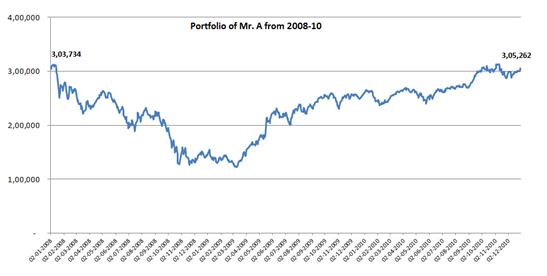
Mr. A, however, chose a different path. Despite the sharp correction and widespread panic, he remained committed to his long-term buy-and-hold approach and stayed invested with his accumulated portfolio value of Rs. 3.03 lakhs.
The contrasting behaviour of both investors during the crisis period highlights a critical difference between reacting to markets and remaining disciplined through volatility.
Investment of Mr. B
Mr. B as we discussed decided to change his style to active and make the most out of a crisis. As we know, no one can predict future market movements. But just to be fair with Mr. B, let’s assume that he participated halfway in every fall or rally.
In every dip, he sells in the middle of the entire dip thinking that markets might fall further. In every rise, he invests in the middle of the entire rise thinking that markets might rise further.
Here we are giving the benefit of the doubt to Mr. B that each of his predictions was right.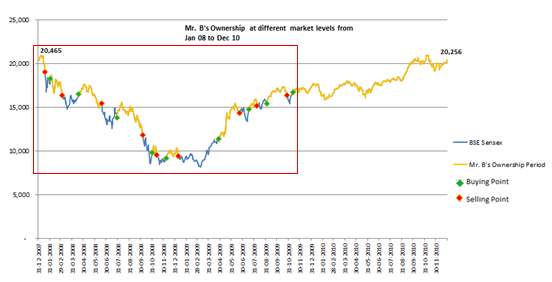
The above chart shows the attempt of Mr. B to predict the dips and rises in the market levels and time his investment accordingly. The highlighted portion is the time period during which Mr. B’s investment strategy differed from Mr. A.
After this hectic exercise by Mr. B, let’s see how his portfolio performed.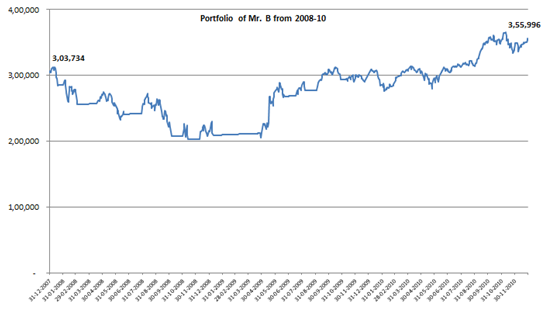
As seen in the above graph, the portfolio of Mr. B increased 3.5 fold in a matter of 3 years. Hence from 2005-2010, his CAGR returns are 23.5% CAGR.
Is Market Timing Really Worth the Effort?
At first glance, Mr. B appears to have outperformed Mr. A by generating a slightly higher CAGR of 23.5% compared to 20.4%. But looking at returns alone ignores several practical realities that significantly influence real-world investing outcomes.
The comparison assumes that Mr. B was consistently able to predict market rises and declines accurately — something that is extremely difficult to achieve repeatedly without hindsight. It also assumes there were no transaction costs, taxes, or execution errors every time he entered or exited the market. In reality, frequent trading often leads to short-term capital gains tax, brokerage costs, and emotional decision-making, all of which can reduce actual returns.
More importantly, both investors experienced entirely different investment journeys despite operating in the same market environment.
Mr. A followed a passive long-term investing approach. He stayed invested through volatility, spent very little time monitoring markets, and allowed his capital to compound over time. This enabled him to focus his energy on other meaningful aspects of life such as his profession, family, and personal growth while his investments continued working in the background.
Mr. B, on the other hand, spent considerable time trying to predict short-term market movements. Although he generated slightly higher returns, it came at the cost of constant anxiety, active monitoring, and emotional involvement with daily market fluctuations. In effect, the additional return required a far greater investment of time and mental bandwidth.
The Real Investing Decision
Every market correction creates the same dilemma for investors – whether to remain disciplined like Mr. A or attempt active market timing like Mr. B. While the idea of avoiding losses and buying back at lower levels sounds appealing, real-life investing rarely works with perfect precision.
Market movements are unpredictable, and even experienced investors struggle to consistently identify tops and bottoms. Frequent buying and selling also introduce costs, taxes, and behavioural mistakes that are often ignored while evaluating returns retrospectively.
For most investors, a disciplined long-term investing approach is far more practical and sustainable. The objective should not be to constantly react to every market movement, but to allocate risk capital wisely and allow compounding to work over time.
The Bottom Line
Most investors naturally fall closer to the “Mr. A” category – people with careers, responsibilities, families, and limited ability to track markets continuously. For them, long-term equity investing works best when supported by patience, discipline, and realistic expectations rather than constant prediction.
Successful investing is not about perfectly timing every market cycle. It is about staying invested in fundamentally strong assets and allowing time and compounding to do the heavy lifting. Once risk capital has been allocated thoughtfully, obsessively tracking daily market movements often becomes an unnecessary and emotionally draining exercise.