SEBI Reg. Investment Advisor

Download App

MoneyWorks4Me

Equity - Small cap Fund 2026

Decizen(Understand the Method):- Q: Quality,
sort up
sort down
Fund Name
sort up
sort down
NAV (Rs.)
sort up sort down
AUM (Cr.)
sort up sort down
Returns Since
inception (%)
Returns
sort up
sort down
Past
sort up
sort down
Avg Rolling
CAGR
Fund DeciZen
sort up sort down
P(%)
sort up sort down
Q
58.07 2,168
26.5
19 Dec' 18
15.27
21.84
19.91
N/A
31.50
31.13
31.85
N/A
cagr
31
Q
49.63 5,952
24.2
07 Feb' 19
9.76
19.1
19.38
N/A
29.35
29.43
30.17
N/A
cagr
29
Q
48.86 11,038
23.2
30 Oct' 18
11.15
24.2
21.79
N/A
28.04
29.22
29.73
N/A
cagr
29
Q
194.54 72,673
23.9
01 Jan' 13
10.36
21.17
22.36
18.42
25.37
25.44
24.49
24.41
cagr
25
Q
172.47 72,673
19.8
16 Sep' 10
10.36
21.17
22.36
18.42
24.19
24.26
24.36
22.19
cagr
24
Q
40.85 11,645
20.2
12 Nov' 18
-8.82
11.75
15.2
N/A
26.89
29.23
29.54
N/A
cagr
29
Q
43.59 11,038
21.3
30 Oct' 18
11.15
24.2
21.79
N/A
26.13
27.28
27.79
N/A
cagr
27
Q
229.91 17,906
21.1
01 Jan' 13
19.4
20.91
19.7
14.38
20.50
21.58
20.06
20.03
cagr
22
Q
91.99 16,877
20.1
12 May' 14
3.03
16.82
18.58
15.31
23.33
21.13
19.69
20.26
cagr
21
Q
152.80 38,809
18.3
01 Jan' 13
-1.76
14.53
16.9
15.8
22.65
21.02
20.10
20.01
cagr
21
Q
193.32 13,850
19.7
01 Jan' 13
7.85
19.34
20
13.72
20.08
20.36
18.75
18.71
cagr
20
Q
82.05 16,877
19
12 May' 14
3.03
16.82
18.58
15.31
22.12
19.95
18.50
19.08
cagr
20
Q
169.56 13,850
14.9
13 Jan' 06
7.85
19.34
20
13.72
18.93
19.14
19.51
18.10
cagr
19
Q
52.72 25,346
30.2
25 Feb' 20
13.74
30.5
22.83
N/A
35.65
31.42
30.56
N/A
cagr
31
Q
47.79 25,346
28.2
25 Feb' 20
13.74
30.5
22.83
N/A
33.53
29.41
28.55
N/A
cagr
29
Q
42.55 13,364
21.9
15 Feb' 19
0.76
14.49
16.49
N/A
29.16
29.24
29.89
N/A
cagr
29
Q
51.40 2,168
24.5
19 Dec' 18
15.27
21.84
19.91
N/A
29.36
29.02
29.73
N/A
cagr
29
Q
44.35 5,952
22.3
07 Feb' 19
9.76
19.1
19.38
N/A
27.35
27.41
28.15
N/A
cagr
27
Q
38.11 13,364
20.1
15 Feb' 19
0.76
14.49
16.49
N/A
27.21
27.27
27.93
N/A
cagr
27
Q
35.95 11,645
18.2
12 Nov' 18
-8.82
11.75
15.2
N/A
24.79
27.05
27.37
N/A
cagr
27
Q
33.99 2,937
21.4
17 Feb' 20
12.23
25.24
17.61
N/A
29.61
26.87
24.72
N/A
cagr
27
Q
30.21 2,937
19.1
17 Feb' 20
12.23
25.24
17.61
N/A
27.20
24.53
22.41
N/A
cagr
25
Q
194.38 37,395
22.4
01 Jan' 13
-0.3
12.54
13.65
16.51
21.62
23.45
23.09
23.13
cagr
23
Q
168.63 37,395
18.4
09 Sep' 09
-0.3
12.54
13.65
16.51
20.31
22.07
23.17
21.46
cagr
22
Q
293.14 30,374
17.4
07 Jan' 13
8.43
20.19
21.84
20.16
26.21
21.71
21.09
19.85
cagr
22
Q
35.78 695
15.3
21 Jun' 17
7.28
18.05
18.11
N/A
18.82
21.67
22.51
15.19
cagr
22
Q
28.04 4,970
20.5
22 Dec' 20
3.68
16.44
16.11
N/A
19.65
21.62
18.90
N/A
cagr
22
Q
301.32 17,806
18.5
01 Jan' 13
-1.47
13.85
13.72
15.15
21.95
21.60
21.07
20.79
cagr
22
Q
124.43 27,840
22.3
29 Nov' 13
2.55
16.02
16.77
17.78
21.39
21.43
21.51
21.00
cagr
21
Q
267.76 30,374
12.2
16 Oct' 96
8.43
20.19
21.84
20.16
25.11
20.77
18.46
13.66
cagr
21
Q
207.56 17,906
17.3
14 Jun' 07
19.4
20.91
19.7
14.38
19.55
20.65
20.88
19.66
cagr
21
Q
31.58 695
13.7
21 Jun' 17
7.28
18.05
18.11
N/A
17.36
20.30
21.14
13.62
cagr
20
Q
254.26 17,806
16.4
24 Feb' 05
-1.47
13.85
13.72
15.15
20.30
19.97
19.93
17.35
cagr
20
Q
106.70 27,840
20.8
29 Nov' 13
2.55
16.02
16.77
17.78
19.85
19.89
19.93
19.47
cagr
20
Q
25.80 4,970
18.7
22 Dec' 20
3.68
16.44
16.11
N/A
17.85
19.83
17.12
N/A
cagr
20
Q
133.39 38,809
15.3
03 Apr' 08
-1.76
14.53
16.9
15.8
21.36
19.71
19.00
17.19
cagr
20
Q
306.74 3,563
17.6
02 Jan' 13
15.74
20.55
19.04
12.34
18.92
18.60
16.99
16.91
cagr
19
Q
96.34 8,949
16.6
02 Jan' 13
0.48
14.31
15.88
14.48
20.15
18.51
17.99
17.70
cagr
19
Q
274.41 3,563
16.8
15 Feb' 05
15.74
20.55
19.04
12.34
17.83
17.57
17.34
15.21
cagr
18
Q
59.96 2,094
16.1
10 Jun' 14
17.02
20.29
18.11
16.13
19.12
17.38
17.60
16.75
cagr
17
Q
85.04 8,949
12.2
18 Oct' 07
0.48
14.31
15.88
14.48
18.88
17.32
17.01
14.68
cagr
17
Q
104.24 5,453
16.5
01 Jan' 13
8.85
17.73
13.92
10.83
18.15
17.15
15.48
15.51
cagr
17
Q
53.77 2,094
15
10 Jun' 14
17.02
20.29
18.11
16.13
18.02
16.33
16.59
15.71
cagr
16
Q
90.98 5,453
12.2
31 May' 07
8.85
17.73
13.92
10.83
16.90
15.93
15.85
14.79
cagr
16
Q
21.17 4,591
23.9
12 Dec' 22
8.26
22.79
N/A
N/A
27.10
24.53
N/A
N/A
cagr
N/A
Q
20.04 4,591
22
12 Dec' 22
8.26
22.79
N/A
N/A
25.11
22.61
N/A
N/A
cagr
N/A
Q
17.91 1,567
12.7
29 Jul' 21
7.76
15.46
N/A
N/A
13.32
15.47
N/A
N/A
cagr
N/A
Q
16.52 1,567
10.9
29 Jul' 21
7.76
15.46
N/A
N/A
11.49
13.62
N/A
N/A
cagr
N/A
Q
11.41 4,123
10.2
31 Jan' 25
13.03
N/A
N/A
N/A
9.37
N/A
N/A
N/A
cagr
N/A
Q
12.87 225
10.2
03 Nov' 23
4.64
N/A
N/A
N/A
5.97
N/A
N/A
N/A
cagr
N/A
Q
11.07 296
32.5
29 Jan' 26
N/A
N/A
N/A
N/A
N/A
N/A
N/A
N/A
cagr
N/A
Q
10.96 53
54.4
25 Mar' 26
N/A
N/A
N/A
N/A
N/A
N/A
N/A
N/A
cagr
N/A
Q
10.21 1,903
2.5
18 Jul' 25
N/A
N/A
N/A
N/A
N/A
N/A
N/A
N/A
cagr
N/A
Q
10.92 53
51.8
25 Mar' 26
N/A
N/A
N/A
N/A
N/A
N/A
N/A
N/A
cagr
N/A
Q
10.07 1,903
0.8
18 Jul' 25
N/A
N/A
N/A
N/A
N/A
N/A
N/A
N/A
cagr
N/A
Q
11.14 296
34.8
29 Jan' 26
N/A
N/A
N/A
N/A
N/A
N/A
N/A
N/A
cagr
N/A
Q
13.38 225
11.8
03 Nov' 23
4.64
N/A
N/A
N/A
7.54
N/A
N/A
N/A
cagr
N/A
Q
11.65 4,123
12
31 Jan' 25
13.03
N/A
N/A
N/A
11.11
N/A
N/A
N/A
cagr
N/A
Q
10.42 1,037
8
27 Nov' 25
N/A
N/A
N/A
N/A
N/A
N/A
N/A
N/A
cagr
N/A
Q
10.38 141
7.5
04 Dec' 25
N/A
N/A
N/A
N/A
N/A
N/A
N/A
N/A
cagr
N/A
Q
12.50 1,891
15
04 Nov' 24
20.89
N/A
N/A
N/A
14.80
N/A
N/A
N/A
cagr
N/A
Q
12.17 1,891
13.1
04 Nov' 24
20.89
N/A
N/A
N/A
12.94
N/A
N/A
N/A
cagr
N/A
Q
10.33 1,037
6.3
27 Nov' 25
N/A
N/A
N/A
N/A
N/A
N/A
N/A
N/A
cagr
N/A
Q
11.35 1,089
72.2
17 Mar' 26
N/A
N/A
N/A
N/A
N/A
N/A
N/A
N/A
cagr
N/A
Q
10.30 141
5.9
04 Dec' 25
N/A
N/A
N/A
N/A
N/A
N/A
N/A
N/A
cagr
N/A
Q
11.31 1,089
69.7
17 Mar' 26
N/A
N/A
N/A
N/A
N/A
N/A
N/A
N/A
cagr
N/A
Q
15.49 6,206
19.5
26 Dec' 23
15
N/A
N/A
N/A
12.19
N/A
N/A
N/A
cagr
N/A
Q
14.99 6,206
17.9
26 Dec' 23
15
N/A
N/A
N/A
10.69
N/A
N/A
N/A
cagr
N/A
Q
13.67 1,222
12.2
30 Oct' 23
2.94
N/A
N/A
N/A
4.90
N/A
N/A
N/A
cagr
N/A
Q
13.18 1,222
10.7
30 Oct' 23
2.94
N/A
N/A
N/A
3.49
N/A
N/A
N/A
cagr
N/A
Q
10.92 730
4.6
18 Jun' 24
5.67
N/A
N/A
N/A
-0.13
N/A
N/A
N/A
cagr
N/A
Q
10.57 730
2.8
18 Jun' 24
5.67
N/A
N/A
N/A
-1.74
N/A
N/A
N/A
cagr
N/A
Q

FAQs

SIP refers to periodic investment in an MF. In this option, you commit to invest a pre-decided amount, at regular intervals, and you get allotted Units based on an MF’s NAV. E.g. Suppose you do an SIP of Rs. 1,000. If, for the 1st month its NAV is Rs. 15, you get 66.67 units. For the 2nd, the NAV is Rs. 25, so you get 40 units. For the 3rd, the NAV is Rs. 20, you get 50 units. At the end of 3 months, you have invested Rs. 3,000 and received 156.67 units at an average NAV of Rs. 19.2.

A Direct Plan means you investing directly thru' an AMC/MF website. As there is no Distributor involved, returns generated by this plan will be higher by the percentage fees paid to a Distributor. We, at MoneyWorks4me, encourage investors to invest in Direct Plans.

Regular Plan is when you invest in an MF scheme through a Distributor or Broker. This means you will end up paying some fees to the Distributor. The fees are directly paid by the AMC to a Distributor. For you as an investor, it is reflected in the lower NAV values, and higher Expense Ratio than a Direct Plan

It is the Fund House or the company responsible for managing investors’ money, and in turn, all the MF schemes.

The money collected by an MF Scheme is invested across asset classes like stocks, debt Funds, gold and cash. The market value of these investments at any given time minus the MF’s liabilities is known as the Fund’s AUM. (E.g. If a Fund’s value of investments is Rs. 100 Cr and liabilities Rs 5 Cr., then AUM is Rs. 95 Cr.) Though, a large AUM denotes a Fund’s popularity and success, it also means restrictions on investing (Fund will have to invest mainly in large companies) and difficulty in replicating past high return performance.

It is the price per unit of the MF scheme. On any given day, NAV is the price at which any investor invests in an MF scheme. NAV = [the market value of all the securities held by the scheme minus its liabilities] ÷ the number of units. Since, market value of securities changes every day, NAV of a scheme also changes every day. Similar to a stock price, a high or low NAV does not affect our investment decision.

A Benchmark is a popular index like the SENSEX, NIFTY or BSE 100, against which a Fund’s performance is gauged. A Fund is supposed to choose a Benchmark based upon the market-section it invests in. E.g. a Mid-Cap Fund may use NSE Midcap Index as its Benchmark. It makes sense to invest in an MF, only if it has consistently beaten its Benchmark performance over a 3-5 year period.

The Expense Ratio is the fee charged by a Mutual Fund for managing its investors’ money. It is shown as a percentage of the Assets Under Management (AUM). E.g. if you invest Rs. 10,000 in a Fund with an Expense Ratio of 1.5%, then you are paying the Fund Rs. 150 to manage your money. As a general rule, you are told to avoid Funds with high Expense Ratio. However, it can also turn to be a good investment, if it consistently generates excess returns (Alpha) over its Expense Ratio.

Load is the fees charged for buying (i.e. Entry load) and selling (i.e. Exit load) MF units. SEBI has scrapped the Entry load wef August 1, 2009. Some Funds may charge Investors an Exit load only on early exit (e.g. within a year of investment) to encourage long-term investment behaviour.

Rolling Returns consider performance on every day or week (or any specified frequency) of a defined period, and hence, tell you how you would have fared regardless of when you chose to invest. E.g. A monthly five-year Rolling Return is return from 1-Jan-2013 to 1-Jan-2018, 1-Feb-2013 to 1Feb-2018, subsequently for all months. For 3-yr or 2-yr rolling, the year changes respectively. We advise our users to look at Rolling Alpha, because it allows you to evaluate the consistency of a Fund’s performance over time - including the ups and downs of market cycles.

Choosing growth option means you will not receive extra units for Dividend declared by the Fund. Instead, the amount will stay invested in the Fund, thereby compounding your returns. Choose this option, if you prefer capital appreciation over regular income from your investment.

An Open-ended Fund or Scheme is one that is available for subscription and re-purchase on a continuous basis. These schemes do not have a fixed maturity period. Investors can conveniently buy and sell units at Net Asset Value (NAV) related prices which are declared on a daily basis. The key feature of open-end schemes is liquidity. The opposite is closed ended where the fund cannot be sold very easily.

Every fund is assessed on the following:
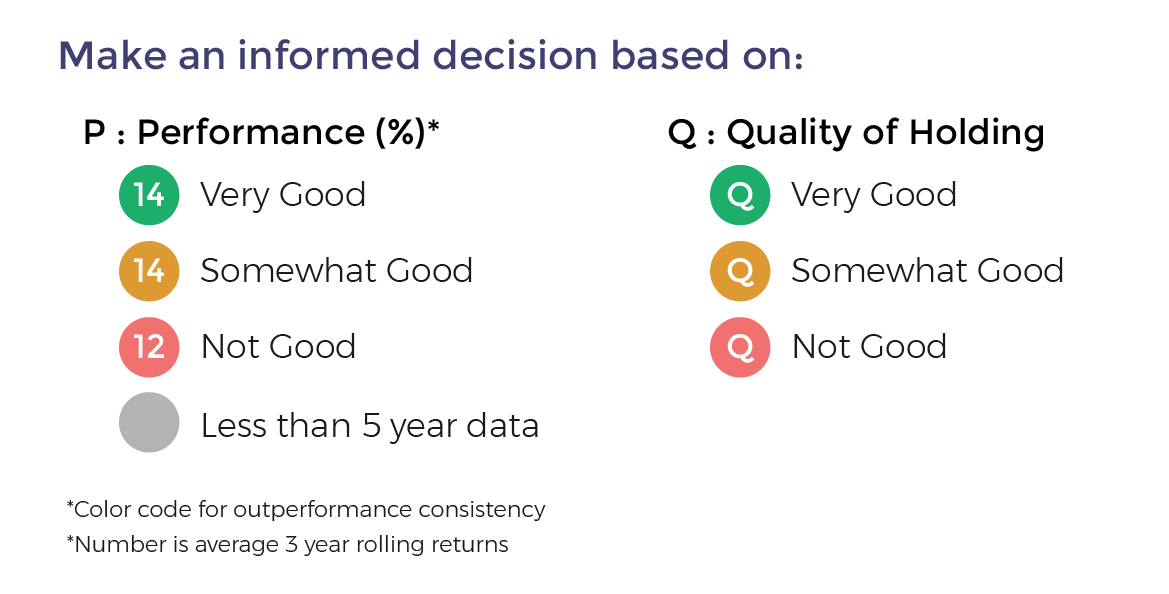
  1. Consistent Outperformers : Track record of having generated returns above a benchmark on a 3-year rolling basis. Consistent performers are Green, followed by Orange. Red have an inconsistent track record on outperforming the index.
  2. The average 3-year rolling returns number appears in the first button.
  3. Quality of Portfolio is assessed based on the quality of each stock held. Predominantly high quality stocks get a Green second button, followed by Orange and Red (large amount of risky stocks).
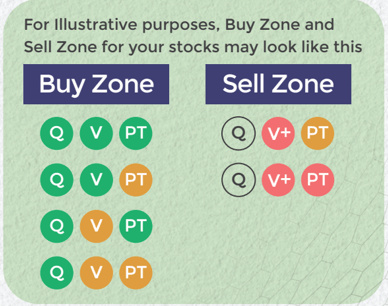
  4. Upside Potential: Every fund is assessed on what returns it could deliver in the next 5 years based on it.

Select the fund that is Green on Performance which shows it has consistently outperformed the index. Select one with a high average 3-year rolling returns - the number in the first button. And select one with a Green rating on Quality-the second button.

Use the Funds Screener and select the category. It shows the funds with Green on Performance and Quality right on the top. The ones with the higher average 3-year rolling returns are ranked the highest. Funds with less than 5 years returns history are colored Grey on Performance. Since the track record is not for an adequately long period they feature lower in the list.

Build a well-diversified portfolio with funds that assures you of a stable growth through market and economic cycles and funds that enhance your portfolio returns over the long run.
  1. Core Funds: Choose from Large cap, Large and Mid cap and Flexicap funds.
  2. Booster Funds
    1. Choose from Mid and Small cap funds.
    2. Select a Sector or Thematic Fund that is likely to outperform in the long term.

Use the Fund Portfolio Analyzer, Sher-ya-Billi to check if your portfolio will deliver healthy returns or disappoint you. Go to Fund Portfolio Analyzer. You can also upload details of your funds in the Portfolio Manager and see the report on this page.

When adding a new fund check how different is the fund compared to your portfolio by using the link in the Right allocation box on the Fund Decision Maker.

Most investors have more, many more funds that they should-over diversified. This tends to reduce returns. Many investors have more of the same i.e. they have funds that have very similar portfolios and hence the fund portfolio is not well-diversified. Either there are too many large cap dominated funds or far too many mid and small cap funds. What you require is a good, balanced mix. Finally investors don't know when to exit a fund and end up carrying it even though the future upside potential is very low.
You have 1 views remaining. Unlock unlimited fund data views for free. Register Now

About MoneyWorks4Me

MoneyWorks4Me is a SEBI-registered Investment Adviser (IA) dedicated to helping investors build long-term wealth through transparent, research-driven, conflict-free guidance. Founded in 2008, we started our journey as a Research Analyst (RA), providing deep fundamental analysis, intrinsic value insights, and long-term investing frameworks for Indian equities. In 2017, we transitioned to a full-fledged SEBI-registered Investment Adviser, strengthening our commitment to acting as a fiduciary—always putting the investor’s interest first.

Our Vision

To become India’s most trusted, research-powered fiduciary advisory platform—where every investor, regardless of experience, can make calm, confident, and well-reasoned investment decisions.

What Makes MoneyWorks4Me Different

  • Fiduciary-first advisory model.
    As SEBI-registered IAs, we are legally and ethically bound to act in the best interests of our clients. We do not sell or distribute any financial products. This ensures our guidance is 100% unbiased and conflict-free.
  • Deep fundamental research + robust valuation discipline.
    Built on more than 15 years of equity research, our framework combines quality assessment, intrinsic value estimation, and a sensible margin-of-safety approach.
  • Process—not predictions.
    We don’t rely on guesswork or market timing. Instead, we focus on asset allocation, risk management, and long-term compounding.
  • Technology + Human Intelligence.
    We believe a combination of both is essential for investing success. We constantly innovate and upgrade in-house tools, financial X-rays, and portfolio analytics so that our team of analysts and advisors are equipped with the best.
  • Partner with Clients.
    We follow a DIWM (Do-It-With-Me) approach where we partner clients in setting goals, financial planning, educating on our investing process and share decision-enabling resources transparently with our clients who retain control on execution.

Our Approach: Ensuring compounding work its magic on client portfolio.

MoneyWorks4Me ensures this through:

  • Investing in stocks, mutual funds, debt, and gold
  • Quality-at-Reasonable-Price way of investing in stocks
  • Constructing Direct Stock Portfolios with Core, Booster, and Amplifier stocks
  • A Mutual Fund Portfolio that delivers consistent out-performance and meaningful diversification (low overlap)
  • Periodic review and rebalancing
  • Clear Buy-Sell-Hold, and Position-sizing frameworks
×