 Nirmal Chaudhari
Tax planning is not merely about reducing liability, it is about aligning tax efficiency with long-term wealth creation. When evaluating tax-saving options under Section 80C, the debate of ELSS vs PPF is one of the most common among investors in India. Two of the most commonly used options under Section 80C of the Income Tax Act, 1961 are ELSS and PPF. While both qualify for deductions up to ₹1.5 lakh annually, their structure, risk profile, liquidity, and return potential differ meaningfully.
The right choice depends on your financial objectives, risk appetite, and time horizon.
Understanding the Instruments
ELSS (Equity Linked Savings Scheme)
ELSS is a diversified equity mutual fund category regulated by Securities and Exchange Board of India. It invests primarily in equities and carries a mandatory lock-in of three years, the shortest among Section 80C instruments.
Because returns are market-linked, ELSS offers higher growth potential but comes with volatility. It is suited for investors willing to tolerate interim fluctuations for long-term capital appreciation.
PPF (Public Provident Fund)
Public Provident Fund (PPF) is a government-backed small savings scheme with a 15-year maturity, extendable in blocks of five years. It offers assured returns declared quarterly by the government (7–8% range in recent years).
PPF falls under the Exempt-Exempt-Exempt (EEE) category – contributions, interest, and maturity proceeds are tax-free under the old regime.
PPF prioritizes capital preservation over growth.
ELSS vs PPF: Key Differences
Returns: Growth vs Stability
Historically, ELSS funds have delivered higher long-term returns (often in the low-to-mid teens over full market cycles), driven by equity exposure. However, returns are not guaranteed and depend on market performance and fund management quality.
PPF provides stable, government-backed returns. While lower than equity over long horizons, they offer predictability and capital safety.
Interpretation:
If your objective is long-term wealth creation and you can withstand volatility, ELSS has an edge. If stability is your priority, PPF is more aligned.
Risk Profile
ELSS carries equity market risk. Portfolio value can fluctuate in the short to medium term.
PPF carries negligible credit risk and no market volatility risk, as returns are government-backed.
Interpretation:
ELSS suits high-risk, long-horizon investors. PPF suits conservative investors or those building a fixed-income allocation for retirement.
Taxation of Returns
Both qualify for deductions under Section 80C (under the old tax regime).
- ELSS gains above ₹1 lakh per year are taxed at 10% as long-term capital gains.
- PPF maturity and interest are completely tax-free.
Under the new tax regime (default from FY 2023–24), Section 80C deductions are not available. In that case, ELSS loses its tax advantage and functions like any other diversified equity fund.
Interpretation:
Tax regime selection materially affects the attractiveness of ELSS as a tax-saving vehicle.
Lock-in and Liquidity
ELSS has a 3-year lock-in from each investment date. After that, redemption is flexible.
PPF has a 15-year tenure. Partial withdrawals are allowed after year five, but full liquidity is restricted until maturity.
Interpretation:
ELSS provides significantly better liquidity.
Strategic Fit in Portfolio Construction
ELSS is fundamentally an equity allocation tool with tax efficiency attached. It should be evaluated like any equity mutual fund based on portfolio quality, valuation discipline, and consistency.
PPF functions as a long-duration fixed-income instrument. It supports capital stability and retirement-oriented planning.
A balanced investor may use both: ELSS for growth and PPF for capital preservation.
So, Which One Is Better?
There is no universal answer.
Choose ELSS if:
- You have a long investment horizon (5+ years ideally)
- You can tolerate volatility
- You seek higher real (inflation-adjusted) returns
- You are under the old tax regime and require 80C deductions
Choose PPF if:
- You prioritize safety and predictable returns
- You are building a retirement corpus conservatively
- You prefer zero taxation on maturity proceeds
- You want fixed-income allocation within your portfolio
From a wealth-building standpoint, equity as an asset class historically outperforms fixed-income over long periods. However, stability has value, especially in uncertain economic cycles.
Final Perspective
Tax-saving should not drive investment decisions in isolation. The primary question is asset allocation – how much equity versus fixed income aligns with your goals, risk profile, and time horizon.
ELSS and PPF serve different strategic roles. The optimal approach is not choosing one blindly, but selecting the instrument that complements your broader financial architecture.
At MoneyWorks4Me, we advocate goal-aligned investing, where tax efficiency, risk control, and return potential are evaluated together, not in silos.
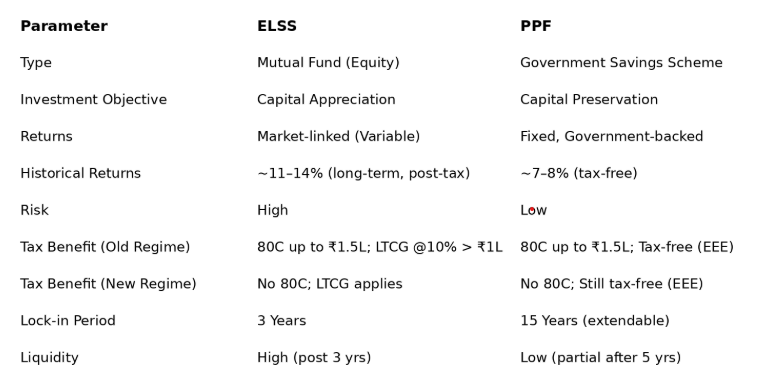
ELSS vs PPF: A Comparison
Which is better: ELSS or PPF?
The optimal choice between ELSS and PPF depends on individual factors such as risk tolerance, investment objective, time horizon, and tax considerations. ELSS may be suitable for high-risk investors seeking potentially higher returns with a shorter lock-in period and greater liquidity. On the other hand, PPF could be more suitable for low-risk investors looking for stable returns, capital security, and tax-free income.
It’s advisable to evaluate ELSS and PPF based on various criteria and align your choice with your specific financial circumstances. Some investors may even opt for a diversified approach by investing in both instruments to achieve a balanced portfolio. Ultimately, the decision should be tailored to your unique financial needs and preferences.
Best Funds From:
Best ETF Funds Best Flexi Cap Funds Best Nifty Index Funds Best Large Cap Funds Best Tax Saver ELSS Funds Fund Screener Best Mutual Funds SIP Calculator


Need help on Investing? And more….Puchho Befikar

Why MoneyWorks4me | Call: 020 6725 8333 | Ebook | WhatsApp: 9860359463
*Investments in the securities market are subject to market risks. Read all the related documents carefully before investing.
*Disclaimer: The securities quoted are for illustration only and are not recommendatory



 Atharva Bhide