Successful investing is not just about identifying great businesses. It is also about understanding the environment in which those businesses operate. One of the most important concepts that investors should understand is the business cycle.
Every economy moves through periods of growth and slowdown. These recurring fluctuations influence corporate earnings, stock prices, employment, interest rates, and investor sentiment. Understanding where an industry or economy stands in the business cycle can help investors make better decisions and avoid costly mistakes.
What is a Business Cycle?
A business cycle refers to the recurring pattern of expansion and contraction in economic activity over time.
Economic growth is not linear. Periods of strong growth are eventually followed by slowdowns, which are then followed by recovery and expansion once again. These phases repeat continuously, although the duration and intensity of each cycle can vary significantly.
Several economic indicators help determine the stage of a business cycle, including:
- Gross Domestic Product (GDP)
- Interest rates
- Employment levels
- Consumer spending
- Industrial production
- Corporate earnings
Unlike a calendar year, business cycles do not follow a fixed timeline. Some may last only a few years, while others can continue for a decade or longer.
The Four Phases of a Business Cycle
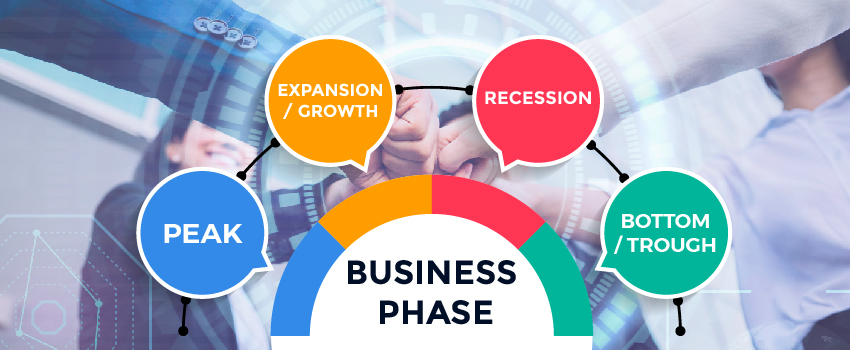
Every business cycle generally passes through four distinct phases.
1. Expansion Phase
The expansion phase is characterized by rising economic activity and increasing business confidence.
During this period:
- Demand for goods and services increases.
- Corporate revenues and profits grow.
- Employment levels improve.
- Capacity utilization rises.
- Companies invest in expansion and new projects.
Businesses often experience strong earnings growth, making this phase favourable for equity investors.
2. Peak Phase
The peak represents the highest point of economic activity before growth begins to slow.
Typical characteristics include:
- Maximum production levels.
- Strong pricing power for businesses.
- High consumer confidence.
- Optimistic business sentiment.
- Elevated valuations in financial markets.
While conditions appear extremely favourable during this stage, the seeds of the next slowdown are often already being planted.
3. Recession Phase
As growth slows, the economy enters a contractionary phase.
Key indicators include:
- Weakening demand.
- Excess supply in certain industries.
- Falling prices or reduced pricing power.
- Declining profitability.
- Lower business investments.
Stock markets often react negatively during this phase as investors anticipate weaker earnings and slower economic growth.
4. Trough or Bottom Phase
The trough marks the lowest point of the cycle before recovery begins.
Characteristics include:
- Negative or very weak growth.
- Financial stress among weaker businesses.
- Excess inventories.
- Reduced corporate investments.
- Industry consolidation and bankruptcies.
Although economic conditions may appear bleak, this phase often creates attractive investment opportunities for long-term investors.
Why Business Cycles Matter for Investors
Understanding business cycles can provide valuable context for investment decisions.
Different sectors and industries respond differently to economic conditions. Some industries perform exceptionally well during expansions, while others remain resilient during downturns.
Investors who understand these cycles can:
- Identify industries entering favourable growth phases.
- Avoid sectors approaching cyclical peaks.
- Improve portfolio allocation decisions.
- Manage risk more effectively during economic slowdowns.
The goal is not to predict every economic turning point perfectly but to understand the broader forces influencing business performance.
Business Cycles Exist at Multiple Levels
Investors often focus only on company-specific factors, but businesses operate within multiple overlapping cycles.
These include:
Global Economic Cycles
International growth trends, interest rates, trade flows, and liquidity conditions affect businesses across countries.
Country-Specific Economic Cycles
Domestic policies, inflation, consumption trends, and government spending influence local industries.
Industry Cycles
Each sector experiences its own demand and supply dynamics. Industries such as real estate, commodities, automobiles, and pharmaceuticals often move through pronounced cycles.
Company Life Cycles
Individual businesses also evolve through growth, maturity, and decline phases independent of broader economic conditions.
Effective investment analysis requires understanding how these multiple cycles interact.
A Business Cycle Example: The Pharmaceutical Sector
The pharmaceutical industry provides a useful example of how business cycles affect investment returns.
During the years leading up to 2015, the global pharmaceutical sector experienced a strong upcycle. Demand growth, favourable pricing conditions, and robust profitability supported rapid earnings expansion.
As a result, several pharmaceutical companies witnessed substantial revenue growth, expanding margins, and premium valuations.
However, once the cycle peaked, growth slowed and valuations contracted. Even strong businesses struggled to generate attractive stock returns despite remaining fundamentally sound.
This demonstrates an important investing lesson:
A great company purchased at the wrong point in the business cycle can still deliver disappointing returns.

The Key Investing Takeaway
Many investors focus only on identifying growing businesses. However, understanding why a company is growing is equally important.
Growth driven by favourable industry conditions may not continue indefinitely. Investors who fail to recognize cyclical peaks often remain invested long after the best returns have been earned.
Business cycle analysis helps investors:
- Understand the drivers of growth.
- Anticipate changing industry conditions.
- Identify emerging opportunities.
- Avoid investing based solely on recent performance.
No forecasting method is perfect, but understanding business cycles can provide investors with a valuable framework for making better long-term investment decisions.
Final Thoughts
The business cycle is a fundamental concept that every investor should understand. Economic expansions, peaks, recessions, and recoveries influence corporate profits, valuations, and stock market returns.
By combining company analysis with an understanding of economic and industry cycles, investors can improve decision-making and position their portfolios more effectively for changing market conditions.
The investors who consistently succeed are often not those who react to cycles, but those who recognize them early and prepare accordingly.
Best Stocks From:
Nifty 50 Nifty Next 50 Nifty 100 Nifty 200 Nifty 500 Nifty Financial Services SmallCap 250 MidCap 100