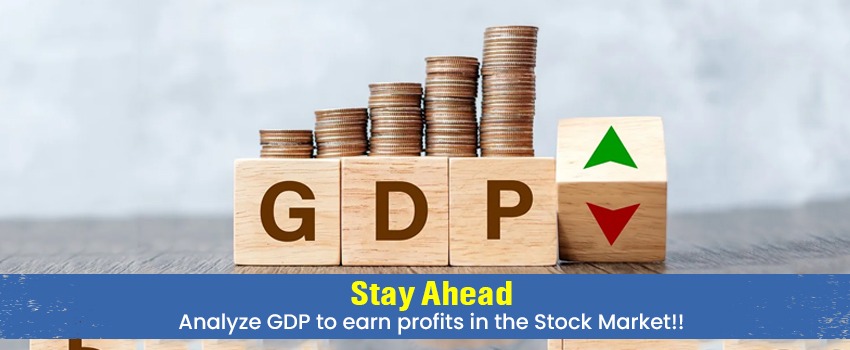
Investors often hear that strong GDP growth leads to rising markets. While there is some truth to that relationship, the connection is not always immediate or straightforward.
How does GDP affect the stock market, and can it help you earn profits? While GDP is one of the most important economic indicators, it is not a direct signal to buy or sell stocks. Instead, understanding the relationship between GDP and the stock market helps investors identify economic trends, sector opportunities, and long-term growth drivers.
1. What GDP Actually Tells Investors
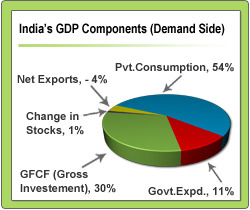
Gross Domestic Product (GDP) measures the total value of goods and services produced in an economy over a period of time. In simple terms, it reflects the overall health of economic activity.
GDP is commonly calculated using the expenditure method:
GDP = Consumption (C) + Government Spending (G) + Investment (I) + Net Exports (X − M)
Each component provides useful signals. Consumption shows demand strength, investment reflects business confidence, government spending indicates policy support, and exports reveal external competitiveness.
In the context of the GDP and stock market relationship, this equation is more than just a formula, it is a breakdown of where economic momentum is coming from.
2. What Is GDP in the Stock Market Context?
GDP in the stock market context refers to how overall economic growth influences corporate earnings, sector performance, and investor expectations. While GDP reflects past and current activity, stock prices typically move based on future growth expectations.
Historically, periods of strong economic expansion tend to support corporate earnings growth. When GDP growth rises:
- Employment opportunities improve
- Disposable incomes increase
- Demand for goods and services expands
- Companies invest in capacity and expansion
These developments typically translate into higher revenues and improving profitability, which eventually reflect in stock prices.
On the other hand, when GDP slows meaningfully, businesses often delay investment, consumption weakens, and earnings expectations get revised downward. Markets tend to react to these changes in expectations.
However, it is important to remember that markets move ahead of GDP, not just with it. Investors price future growth before it appears in official data.
Take a look at the graph below to see the movement of the GDP growth rate and Sensex.
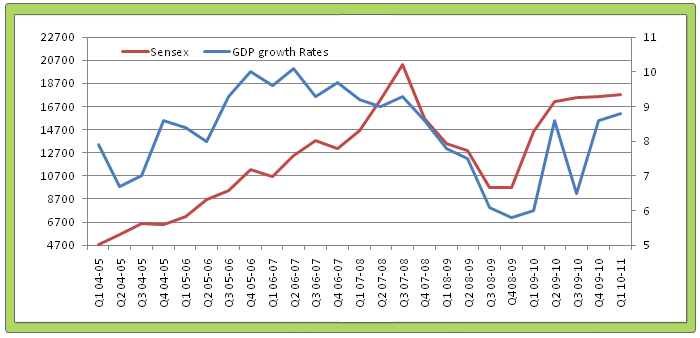
It is evident that there is positive correlation between the GDP growth rate and the movement of the Sensex. The Sensex falls with a falling GDP number and rises when the economy starts showing good numbers again.
3. The Sectoral Clues Hidden Inside GDP Data
Looking only at the headline GDP number can be misleading. The real insight lies in which sectors are driving growth.
In India, GDP broadly comes from three major segments:
- Agriculture and allied activities
- Industry (manufacturing, mining, power, etc.)
- Services
The services sector contributes a large share to India’s economy, but changes in industrial and investment activity often influence market cycles more strongly.
For investors, sectoral GDP trends help answer an important question:
Where is the next earnings growth likely to come from?
For example:
- Rising industrial activity → capital goods, infrastructure opportunities
- Strong consumption → FMCG, auto, retail
- Service sector growth → IT, telecom, financials
4. What Investors Should Actually Track in a GDP Report
A GDP report contains several signals that can help investors understand future opportunities across sectors.
Consumption Trends
Private consumption forms a large portion of GDP. Weak consumption can impact sectors such as autos, real estate, and banking, while strong demand supports earnings visibility.
Industrial Activity (IIP Trends)
The Index of Industrial Production often acts as an early indicator of economic momentum. Rising industrial output may signal improving manufacturing demand and capital cycle recovery.
Quality of GDP Growth
Growth driven primarily by temporary government spending may not be sustainable. Durable growth typically comes from private investment, infrastructure development, and manufacturing expansion.
Agriculture Performance
Agriculture still plays an important role in rural demand. A weak monsoon or lower crop output can affect consumption across multiple industries.
Investment Demand
Capital expenditure trends signal long-term economic strength. A sustained pickup in investment activity usually benefits sectors like infrastructure, capital goods, and banking.
Service Sector Indicators
Metrics such as tourism activity, telecom growth, and transport demand often provide early signals of broader economic expansion.
The key is not to react to one number, but to understand the direction of economic momentum.
The Bottom Line
The relationship between GDP and the stock market is not about timing the market.
It is about understanding direction.
Investors who use GDP as a context-setting tool, rather than a timing signal, are better positioned to make disciplined long-term decisions.
A Note from MoneyWorks4Me
At MoneyWorks4Me, we focus on combining economic insights with valuation discipline and company-level research. Understanding the broader environment is important, but successful investing ultimately comes from owning quality businesses at the right price.
If you liked what you read and would like to put it in to practice Register at MoneyWorks4me.com. You will get amazing FREE features that will enable you to invest in Stocks and Mutual Funds the right way.