
The Multibagger Trap: Why Market Capitalization Matters
“This small-cap stock can become the next multibagger!”
Most investors have come across such messages at some point. The word that immediately grabs attention is multibagger – the promise of quick, outsized returns. Naturally, the idea of multiplying wealth in a short time is appealing.
However, this is where many investment decisions begin to go off track.
In focusing on the upside potential, investors often overlook the more critical part of the statement – small-cap stock. While a few such ideas may deliver strong returns, many carry significant risk, including the possibility of permanent capital loss.
This is where market capitalization becomes important. It is not just a label – it offers insight into a company’s size, stability, and risk profile. Aligning your investments with the right market-cap segment, based on your risk tolerance, can help protect capital and improve long-term outcomes.
What is Market Capitalization?
If you were to buy an entire company at its current market price, what would you pay?
That total cost is known as the company’s market capitalization.
In simple terms, market capitalization represents the total value the market assigns to a company at any given point in time. It is calculated as:

This measure helps investors broadly understand where a company stands – whether it is relatively stable or carries higher uncertainty – forming a useful starting point for making informed investment decisions.
Let’s understand it with the help of an example. Suppose, you decided to purchase ABC Industries on New Year, when its shares were trading at Rs.50 and the number of shares outstanding were 1 crore. You would have paid,
Rs.50 x 1,00,00,000 = Rs. 50,00,00,000
i.e., Rs. 50 Cr. is the Market Capitalization of ABC Industries.
However, what you should remember is that the market price of a share is the public opinion about the worth of a company’s stock. Thus, Market Capitalization is the public opinion of what the whole company is worth. This opinion is based on the past performance, future prospects and market sentiments of the public about the company. The market capitalization changes with time as a result of factors like company performance, economic factors like inflation, interest rates, etc. In India, you can find companies with market capitalization ranging from a few lakh to as much as few lakh crores! As a result, companies are usually classified as large-cap, mid-cap and small-cap companies. This brings us to the next question.
Large-cap, Mid-cap, and Small-cap: How Are Companies Classified?
Investors often hear terms like large-cap, mid-cap, and small-cap when discussing stocks. While these labels are commonly used, they are not arbitrary – they are based on a company’s market capitalization relative to the overall market.
To bring consistency, exchanges like the BSE classify companies using a structured approach.
The 80-15-5 Classification Framework
Companies are first arranged in descending order based on their market capitalization. They are then grouped as follows:
- Large-cap companies: The top set of companies that together account for 80% of the total market capitalization
- Mid-cap companies: The next set contributing 15% (from 80% to 95%)
- Small-cap companies: The remaining companies contributing the final 5%
This framework highlights an important reality — a relatively small number of large companies dominate the overall market value, while a large number of smaller companies together form a much smaller portion of it.
What This Means for Investors
It is important to understand that these classifications are relative, not fixed.
A company does not become mid-cap or small-cap simply because its stock price falls, or vice versa. Instead, the classification changes only when there is a shift in the overall market capitalization distribution. In other words, it is the market’s total size and structure that determine these categories — not just individual stock movements.
So, what is the difference between these categories?
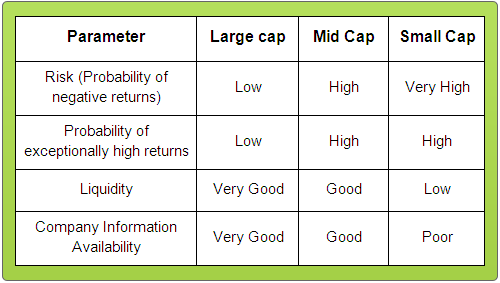
Market capitalization is often used as a proxy for a company’s size – but for investors, it also signals differences in risk, stability, and growth potential.
A simple way to understand this is through an analogy.
Think of a large-cap company as a heavy goods carrier. It moves steadily, handles bumps on the road with relative ease, and offers stability. In contrast, a mid-cap company is like a smaller vehicle – more agile and capable of accelerating faster, but also more sensitive to shocks.
This highlights a key trade-off.
Large-cap companies tend to be more resilient during market volatility, backed by established businesses, stronger balance sheets, and consistent performance. However, their growth tends to be relatively moderate.
Mid-cap and small-cap companies, on the other hand, often offer higher growth potential, as they are still in earlier stages of expansion. But this comes with greater uncertainty and sharper price movements, especially during market downturns.
For investors, the choice is not about picking one category over the other, but about balancing stability and growth in line with their risk tolerance and investment horizon.
So, why should you as an investor look at a company’s market capitalization?
Let’s have a look at the Investor Meet where three good friends – Mr. Conservative, Mr. Practical and Mr. Adventurous are having dinner together:

What did u observe in the above picture?
Mr. Conservative has a very low risk appetite, so he wants to be safe and invests only in large-cap stocks.
Mr. Practical understands that if he wants high returns he must take high risk. So, he invests a part of his funds in Mid-cap stocks which increases his chance of getting a high return on his total investment. At the same time, he keeps a large part of his investment exposed to low risk by investing in large-cap stocks.
Mr. Adventurous, on the other hand, is willing to risk losing a large part of his investment, for the possibility of getting very high returns on his investments. So, he invests most of his funds in risky mid-cap and highly risky small-cap stocks; he keeps a very small part of his fund invested in large cap stocks.
Thus, market capitalization plays an important role in deciding which companies you should invest in considering your expected returns and your risk appetite.
So, what kind of person are you? Are you Mr. Conservative, Mr. Practical or Mr. Adventurous?
If you liked what you read and would like to put it in to practice Register at MoneyWorks4me.com. You will get amazing FREE features that will enable you to invest in Stocks and Mutual Funds the right way.