“This time is different.” As John Templeton famously warned, these may be the four most dangerous words in the stock market.
Every market cycle certainly has its own triggers, themes, and narratives. But while conditions may evolve, investor behaviour—and more importantly, how financial intermediaries respond to rising participation—often follows a familiar pattern.
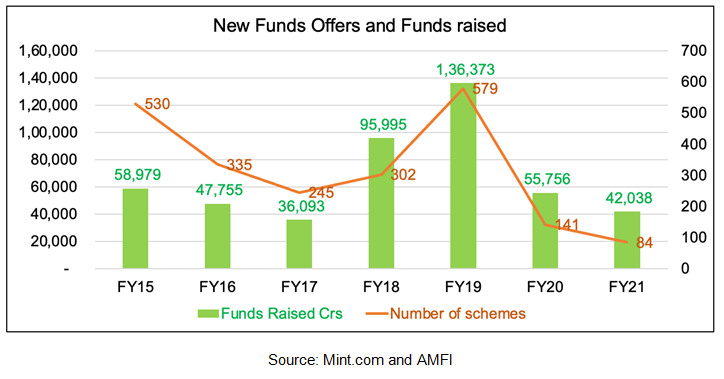
When liquidity is abundant and market optimism rises, investment banks and financial institutions typically accelerate the launch of new offerings. IPOs (Initial Public Offerings) and NFOs (New Fund Offers) begin flooding the market, capitalising on investor enthusiasm.
This is where understanding NFO vs IPO becomes important.
Investor excitement around IPOs is relatively easy to understand. IPOs often represent businesses in emerging sectors, new-age models, or high-growth industries seeking capital to scale. For investors, this creates the appeal of participating early in potentially transformative opportunities.
But the same enthusiasm around NFOs is harder to justify.
Unlike IPOs, which introduce a business to public markets, NFOs are often simply new mutual fund products entering already crowded categories. Yet, despite this distinction, NFOs continue to attract extraordinary inflows—especially during strong market phases.
This raises an important question: if the opportunity is not fundamentally new, what exactly is driving such investor excitement?
Why Most NFOs Are Not Really “New”
A key distinction in the NFO vs IPO debate lies in understanding what investors are actually buying.
An IPO typically gives investors access to a specific business—often a company entering public markets for the first time to raise growth capital. An NFO, however, works very differently. NFO proceeds are usually deployed into diversified portfolios of already listed stocks, often using strategies that closely resemble existing mutual fund categories.
This is why, despite the label, most NFOs offer very little that is genuinely “new.”
For example, the frequent launch of flexi-cap or multi-cap NFOs may appear innovative in packaging, but in practice, many of these strategies are broadly similar to existing equity funds already available in the market. Unless the fund introduces a distinctly new mandate, structure, or diversification opportunity, it is unlikely to materially differ from alternatives investors already have.
In essence, novelty in launch does not automatically translate into novelty in investment opportunity.
Rarely, an NFO may offer something differentiated—such as access to a new asset class, geographic theme, or structure not previously available. But these remain exceptions rather than the norm.
NFOs Have No Track Record
One of the biggest drawbacks of an NFO is simple—it has no history.
Mutual fund investing is usually based on evaluating a fund manager’s track record, portfolio discipline, and performance across market cycles. This helps investors judge whether the fund has delivered consistently over time.
An NFO offers no such evidence.
Since it is a fresh launch, investors are essentially committing money without knowing how the portfolio will shape up or how the strategy will perform in real market conditions. Unless the fund manager has a strong reputation and a clearly differentiated mandate, investing in an NFO often means investing without enough proof.
This is why investors must be cautious—many NFOs may gather large inflows more because of distributor push than established merit.
NFO Is Not Cheap Just Because NAV Is ₹10
A common myth around NFOs is that they are “cheap” because they are launched at an NAV of ₹10.
This is misleading.
NAV is simply the starting price per unit—it does not make the fund undervalued or give it higher return potential.
If two funds own similar stocks, their returns will depend on portfolio performance, not whether one started at ₹10 and the other is at ₹500.
A lower NAV does not mean more upside. It is just a smaller unit value.
For investors, what matters far more is the quality of the portfolio, fund strategy, and long-term execution—not the launch price.
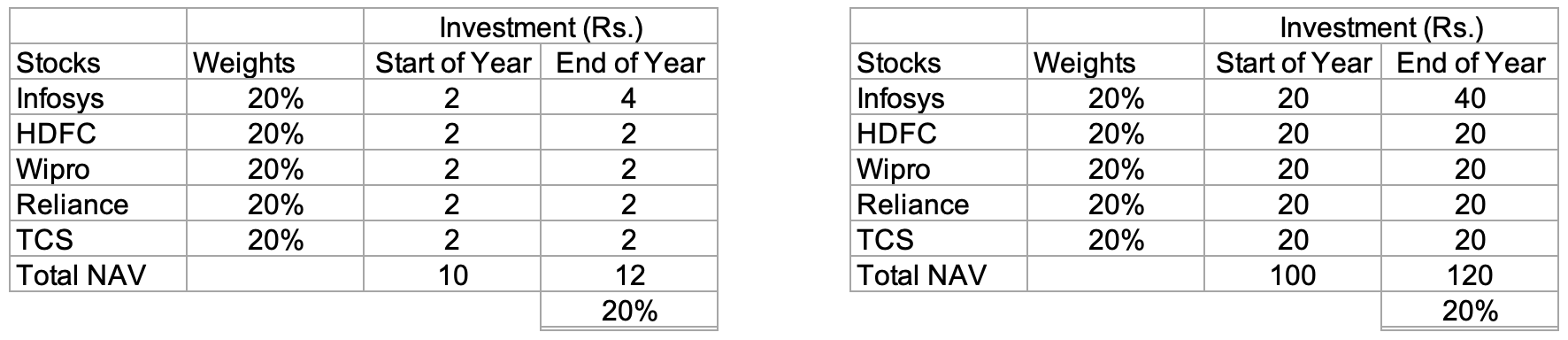
Take two funds with lower and higher NAV. If investment in Infosys doubles, NAV of NFO will go up by Rs. 2/unit or 20%. The existing fund also benefits from Infosys stock, as its NAV rises by Rs. 20/unit which is a similar 20% return.
The lower NAV of NFO doesn’t mean it has more upside potential.
When Does an NFO Actually Make Sense?
Despite the skepticism, not every NFO should be dismissed.
An NFO can be worth evaluating if it offers something genuinely unique—such as access to a new sector, market segment, or investment structure that existing funds do not provide. A differentiated mandate can create real diversification opportunities, especially when it introduces exposure that was previously unavailable.
However, such cases are relatively rare.
In most situations, new funds are launched in categories that already have multiple alternatives with established track records. In such cases, investors are often better served by choosing an existing fund with a few years of performance history—provided it aligns with their portfolio needs.
The bigger question should always be: Does this fund meaningfully improve my portfolio, or is it simply adding overlap?
A typical diversified fund may already hold dozens of stocks, many of which could significantly overlap with your current investments. If the portfolio is largely similar, the “new” fund may add little beyond complexity.
The focus, therefore, should not be on the novelty of the launch—but on whether the NFO genuinely improves diversification, strategy, or exposure.
If you liked what you read and would like to put it into practice Register at MoneyWorks4me.com. You will get amazing FREE features that will enable you to invest in Stocks and Mutual Funds the right way.