
Cyclical stocks are companies whose earnings rise and fall with economic cycles. Understanding how to invest in cyclical stocks requires timing, valuation discipline, and the ability to identify turning points in the business cycle. Cyclical stocks are companies whose earnings move with economic cycles, often leading to sharp price swings. Earnings swing sharply between boom and bust, and stock prices amplify those moves. For many investors, this volatility creates confusion – high reported profits tempt buying at the wrong time, while temporary losses trigger panic selling.
Understanding how cycles work—and how valuations behave within them – is critical. In this article, we outline what defines cyclical businesses, how to approach them rationally, and the discipline required to invest in them effectively.
1. What Are Cyclical Businesses?
As defined by Peter Lynch, cyclical companies are those whose revenues and profits move in tandem with the broader economic cycle.
They typically fall into two broad categories:
Rate-sensitive sectors – Autos, banks, and capital goods. Their demand depends on interest rates, credit availability, and economic activity.
Commodity-based sectors – Metals, mining, sugar, and cement. Their earnings fluctuate based on demand-supply dynamics and pricing cycles.
During economic slowdowns, profits can collapse sharply. In expansions, earnings often rebound dramatically. Importantly, regulatory and policy decisions frequently influence the depth and duration of these cycles.
2. The Core Mistake: Buying at the Peak
Cyclical investing is often misunderstood. Investors are drawn to companies when profits are strong and valuations appear optically cheap. However, price-to-earnings multiples tend to compress as earnings peak.
Conversely, when profits are depressed, valuations may look expensive—but this is often when future returns are most attractive.
The rational approach is counter-intuitive:
- Accumulate when the industry is under stress but balance sheets remain intact.
- Exit when capacity expansion, rising costs, and exuberant earnings indicate late-cycle conditions.
3. A Framework for Investing in Cyclicals
Successful cyclical investing requires tracking industry signals rather than quarterly earnings momentum.
Key indicators include:
- Inventory levels and demand-supply balance
- Capacity additions across the industry
- Interest rate direction and credit growth
- Debt-to-equity levels and cash flow resilience
- Insider buying or share buybacks during downturns
Industries due for revival often show declining inventories, improving pricing power, and stabilizing input costs.
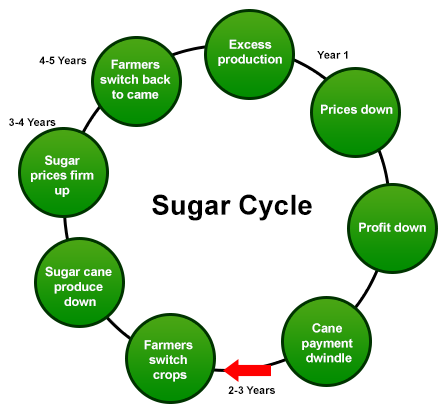
4. The Sugar Industry: A Classic Cycle
The Indian sugar industry is a textbook example of demand-supply-driven cyclicality.
When sugar prices fall, mills struggle with profitability, leading to delayed payments to farmers. Lower farmer incentives reduce cane cultivation, eventually tightening supply. Reduced output pushes sugar prices higher, restoring profitability—until increased production once again creates surplus and price pressure.
This recurring pattern defines the industry’s earnings volatility.
This could be easily explained with the help of the following illustrations:
5. Knowing When to Exit
Exiting cyclicals requires as much discipline as entering them.
Warning signs of late-cycle conditions include:
- Rising interest rates and slowing consumption
- Aggressive capacity expansion across competitors
- Falling commodity prices
- Inventory buildup
- Regulatory pressures or deteriorating cash flows
When plants operate at full capacity and companies announce large expansions funded by leverage, it often signals peak optimism.
The Bottom Line
Cyclical stocks can generate strong returns – but only when approached with valuation discipline and an understanding of industry dynamics. Buying during pessimism and exiting during optimism is easier said than done, but it defines successful cyclical investing.
Returns in such businesses depend less on prediction and more on process – tracking normalized earnings, balance sheet strength, and cycle indicators rather than headlines.
At MoneyWorks4Me, we evaluate cyclical businesses through a structured valuation framework that emphasizes normalized profitability, capital allocation quality, and margin of safety—helping investors participate in cycles without being trapped by them.
If you liked what you read and would like to put it in to practice Register at MoneyWorks4me.com. You will get amazing FREE features that will enable you to invest in Stocks and Mutual Funds the right way.