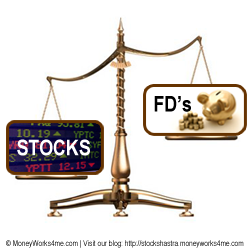
When comparing Stocks vs FD, investors are often caught between safety and growth. While fixed deposits offer predictable returns, equities provide long-term wealth creation potential. Understanding how Stocks vs FD investments differ across risk, returns, and inflation impact is essential for making the right financial decision.
The Core Difference: Safety vs Growth
A Fixed Deposit is a capital preservation instrument. You deposit money for a fixed tenure and earn a predetermined rate of interest. Returns are stable and predictable.
Stocks, on the other hand, represent ownership in businesses. Returns are market-linked and fluctuate in the short term, but historically offer superior long-term compounding potential.
The Stocks vs FD trade-off is clear:
FDs prioritize certainty.
Stocks prioritize growth.
What is Stocks vs FD in Investing?
The Stocks vs FD decision refers to choosing between two fundamentally different asset classes. Fixed deposits are designed to protect capital and generate steady income, while equities aim to grow wealth by participating in economic and corporate growth.
This distinction is critical because it directly impacts long-term financial outcomes.
A Simple Portfolio Illustration
Consider three investors allocating 70% of their portfolio to the Public Provident Fund and the remaining 30% differently:
- Investor A: Entire 30% in Fixed Deposits
- Investor B: 20% in FD, 10% in equities
- Investor C: Entire 30% in equities
Assume long-term average returns:
- PPF: 7–8% (current realistic range)
- FD: 5–7%
- Equity: 12–15% (long-term disciplined investing)
The portfolio return depends on allocation.
Over long periods, even a 2–3% difference in annual returns creates a significant wealth gap due to compounding.
A = P(1 + r)^n
The power of compounding amplifies small return differences dramatically over 20–30 years. A modest annual outperformance can translate into nearly double the corpus over long durations.
This is the structural advantage equities hold in the Stocks vs FD comparison.
Stocks vs FD: Impact of Inflation and Taxation
One of the most critical aspects of the Stocks vs FD decision is how each performs after adjusting for inflation and taxes.
- FD returns are fully taxable as per your income slab, reducing effective returns.
- If inflation exceeds FD returns, real purchasing power declines.
Equities, however, tend to adjust better to inflation over time as businesses grow revenues and profits. Additionally, long-term capital gains taxation in India is relatively more efficient compared to slab-based taxation on FD interest.
Fixed Deposits: Stability with Limitations
Strengths
- Capital protection (subject to bank credit risk)
- Predictable returns
- Suitable for short-term goals
- Low volatility
Limitations
- Lower Real Returns
FD rates typically range around 5–7%. After tax, effective returns fall further. - Inflation Risk
If inflation exceeds your FD return, purchasing power declines. - Taxation
Interest income is fully taxable. - Liquidity Constraints
Premature withdrawal often attracts penalties.
FDs play an important role in the Stocks vs FD framework, but primarily for stability, not wealth creation.
Equities: Growth with Volatility
Stocks are volatile in the short term but powerful in the long term.
Key Advantages
- Higher Return Potential
Equities participate in economic growth. Over long periods, earnings growth drives price appreciation. - Inflation Hedge
Corporate performance typically adjusts with inflation. - Liquidity
Listed stocks can be bought and sold during market hours. - Tax Efficiency
Long-term capital gains taxation is relatively favorable.
However, in the Stocks vs FD comparison, equity returns are not guaranteed. Poor stock selection or emotional decisions can lead to losses.
Stocks vs FD: What Should You Choose?
The Stocks vs FD decision should not be framed as a binary choice.
Choose FDs if:
- You have short-term financial goals
- Capital protection is critical
- You have low risk tolerance
- You need predictable cash flows
Choose equities if:
- You are investing for 5–10+ years
- You seek inflation-beating growth
- You can tolerate volatility
- You follow a disciplined investment framework
Most investors benefit from a combination, using FDs for stability and equities for growth.
Final Perspective
In the Stocks vs FD debate, the difference between 6% and 12–15% returns is not incremental, it is transformational over long periods.
FDs provide psychological comfort and capital stability.
Equities enable long-term wealth creation through compounding.
The stock market is not a game of chance when approached with discipline and valuation awareness. It becomes risky only when treated as speculation.
A well-structured allocation between the two ensures that your portfolio balances safety with growth because in investing, preserving wealth is important, but compounding it is essential.
Also Read: Trading or Investing – What’s right for you?
If you liked what you read and would like to put it in to practice Register at MoneyWorks4me.com. You will get amazing FREE features that will enable you to invest in Stocks and Mutual Funds the right way.