

 Anupama Shukla - Team MoneyWorks4me
Most participants in the stock market eventually face a common question: should you trade actively or invest for the long term? The terms are often used interchangeably, but they represent very different approaches.
Understanding how each works—and what it demands from you—can help you decide which path aligns better with your goals, temperament, and time commitment.
1. How Trading Works
Trading focuses on short-term price movements. The objective is to buy and sell stocks quickly to capture small price differences.
Traders typically rely on two broad approaches:
- Anticipating short-term events or news that may move a stock
- Using technical analysis based on price patterns, volume trends, and market signals
Positions are often held for very short durations—sometimes hours or days. Traders usually define clear exit points, such as a target price or a strict time window.
While trading can produce quick gains, it also involves:
- Frequent transactions
- Higher costs from brokerage and fees
- Greater exposure to market volatility
- In some cases, leverage or borrowed funds
Success in trading often depends on precise timing, which is difficult to sustain consistently.
2. How Investing Differs
Investing is built around long-term ownership of businesses rather than short-term price movements.
Investors typically evaluate:
- Company fundamentals and financial strength
- Industry dynamics and competition
- Long-term growth potential
- Intrinsic value compared to market price
The goal is to buy businesses that are undervalued or capable of sustained earnings growth and hold them through market cycles.
Unlike traders, long-term investors:
- Are less focused on short-term price fluctuations
- Benefit from compounding returns
- May earn dividends in addition to price appreciation
- Often reinvest gains to build wealth over time
In many cases, investors do not define a fixed selling price in advance, as long as the investment thesis remains intact.
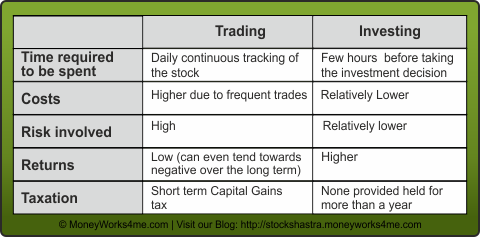
3. Risk, Costs, and Practical Reality
Both trading and investing involve risk, but the nature of that risk differs.
Trading typically carries:
- Higher transaction costs due to frequent buying and selling
- Greater reliance on timing the market
- Increased emotional pressure and time commitment
Research across markets has shown that a large majority of active traders struggle to consistently outperform broad market returns over long periods.
Investing, on the other hand, relies more on:
- Business quality
- Earnings growth
- Long-term discipline
For most retail investors, this approach tends to be more practical and sustainable.
4. Why Mixing the Two Often Creates Confusion
Some investors attempt to combine trading and investing. In practice, this can blur decision-making.
A common pattern emerges:
- When a stock rises quickly, it is treated like a trade
- When a position falls, it suddenly becomes a “long-term investment”
This shift in mindset can weaken discipline and increase risk.
A clearer approach is to decide why you are buying a stock before you buy it—whether it is for short-term price movement or long-term ownership.
The Bottom Line
Trading and investing are fundamentally different strategies. Trading depends on timing and short-term price movements, while investing relies on identifying quality businesses and allowing earnings to compound over time.
For most individual investors, long-term investing tends to offer a more reliable path to wealth creation, provided it is supported by research, valuation discipline, and patience.
A Note from MoneyWorks4Me
At MoneyWorks4Me, our focus is on helping investors identify fundamentally strong companies available at reasonable valuations. By combining research-driven insights with long-term discipline, investors can build portfolios designed to grow steadily across market cycles.
If you liked what you read and would like to put it in to practice Register at MoneyWorks4me.com. You will get amazing FREE features that will enable you to invest in Stocks and Mutual Funds the right way.



Need help on Investing? And more….Puchho Befikar

Kyunki yeh paise ka mamala hai
Start Chat | Request a Callback | Call 020 6725 8333 | WhatsApp 8055769463

 Yog Rajani

 Ketan Pitrubhakta



Definitely investing works out to be a better option since trading most often turns out to be a zero sum game
@37c332a01e364037add8f177a9bc53e1:disqus Investing definitely works out to be a better
option. In fact great investors like Warren Buffett and Rakesh
Jhunjhunwala have made great returns from safe investing rather
than trading.
Without a proper study of the trading strategy with technical skills and strict stop loss mechanism in place,one should not indulge in stock trading.Never borrow or leverage and trade.
@facebook-100000502520519:disqus Its good to hear about your understanding of
pitfalls to be avoided while doing trading. Stock trading, even
with sound trading strategy and proficiency in technical skills is
a tough task to master. The risks increase manifold when trading
is done with borrowed funds.
investing in long term is safe and its 100% safe in money & time
@ Saby, Thanks for your comment. Investing is definitely
safe and preferred over trading. Choosing the right stock at right
price makes investing much more fruitful. To get more insight
about investing, please visit our website http://www.moneyworks4me.com
investment is better way than trading..
Hey that’a good article and thanks for writing up !
Want to play safe and wan to get good returns more than saving acc and beat inflation investing works,,,
Want to make your hands dirty and play game with adrenaline rush, then u should look at trading with pre-determined error bearing capability.
Trading vs Investing… well, I like to use both, depending on worlds Market. Investing, in dividend is smart, because even if you hold during years, at least you have some cash flow. But Trading it’s also necessary, especially in “bear market” , or in “distribution market”,
Personally I like to use both, and when I’m looking for “investing strategies”, I use technical analyse and my trading skills.
But, I disagree by saying investing give better ROI than trading.. In fact, you can make about 25 easy ROI in a year with trading, whit low risk as 1% of your capital, if done properly. Against Stocks /Dividend that give you about 3-5% ROI.
At another way, for the time, it took me, till I become a positive trader in the market, …it cost me a lot of money in education (mistake/course/Testing stuff etc).
On investing side, I does require some trading skills how ever. If stocks, going down, (and you can see this in technical analyse).It will be smart to use “hedge” against your position, to protect it.
I can go on and on…but I will stop here.
For conclusion, I think if you would like to make money in trading, you need to use appropriate skills in appropriate market time. Or something, use both. Today market are affected same way, by all world good and bad news. And you need to adapt your self very fast and use the right skills at the right time.