 Madhur Rathi
REITs and InvITs: Structured Access to Real Estate and Infrastructure Income
Real estate is often perceived as a safe and reliable investment. In reality, rental yields are typically in the low single digits, liquidity is limited, transaction costs are high, and ticket sizes are substantial.
Physical ownership also involves regulatory friction, maintenance oversight, and exit timing risk. For investors seeking income and real asset exposure without these constraints, REITs and InvITs provide a more structured alternative.
Many investors looking for real estate exposure in India come across REITs and InvITs but are unsure how these structures work and whether they are suitable for income investing.
This article explains what they are, how they function, and what investors should evaluate before allocating capital.
What Are REITs and InvITs?
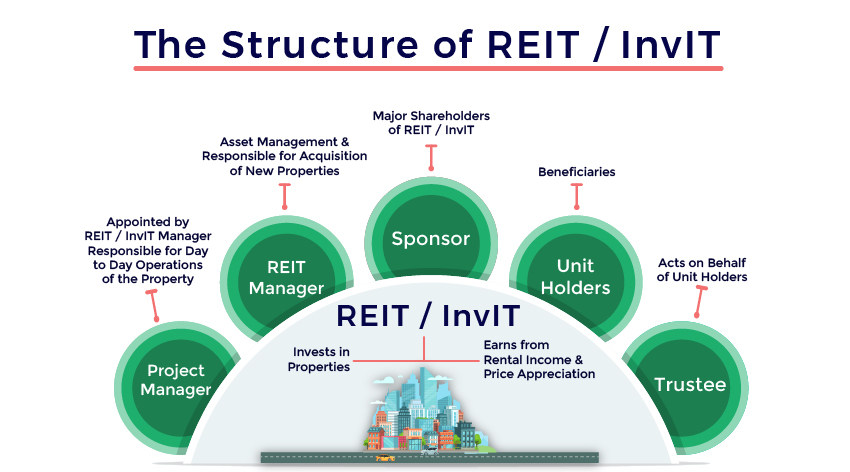
A Real Estate Investment Trust (REIT) or Infrastructure Investment Trust (InvIT) is a tax-efficient trust structure that owns income-generating real estate or infrastructure assets.
The structure is similar to a mutual fund. A sponsor creates the trust and transfers assets to it, either directly or through Special Purpose Vehicles (SPVs). Units are issued to investors against these assets, and income generated is distributed to unit holders.
REITs typically invest in commercial real estate such as office parks and retail spaces. InvITs invest in infrastructure assets like highways, power transmission lines, pipelines, and renewable energy projects.
Investor implication: These vehicles allow participation in large, professionally managed assets without direct property ownership.
How the Income Model Works
The operating model is straightforward: assets are leased or operated, income is collected, and the majority of distributable cash flows are passed on to investors.
Under SEBI regulations, at least 90% of net distributable cash flows must be distributed. A minimum of 80% of assets must be completed and income-generating, with limited exposure permitted to under-construction or financial assets. There is also a minimum asset size requirement of ₹500 crore, and NAV must be declared at least twice annually.
This mandatory payout structure makes REITs and InvITs inherently income-oriented.
Investor implication: These instruments are designed for steady yield rather than aggressive capital appreciation.
Why They Make Sense for Individual Investors
REITs and InvITs address three structural challenges of physical ownership: high ticket size, concentration risk, and illiquidity.
Because units are listed on exchanges, investors can buy and sell more easily than physical property. Additionally, exposure is diversified across multiple assets and tenants rather than a single property. Importantly, investors gain access to premium commercial and infrastructure assets that would otherwise be inaccessible.
However, returns depend on occupancy levels, lease renewals, regulatory stability, and asset life not simply on rising property prices.
Investor implication: They are suitable for investors seeking income stability and real asset diversification within a portfolio.
What to Evaluate Before Investing
For REITs, focus on occupancy levels, lease tenure visibility, tenant quality, and geographic diversification. Longer lease expiries and diversified tenant profiles improve income predictability.
Listed Indian REITs include Brookfield India Real Estate Trust, Embassy Office Parks REIT, and Mindspace Business Parks REIT.
For InvITs, evaluate concession life, operating and maintenance costs, regulatory framework, and revenue stability. Since these assets generate toll, annuity, or transmission income, cash flow durability is central.
Examples include PowerGrid Infrastructure Investment Trust, India Grid Trust, and IRB Infrastructure Trust.
Investor implication: Treat these trusts as operating cash flow businesses. Asset quality and income visibility matter more than headline yield.

Taxation Framework
Distributions such as interest, dividends, or rental income are taxed at the investor’s applicable income tax slab, with TDS deducted at source.
Capital gains taxation is similar to debt instruments, with higher tax rates for shorter holding periods. Investors should therefore evaluate post-tax yield rather than relying solely on gross distribution figures.
The Bottom Line
REITs and InvITs provide structured access to income-generating real estate and infrastructure without the operational burden of ownership. They reduce entry barriers, improve liquidity, and enhance diversification.
However, they are yield-oriented vehicles. Sustainable returns depend on asset quality, lease visibility, regulatory stability, and disciplined capital allocation not speculative price appreciation.
A Disciplined Approach
At MoneyWorks4Me, we evaluate REITs and InvITs through a valuation-driven framework that prioritizes cash flow durability and risk-adjusted return potential. Structured income is valuable but only when the underlying assets justify the price.
Best Stocks From:
Nifty 50 Nifty Next 50 Nifty 100 Nifty 200 Nifty 500 Nifty Financial Services SmallCap 250 MidCap 100


Need help on Investing? And more….Puchho Befikar

Why MoneyWorks4me | Call: 020 6725 8333 | Ebook | WhatsApp: 9860359463


 Roshan Pande
 Raymond Moses - Founder, MoneyWorks4me
 Yog Rajani
 Team-MoneyWorks4me