Disclosure: MoneyWorks4me's employees may have exposure in the securities mentioned in the above report. For detailed disclosure
 SEBI Registered: Investment Adviser - INA000013323
| Name of the IA registered with SEBI: | The Alchemists Ark Pvt. Ltd. |
| Logo: |  |
| Trade/Brand Name of IA: | MoneyWorks4Me Investment Advisers |
| Brand Logo: |  |
| SEBI Registration Number: | INA000013323 Validity - May 16, 2019 - Perpetual |
| Registration: | Non-Individual |
| BSE Enlistment No: | 1187 |
| Address: | B-101, Signet Corner Building, Balewadi Phata, Baner, Pune, Maharashtra 411045 |
| Compliance officer Details: |
Name: Shrikant Jagtap Email: shrikant.jagtap@moneyworks4me.com Telephone: +919860359463 Address: Same as IA |
| Grievance Officer Details: |
Name: Mukta Vaze Email: mukta.vaze@moneyworks4me.com Telephone: +91 98609 19463 Address: Same as IA |
| Principal Officer Details: |
Name: Atharva Bhide Email: atharva.bhide@moneyworks4me.com Telephone: +91 91758 99463 Address: Same as IA |
| Standard Warning: | Investment in securities market are subject to market risks. Read all the related documents carefully before investing. |
| Disclaimer: | Registration granted by SEBI, enlistment with exchange and certification from NISM in no way guarantee performance of the intermediary or provide any assurance of returns to investors. |

Warning: Investment in securities market are subject to market risks. Read all the related documents carefully before investing.
Disclaimer: Registration granted by SEBI, membership of BASL (in case of IAs) and certification from NISM in no way guarantee performance of the intermediary or provides any assurance of returns to investors.
SEBI regional/local office address -


Address:
© 2026 The Alchemists Ark Pvt. Ltd. All rights reserved. MoneyWorks4Me ® is a registered trademark of The Alchemists Ark Pvt. Ltd.

MoneyWorks4Me method for rating and ranking mutual funds for SIP
MoneyWorks4Me rating and ranking of funds for SIP is available to subscribers only. Moneyworks4Me is not a rating and ranking agency, however it is required that users have a way of selecting funds and building a Portfolio. The method used by it are described below to enable users to understand the logic behind the rating and ranking Subscriber will find more details on this in the various content made available from time to time. In case you need more please write to besafe@moneyworks4Me.com
MoneyWorks4Me rates and ranks mutual funds based on the following data-driven system:
- Performance Consistency: This is measure based on whether the fund has beaten the benchmark index consistently. For this we compare the 3-year rolling returns of the fund with the benchmark for a minimum of 5 years and preferable 10 years. The period of rolling is one month and holding period is 3 years. Fund are color-coded Green on Performance when the fund beats the benchmark more than 90% of the time. It is Orange if it beats 80% to 90% of the time and Red if less than 80%. Funds with less than 5 year data are color-coded Grey.
- Quality of Portfolio Holding: Moneyworks4Me has color-coded stocks as Green, Orange and Red based on whether the company's performance has generated a ROCE above a threshold level (cost of capital) over 10 years (minimum 6 years) and generated positive Free Cash Flow. For Banks it checks whether ROE is greater than 15% and sales has grown over previous year. Stocks that perform consistently on these combined metrics are color-coded Green (min score 14 out of 20), Orange (between 8 and 14) and Red (less than 8 out of 20). Fund are color-coded Green provided the portfolio has 70% holding in Green stocks but not more than 20% in Red stocks. Funds with more than 20% Red stocks in the portfolio are color-coded Red. The rest are Orange funds
Funds ranking in screeners: Performance Consistency and Quality are two parameters used for ranking funds for SIP. The ranking as follows GG, GO, GR, OG, OO, OR, RG, RO and RR.
With the same color-coded funds, the one with the higher Average 3-year rolling returns (over 5 to 10 years), the number that appears in the Performance tag, ranks higher.
Here is the summary:
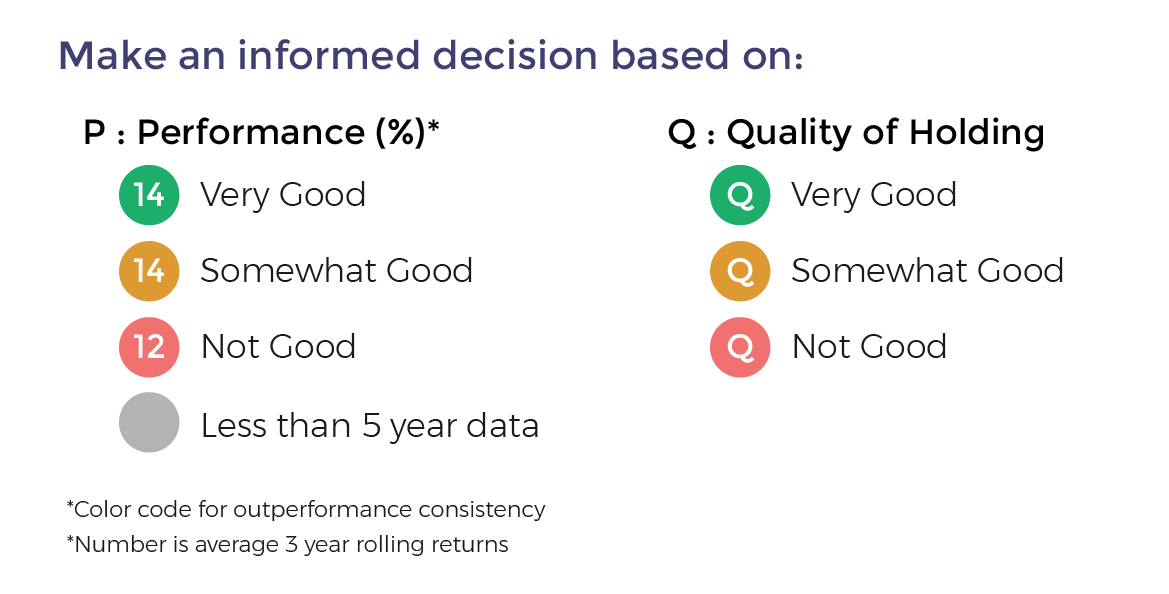
The third tag Upside Potential is not relevant for SIP. It is relevant for lumpsum investments in Mutual Funds.
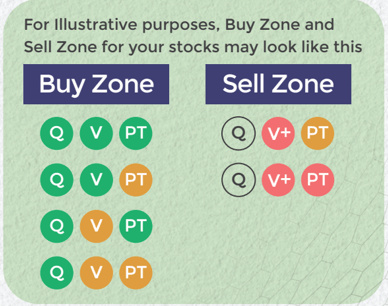
Make an informed decision for Stocks
Invest using an intelligent system with powerful data-driven tools that help you identify opportunities and make informed buy-hold-sell decisions
Q Very Good
Q Somewhat Good
Q Not Good
V+UnderValued (UV)
V Somewhat UV
V Fair Value
V Somewhat OV
V+ OverValued (OV)
Buy quality Stocks when they are available at reasonable prices and supported by an upward price trend and Sell when they are Overvalued using the Decizen Rating System. Covers 3500+ stocks