


 Team-MoneyWorks4me
What is IIP and Why Does It Matter?
The Index of Industrial Production (IIP) measures the level of industrial activity in the economy over a given period. It reflects the supply side of the economy by capturing production across key sectors.
As per the latest available IIP series released by the Ministry of Statistics and Programme Implementation (Base Year 2011–12), the index is composed primarily of manufacturing, which accounts for approximately 77.6% of the total weight. Mining contributes around 14.4%, while electricity makes up about 8.0%.
This composition is significant because it highlights that manufacturing activity largely drives overall IIP trends. For investors, this means that any sustained shift in manufacturing output can have a meaningful impact on broader economic indicators and, by extension, the stock market.
It is also important to note that while these weights are based on the current official series, a revision of the base year is expected in the future to better reflect structural changes in the economy.
Understanding the IIP Data Impact on Stock Market
The IIP data impact on stock market stems from its connection to business performance and earnings expectations. Stock markets are forward-looking and tend to react to changes in economic activity well before they are fully reflected in financial results.
When IIP growth is strong, it indicates that companies are producing more to meet rising demand. This typically leads to higher revenues, improved operating leverage, and stronger earnings visibility. As a result, investor sentiment tends to improve, supporting stock prices.
Conversely, weak IIP data signals slowing demand and reduced production activity. This can translate into pressure on corporate earnings, leading to cautious sentiment and potential declines in stock prices. While the relationship is not always immediate, sustained changes in IIP trends tend to align closely with broader market movements over time.
How is IIP the lifeline of Economy & Stock Market?
The relationship between the IIP and the stock market is backed by a whole chain of events.
In our blog on Consumer Spending, we learnt that consumer spending is indicative of the demand in the economy. IIP, on the other hand, indicates the total production in the economy and is the other side of the coin i.e. the Supply side.
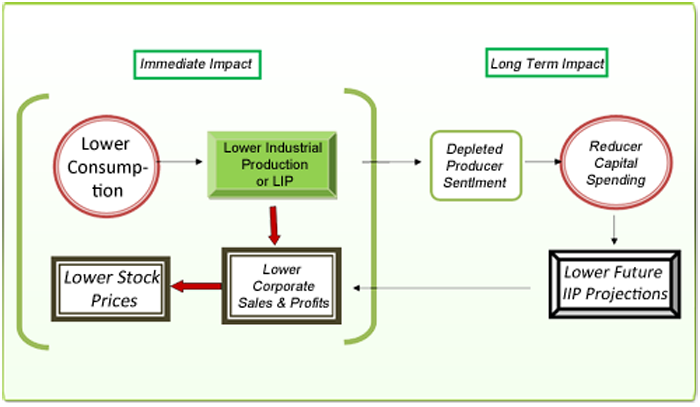
The diagram given above shows how lower IIP – which usually results due to lower consumer spending – can lead to a drop in stock prices.
To fully understand the IIP data impact on stock market, it is essential to view it within the broader economic cycle.
When consumer demand weakens, businesses experience a decline in sales. In response, they reduce production, which leads to a slowdown in IIP. This reduction in output eventually impacts corporate revenues and profitability. As earnings expectations decline, stock prices tend to adjust accordingly.
Over a longer horizon, the impact becomes more structural. Weak demand reduces business confidence, leading to lower capital expenditure and delayed expansion plans. This, in turn, affects future growth prospects and weighs on market valuations.
On the other hand, strong demand drives higher production, supports earnings growth, and creates a positive feedback loop that sustains market momentum. This interconnected cycle explains why IIP is closely tracked by both economists and investors.
So is IIP just about overall production or does it give us an in-depth picture of different industries?
Sectoral View: What IIP Data Really Reveals
Headline IIP numbers often mask important sector-level trends. A deeper breakdown helps investors better understand how the IIP data impact on stock market plays out across industries.
To interpret IIP data effectively, focus on the following sectoral drivers:
- Manufacturing (77.6% weight):
This is the most critical component of IIP. Sustained growth in manufacturing typically reflects broad-based economic strength and improving demand conditions. It has the highest correlation with corporate earnings and overall market direction. - Mining (14.4% weight):
Mining activity provides early signals about commodity demand and industrial input cycles. Trends here can influence sectors such as metals, energy, and infrastructure, making it a useful indicator for cyclical positioning. - Electricity (8.0% weight):
Electricity consumption acts as a proxy for underlying economic activity. Higher power generation generally indicates increased industrial and commercial usage, supporting the broader growth narrative. - Capital Goods (Use-Based Classification):
Rising production in capital goods signals increased investment activity and capacity expansion. This often precedes future earnings growth and is a positive indicator for long-term economic momentum. - Consumer Goods (Durables & Non-Durables):
Growth in consumer goods reflects demand strength. Strong trends here typically benefit FMCG and discretionary sectors, while a slowdown may indicate weakening consumption. - Intermediate Goods:
These serve as inputs for final production. Consistent growth suggests stable industrial activity and healthy supply chains, supporting overall production continuity.
By analysing these components together, investors can move beyond headline numbers and gain a more nuanced understanding of where growth is coming from, and which sectors are likely to benefit in the stock market.
The IIP does not include growth of banking sector. However, increase in production & investment activity is usually financed through borrowings from banks. So, if industrial production & capital spending is increasing then it is likely to have a positive impact on the banking sector.
How Investors Can Use IIP Data
Understanding the IIP data impact on stock market enables investors to make more strategic allocation decisions rather than reacting to short-term volatility.
A sustained increase in IIP growth can indicate improving economic conditions and may justify higher exposure to cyclical sectors. Conversely, a prolonged slowdown in IIP growth may signal potential headwinds for corporate earnings, prompting a more cautious investment approach.
IIP trends can also help identify sectoral opportunities. Strong growth in specific industries may translate into better earnings visibility for companies within those sectors. Similarly, periods of weak industrial growth may create opportunities to accumulate fundamentally strong stocks at more attractive valuations.
However, IIP should not be viewed in isolation. It is most effective when used alongside other macroeconomic indicators and company-specific analysis.
Limitations of IIP as an Indicator
While the IIP data impact on stock market is meaningful, the indicator has certain limitations that investors should be aware of.
IIP data is released with a lag, which means it may not fully reflect current economic conditions. It is also subject to revisions, which can alter initial interpretations. Moreover, IIP does not capture the services sector, which constitutes a significant portion of the Indian economy.
These limitations highlight the importance of using IIP as part of a broader analytical framework rather than relying on it as a standalone signal.
Final Perspective
The IIP data impact on stock market lies in its ability to act as an early indicator of economic direction. While it does not determine market movements on its own, it plays a critical role in shaping expectations around growth, earnings, and investment activity.
For investors, the real value of IIP lies in identifying trends rather than reacting to individual data points. When combined with a disciplined investment approach, this understanding can significantly enhance long-term decision-making.
If you liked what you read and would like to put it in to practice Register at MoneyWorks4me.com. You will get amazing FREE features that will enable you to invest in Stocks and Mutual Funds the right way.


Need help on Investing? And more….Puchho Befikar

Kyunki yeh paise ka mamala hai
Start Chat | Request a Callback | Call 020 6725 8333 | WhatsApp 8055769463


 Yog Rajani

 Ketan Pitrubhakta



it is offcourse a very thought-proviking analysis of economic developement measuring rod.
salute to the team-members.
kailash thakur
Thank you for your appreciation. Do keep reading and posting your comments
where to get the IIP numbers officially at any point in time?
You can get the official IIP data on RBI and CSO’s website. RBI releases a monthly bulletin which is usually out by the 15th of every month which has this data. But, keep in mind that the data is released with a lag of 2 months.
Very nice article and we all new investors must know IIP impact but let me add something of my view that Stock prices are quite sensitive and very often decision making process of Expert one can be deviated Because all suspect corporate governance issue and their thirst to get utmost in very short period of time what actually happen with Midcaps and SmallCaps.Largecaps are well known entities and any how they are landmarks for a economy as whole hence they will always being favorite to all new investors like me who understand very little of book of account which can be easily inflated in Indian context.So being learners we all want to work out on authentication or rating system for Book of Account if it persists already then why non-rated kind of stocks(on the basis of book of account/corporate governance) get listed on public exchanges like BSE & NSE ?
Thanks for your appreciation. You have rightly pointed out that corporate governance practices and accounting disclosures are not the most transparent in India especially for midcaps and small caps. We completely agree with you that there needs to be a method/system to rate the accounting practices/disclosures and corporate governance practices of the various companies. We are trying to form such a system and incorporate it in our valuation methodology. We are also planning to start a series on how companies usually manipulate their financial statements and what signs you could look for in some days. We are sure this will definitely help you to identify which company should you invest in. So, do stay posted for this.
Excellent
Thank you.
Hi,
It is simply amazing to read your stock shashtras and this was no exception.
shivaraj e
Thank you. Do keep reading stock shastra and post your feedback/comments.
Hi,
When iip data release in month, any particular date for release that data?
Realy IIP effects is on market is almost 70 % so its important to watch globel market production ratio is amazing .
This website is another institute for me in field of financial markets after my study. Information about stocks and securities market is given here in very simple and interesting manner , specially the way to explaining of fundamental analysis.