

 Team-MoneyWorks4me
Why Industry Analysis Matters in Stock Investing
Most investors spend a disproportionate amount of time analysing individual companies while overlooking the broader context in which these companies operate. However, industry analysis in stock investing is often the difference between average and superior outcomes.
A company’s performance is not driven solely by its management or strategy. It is equally influenced by the structure, growth, and competitive dynamics of the industry it belongs to. This is why, at times, even a fundamentally average company in a high-growth industry can outperform an excellent company operating in a declining sector.
Before you decide which stock to buy, it is critical to first understand which industry to invest in. This article lays down a structured approach to how to analyse an industry, helping you make better and more informed investment decisions.
Industry Composition: The Foundation of Industry Analysis
The first step in any industry analysis framework is to clearly define the industry itself.
At first glance, industries may appear straightforward, but a deeper look reveals meaningful differences within the same sector. For instance, companies manufacturing passenger cars and those producing two-wheelers are both classified under the automobile sector. Yet, their demand drivers, pricing power, customer segments, and growth trajectories can be very different.
If you fail to correctly identify industry composition, you risk comparing businesses that are not truly comparable—essentially comparing apples with oranges.
A robust sector analysis begins with understanding:
- What products or services companies offer
- How revenues are segmented (product-wise or geography-wise)
- Which customer segments they cater to
Once this clarity is achieved, the next step is to analyse how the industry functions as a system. This includes studying input costs such as raw materials and labour, understanding the end-user industries, and examining historical trends in revenues, margins, and profitability.
This forms the base upon which deeper industry analysis in stock investing can be built.
Porter’s Five Forces: A Practical Framework for Industry Analysis in Stock Investing
To move beyond surface-level understanding, investors need a structured way to evaluate how competitive and profitable an industry truly is. One of the most effective tools for this is the Porter’s Five Forces Model, developed by Michael E. Porter. This framework helps in assessing the deeper structural forces that determine long-term profitability within an industry, making it an essential part of industry analysis in stock investing.
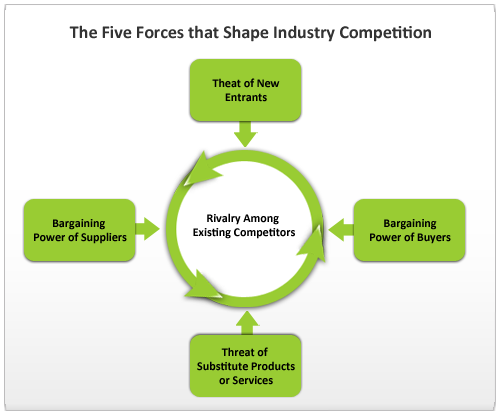
- Threat of New Entrants – This force examines how easy it is for new companies to enter an industry. When entry barriers are low, new players can enter quickly, increasing competition and putting pressure on prices and margins. On the other hand, industries with high entry barriers—such as large capital requirements, strong brand loyalty, regulatory hurdles, or complex distribution networks—tend to protect existing players. From an investor’s perspective, industries that are difficult to enter are generally more stable and capable of sustaining profitability over longer periods.
- Bargaining Power of Suppliers – Suppliers play a crucial role in determining the cost structure of an industry. When suppliers are few in number or provide specialised inputs, they gain significant pricing power. This can directly impact the margins of companies operating within the industry. In contrast, when there are many suppliers or easy substitutes for inputs, companies have better negotiating power and can control costs more effectively. Industries that are heavily dependent on limited or critical resources often face higher supplier power, making them more vulnerable to cost pressures.
- Bargaining Power of Buyers – This force evaluates how much influence customers have over pricing and terms. When buyers have multiple alternatives or can easily switch between products or services, they tend to demand lower prices and better value, which reduces profitability for companies. In contrast, when products are differentiated or switching costs are high, companies retain pricing power. Industries where customers are highly price-sensitive or have abundant choices tend to experience margin pressure, whereas those with loyal customer bases or unique offerings are better positioned.
- Threat of Substitutes – Substitutes refer to alternative products or services that can fulfil the same need. A high threat of substitutes limits the ability of companies to increase prices, as customers can shift to alternatives if they find better value elsewhere. This force is particularly important in industries where innovation or changing consumer preferences can quickly introduce viable alternatives. Even if an industry appears strong, the presence of close substitutes can cap long-term profitability and growth potential.
- Competitive Rivalry Within the Industry – Competitive rivalry reflects the intensity of competition among existing players in the industry. When competition is high, companies often engage in price wars, aggressive marketing, and continuous innovation, all of which can reduce profitability. On the other hand, industries with fewer players or differentiated offerings tend to maintain healthier margins. Factors such as the number of competitors, industry growth rate, and ease of exit play a significant role in determining the level of rivalry. Highly competitive industries are typically more volatile, while less crowded industries offer more stable returns.
Industry Life Cycle: Identifying Where the Sector Stands
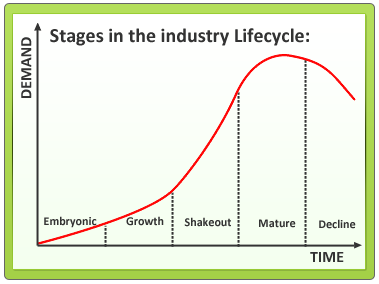
Industries are not static. They evolve over time, and each stage of this evolution offers a different risk-return profile. Understanding the industry life cycle is therefore essential.
Characteristics of the different stages
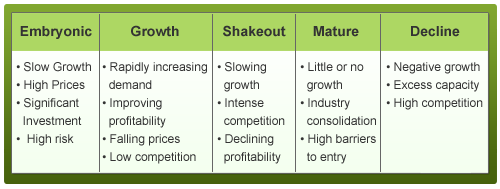
In the early or embryonic stage, industries are characterised by innovation, uncertainty, and low penetration. As they transition into the growth stage, demand expands rapidly, profitability improves, and companies scale operations.
Eventually, industries enter a shakeout phase where weaker players exit, and consolidation begins. This is followed by the mature stage, where growth stabilises, competition intensifies, and margins become predictable.
Finally, some industries enter a decline phase due to technological disruption, changing consumer preferences, or saturation.
For an investor, identifying the stage of the industry is crucial. High growth industries may offer better opportunities, but they also come with higher uncertainty. Mature industries may provide stability but limited upside. A well-rounded sector analysis framework always incorporates life cycle positioning.
Growth Drivers and Roadblocks: What Shapes the Future of an Industry
While historical performance provides context, investment decisions are ultimately driven by future expectations. This makes it essential to identify the growth drivers and potential risks within an industry.
Industries do not grow in isolation. Their performance is influenced by broader macroeconomic and structural factors.
Economic growth, for instance, can boost demand across sectors. Technological advancements can create entirely new industries or disrupt existing ones. Demographic shifts can change consumption patterns, while government policies can either accelerate or restrict growth. On the other hand, certain factors can act as roadblocks. Regulatory restrictions, rising input costs, declining demand, or disruptive innovations can negatively impact industry performance. For example, favourable government reforms can unlock growth in regulated sectors, while restrictive policies can hinder expansion.
A thorough industry analysis in stock investing requires evaluating both sides, what can drive growth and what can derail it.
The Behavioural Edge: Invest Only in What You Understand
Beyond frameworks and models, there is a behavioural dimension to industry analysis that is often ignored.
Even if an industry looks attractive on paper, it may not be suitable for you if you do not understand it well. Investing requires continuous tracking of developments, interpreting data, and responding to changes.
If you lack clarity about how an industry operates, you are more likely to make reactive decisions, especially during periods of volatility.
On the other hand, when you understand an industry deeply, you can:
- Stay invested during downturns
- Identify opportunities early
- Make rational decisions based on fundamentals
This behavioural advantage is often underestimated but plays a critical role in long-term success.
Conclusion: Industry Analysis Is the Starting Point of Smart Investing
The process of industry analysis in stock investing is not merely an academic exercise—it is a practical necessity.
Before selecting individual stocks, investors must understand:
- How the industry operates
- What drives its growth
- What risks it faces
- Where it stands in its life cycle
Only after building this foundation should one move to company-level analysis.
A disciplined approach to sector analysis improves decision-making, reduces risk, and increases the probability of long-term investment success.

If you liked what you read and would like to put it in to practice Register at MoneyWorks4me.com. You will get amazing FREE features that will enable you to invest in Stocks and Mutual Funds the right way.


Need help on Investing? And more….Puchho Befikar

Kyunki yeh paise ka mamala hai
Start Chat | Request a Callback | Call 020 6725 8333 | WhatsApp 8055769463


 Yog Rajani

 Ketan Pitrubhakta



Hi,
Thanks a lot for the appreciation. We are glad that you liked the article so much. Do keep reading and let us know your feedback.
Hi,
Thanks a lot for the appreciation. We are glad that you liked the article so much. Do keep reading and let us know your feedback.
Thanks a lot for the appreciation. Do keep reading and let us know your feedback.