
In our last article about the new features on our revamped site MoneyWorks4me.com, we talked about the 10 YEAR X-RAY PRO. We told you how now you can understand not only the business performance of the company but also its efficiency of financial management (through Key Financial Ratios) in a single snap shot.
So, let’s take a small test. Given below is the screenshot of the 10 YEAR X-RAY of a company. Click to see the X-RAY.
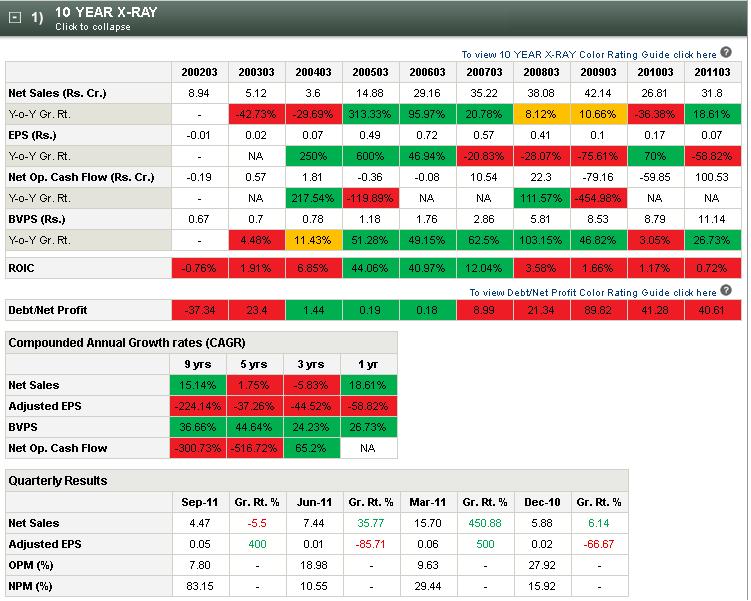
So, what’s your take on the financial performance of this company?
Is it
a) Green (Very Good) b) Orange (Somewhat Good) or c) Red (Not Good) ?
Well, the company given above seems to be doing badly on most of the parameters. The biggest concern: Very high Debt to Net Profit ratios for the last 5 years. A clear sign to stay away!
The verdict: It’s as RED as red can get!
Now, let’s take a look at another company.
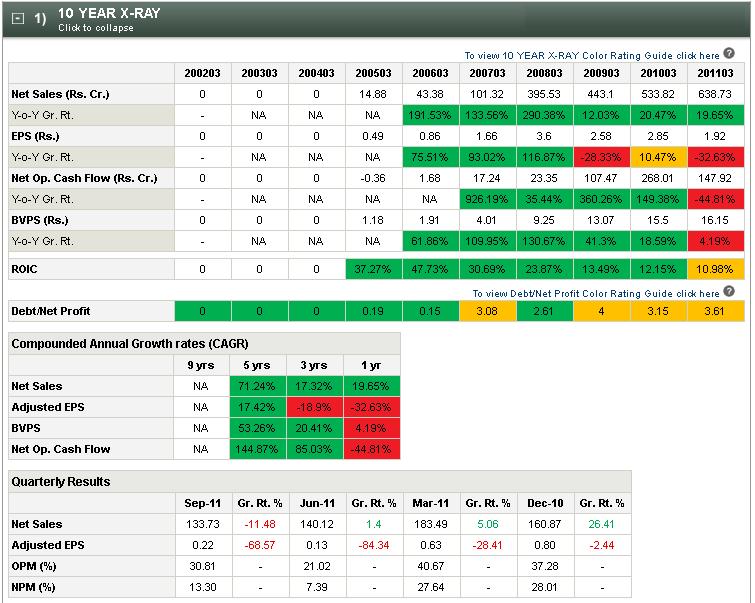
So, what’s your conclusion now? Green, Orange or Red.
Well, for starters, the performance of this company is definitely much much better than the previous one and its numbers are way better from the numbers seen in the previous company.
I am sure all of us will agree that the company’s performance can atleast be classified as Orange (Somewhat Good). Right?
But wait, here comes the googly.
What if I told you that both these 10 YEAR X-RAYs belong to the SAME COMPANY!!
Surprised?! Don’t be! Many people feel that financial statements are confusing. And this is especially true if you are looking at 2 sets of them – like the above situation. Wondering how a company can have 2 sets of financial numbers? The answer is because of Standalone and Consolidated operations.
Standalone vs Consolidated Financials: What Should Investors Focus On?
When analysing a company’s financial performance, you will often come across two sets of numbers — standalone and consolidated financials.
This distinction exists because many companies operate through subsidiaries.
A subsidiary is a separate legal entity that is owned (partly or fully) and controlled by a parent company. For instance, Tata Motors operates globally, and part of its international business is conducted through subsidiaries like Jaguar Land Rover.
What Do These Numbers Represent?
- Standalone financials reflect the performance of the parent company alone
- Consolidated financials combine the financials of the parent company along with all its subsidiaries
In essence, consolidated numbers present the business as a single economic entity.
Why Consolidated Financials Matter
Looking only at standalone numbers can sometimes give an incomplete picture.
A parent company may appear financially strong on a standalone basis, but its subsidiaries could be underperforming — impacting the overall health of the business. Consolidated financials help capture this broader reality.
This becomes particularly important for companies with significant international operations, where subsidiaries may be affected by different economic conditions.
Why Analysis Can Be Complex
While consolidated financials are more comprehensive, they are also more complex to interpret.
Companies may have varying ownership structures — including subsidiaries, associates, and joint ventures — each accounted for differently. Additionally, consolidation methods can vary, making it harder to clearly assess underlying performance.
So, What Should Investors Do?
There is no one-size-fits-all answer.
Ideally, investors should:
- Understand the standalone performance of the core business
- Evaluate the consolidated performance to capture the full picture
In reality, detailed financials of subsidiaries are not always easily accessible. Therefore, the practical approach is to consider both standalone and consolidated numbers together.
If there is a significant gap between the two, it is often a signal that requires deeper investigation.
Investor Takeaway
A company’s financial strength cannot be judged in isolation.
Relying on just one set of numbers may lead to incomplete or even misleading conclusions. A more balanced view — considering both standalone and consolidated performance — helps investors make better-informed decisions and avoid unpleasant surprises.
If you liked what you read and would like to put it in to practice Register at MoneyWorks4me.com. You will get amazing FREE features that will enable you to invest in Stocks and Mutual Funds the right way.