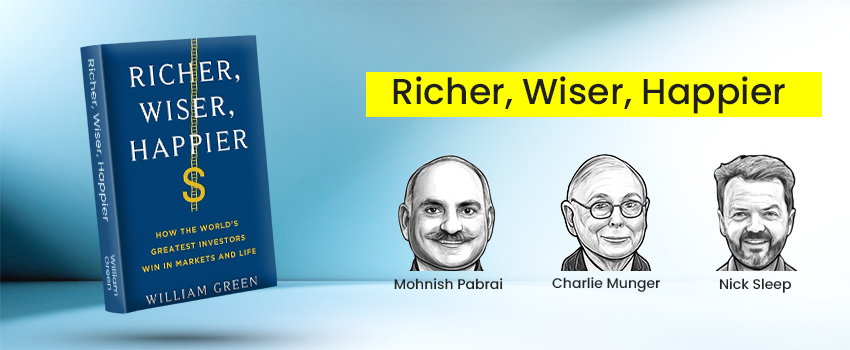
Richer, Wiser, Happier is not a typical investing book filled with formulas or stock tips. It is a study of how some of the world’s most successful investors think, behave, and make decisions over long periods of time.
William Green draws insights from investors such as Mohnish Pabrai, Howard Marks, and Nick Sleep, and distills their philosophies into practical mental models. What emerges is not just a framework for investing, but a way of thinking about life, risk, and decision-making.
The ideas in this book align closely with a disciplined, process-driven approach to investing, where outcomes are a byproduct of behaviour rather than prediction.
Learning by Cloning, Not Reinventing
One of the most powerful ideas comes from Mohnish Pabrai, who advocates learning by copying what already works instead of trying to invent something new.
This approach challenges the common urge to be original. In investing, originality is often overrated, while disciplined replication of proven strategies tends to work better. Surrounding yourself with better thinkers, focusing on internal benchmarks instead of external validation, and aligning actions with your own temperament are recurring themes.
The underlying idea is simple. You do not need to be the smartest person in the room. You need to be consistent in applying sound principles.
The Power of Independent Thinking
John Templeton represents a different but equally important dimension of investing, the willingness to stand apart from the crowd.
Superior returns rarely come from doing what everyone else is doing. They come from identifying mispriced opportunities and having the conviction to act on them.
At the same time, Templeton emphasizes humility. Investors are often led astray not just by emotions, but by ignorance. Acting with limited understanding is one of the most common causes of poor outcomes.
Diversification, patience, and resisting market fads are not just defensive strategies. They are essential for survival in uncertain environments.
Accepting Uncertainty and Cycles
Howard Marks brings attention to a reality that many investors struggle to accept. The future cannot be predicted with precision.
Markets move in cycles. Periods of excess are followed by corrections, and pessimism eventually gives way to recovery. Recognizing these patterns does not allow you to predict exact turning points, but it helps you avoid extreme behaviour.
The emphasis here is on humility and preparedness. Instead of trying to forecast outcomes, the focus shifts to building resilience and responding rationally to changing conditions.
Building Resilience Instead of Chasing Returns
Jean-Marie Eveillard reframes investing in a way that is often overlooked. The goal is not just to generate returns, but to avoid ruin.
Reducing leverage, controlling costs, and maintaining a margin of safety are fundamental to long-term survival. Short-term outperformance becomes irrelevant if it comes at the cost of long-term fragility.
This perspective changes how success is defined. It is no longer about beating benchmarks in isolated periods, but about staying in the game across cycles.
Simplicity as a Competitive Advantage
Joel Greenblatt reinforces an idea that appears repeatedly across great investors. Complexity is not a prerequisite for success.
A strategy does not need to be perfect. It needs to be understandable and repeatable. The real challenge lies not in designing a strategy, but in sticking to it when it temporarily stops working.
Investors often overestimate their ability to outperform markets. Accepting this limitation can lead to better decisions, including the possibility of choosing simpler, market-linked approaches.
The Long-Term Advantage of Quality and Patience
The partnership of Nick Sleep and Qais Zakaria highlights the power of long-term thinking.
Their philosophy revolves around owning high-quality businesses and allowing time to do the heavy lifting. Instead of reacting to short-term noise, they focused on durability, scalability, and ethical business models.
One of their key insights is the concept of shared scale economies, where businesses reinvest efficiencies back into customers, creating a reinforcing cycle of growth. This kind of thinking requires patience, but it also creates sustainable wealth over long periods.
Richer, Wiser, Happier: Habits and the Discipline to Avoid Mistakes
A recurring theme across the book is that success in investing is less about brilliance and more about behaviour.
Warren Buffett emphasizes the importance of habits. Good habits compound over time, just like capital. Poor habits, on the other hand, can quietly erode outcomes.
Charlie Munger takes this further by focusing on avoiding stupidity rather than chasing brilliance. Many investment mistakes are preventable. Overpaying, investing in businesses you do not understand, or ignoring governance risks are all avoidable errors.
The discipline to follow a process, seek disconfirming evidence, and learn from mistakes becomes a structural advantage over time.
Closing Perspective
The central idea of Richer, Wiser, Happier is not about finding the next winning stock or timing the market.
It is about building a way of thinking that improves decision-making across all areas of life. Investing becomes an outcome of this thinking, not the starting point.
The investors featured in the book differ in style, but they share common traits. Patience, discipline, humility, and a long-term orientation.
These are not complex ideas. But applying them consistently is what separates average outcomes from exceptional ones.
Undervalued Nifty 50 Nifty 500 – Quality with Price Strength Screener Alpha Cases 5 Stars Rated Stocks from Nifty 500 Business Houses Group