
Equity investing often feels unpredictable in the short term, much like a game of Snakes and Ladders. Understanding how equities work over the long term can help investors stay confident despite market volatility.
Why Equity Investing Feels Like Snakes and Ladders
Think back to your childhood and the game of Snakes & Ladders. It was simple, unpredictable, and full of surprises. You could climb rapidly with a ladder and just as quickly slide down because of a snake. Yet, no matter how many ups and downs you faced, the goal remained the same—reach the final square.
Equity investing works in a remarkably similar way.
Markets move in cycles. There are phases when portfolios surge, much like hitting a ladder, and phases when corrections pull values down, just like landing on a snake. These movements often feel random in the short term, testing patience and conviction. But just like the game, the outcome depends less on individual moves and more on staying in the game long enough.
The Reality of Market Volatility
Short-term market movements can be unsettling. Data from indices like the BSE Sensex shows that one-year returns can be highly volatile, with a meaningful probability of negative outcomes even in a growing economy like India.
As of recent market cycles, including corrections seen in 2020 during the pandemic and intermittent volatility through 2022–2024 due to global inflation and interest rate hikes, short-term declines have remained a consistent feature of equity markets. These periods often shake out investors who enter with a short horizon.
However, the picture changes significantly as the investment horizon expands. Over longer periods, such as a decade or more, Indian equities have historically delivered positive returns across most rolling periods. The volatility that dominates the short term tends to smooth out, and the underlying economic growth begins to reflect in market performance.
Time in the Market Beats Timing the Market
The biggest mistake many investors make is treating equities like a short-term game.
In reality, equities reward patience. When investors exit too early—often within a couple of years—they expose themselves to the randomness of short-term movements rather than the power of long-term compounding. This is similar to quitting a game of Snakes & Ladders midway because of a few unlucky rolls.
India’s economic trajectory, supported by structural drivers such as rising consumption, digital adoption, and infrastructure spending, has contributed to long-term wealth creation in equities. While returns may not replicate historical averages exactly, the broader principle remains intact: staying invested through cycles improves the odds of success.
See the following table:
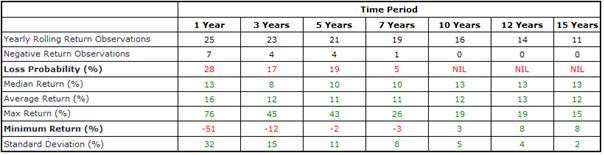
(Source: BSE Sensex; HDFC MF)
The Power of Staying Invested
When you look at equities over extended periods, the “snakes” begin to matter less, and the “ladders” become more impactful.
Corrections, bear markets, and temporary setbacks are part of the journey. But they are often followed by recoveries that take markets to new highs. Investors who remain invested through these cycles benefit from compounding, while those who frequently enter and exit risk missing the most rewarding phases.
The key insight is not that markets will always go up in the short term, but that over time, they tend to reflect economic growth and corporate earnings expansion.
The Mindset Shift That Makes the Difference
Equity investing is not about avoiding volatility—it is about understanding and accepting it.
Just as you wouldn’t expect a smooth, uninterrupted path in a game of Snakes & Ladders, expecting linear returns from equities can lead to disappointment. Instead, viewing volatility as a natural part of the journey helps build the discipline required to stay invested.
Rational investors focus on their long-term goals rather than short-term fluctuations. They understand that the real risk lies not in temporary declines, but in exiting too soon and missing the eventual upside.
The Bottom Line
Equities, like Snakes & Ladders, are a game of patience and persistence.
Short-term ups and downs are inevitable, but long-term participation increases the probability of success. The longer you stay invested, the more the odds shift in your favor.
The goal is simple—stay in the game long enough to reach the destination.
If you liked what you read and would like to put it in to practice Register at MoneyWorks4me.com. You will get amazing FREE features that will enable you to invest in Stocks and Mutual Funds the right way.