Investment basics start with understanding the two most important aspects of the whole game, which are risk and return. It is these two concepts around which every investment philosophy revolves. Return is the gain you wish you make on your investment. It is the opportunity cost you wish you be compensated for, for parting with your money for some time, and for choosing a particular investment avenue over the other. Risk, in its most simple sense, is the chance you are willing to take on an investment. It includes the possibility of losing some or all of your capital investment. But, unlike the flipping of a coin, where you take your chance purely on the basis of your hunch or gut-feeling, risks in investment decisions can be guided by knowledge.
In an attempt to provide you with a one-page beginner’s guide on the subject, much like the ‘how to play’ guide accompanying a board game (‘The Stock Market’ in this case), let me take you through some basic investment concepts:
Fundamental & Technical Analysis
These are two different strategies used to analyse stocks for their expected future performance. Investment decisions and stock-picking are commonly based on such analysis.
Fundamental Analysis involves studying the overall economic and company specific factors along with the financial performance of the company to determine the true intrinsic value of its stock. Such value vis-à-vis the price of the stock in the stock market helps determine whether, or not, to invest in the stock
Technical Analysis, on the other hand, is a means of analysing a stock by studying statistics and data derived from the stock market, including identifying trends in price movement, volume change etc.
Fundamental analysis works best for those seeking to invest in value stocks for the long-term with an intention to make gains out of capital appreciation i.e. increase in the value and price of the stock over a period of time. Technical analysis is more suited to a trader, who buys and sells stocks over the short-term with the intention of making quick gains.
Value Stocks
It is important to understand the difference between the ‘price’ and ‘value’ of a stock. It is the difference between what the stock is worth, and what you pay.
Much like a child’s favourite toy, where the value that he would ascribe to it would easily surpass any price tag at which it can be bought from the market or, the price of onions in times of supply shortage, when the price tops all expectations and the true value of the commodity lies
On the same lines, value investing aims to find the true value, or intrinsic value of the stock. It is what the stock is actually worth, and not what the market has determined as its price. A stock’s value is a function of its financial performance, its strategic implementations, its growth prospects, and its competitive ability.
On the other hand, market-determined price is a function of the demand (buyers) and supply (sellers) forces of the stock, with a substantial influence from news, investor perception, uncertainty etc.
Investment/ Portfolio Management
Investment/Portfolio management is the professional management of securities (stocks) and other investments (real estate etc.) held by a person, with the aim of meeting his/her investing goals. It involves assessing a person’s risk tolerance, and return expectations, and designing his/her investment portfolio across various asset classes in a manner that meets both the criteria. Portfolio is a term generally ascribed to a person’s investments in stocks.
Let Knowledge be your Investment Guide
When entering the stock market to make an investment, you need to be aware of some important considerations, which serve as a guide while building or re-balancing your portfolio of stocks:
Be clear about your investment objective, your timeframe, and your attitude towards risk. The more specific you can be, the better the chances of success.
Keep your expectations realistic. Take into consideration your current circumstances, limitations, and any prospects of change in future.
Determine your asset allocation among various asset classes (stocks, bonds, commodities etc.), depending on your investment objective. While doing so, it is important to decide how much control you want over your investments.
Diversify your investments to minimize risk, especially when investing for the long-term, to enable your portfolio to handle any short-term market fluctuations with ease.
Keep yourself updated and abreast of any changes affecting your investment’s performance and returns.Review and re-balance your portfolio periodically to maintain a match to your risk-return profile.
Create stable, long-term investment portfolio with strong, consistent stocks.
MoneyWorks4Me method for rating and ranking mutual funds for SIP
MoneyWorks4Me rating and ranking of funds for SIP is available to subscribers only. Moneyworks4Me is not a rating and
ranking agency, however it is required that users have a way of selecting funds and building a Portfolio. The method used by it are described below to enable users to understand the logic behind the rating and ranking Subscriber will find more details on this in the
various content made available from time to time. In case you need more please write to besafe@moneyworks4Me.com
MoneyWorks4Me rates and ranks mutual funds based on the following data-driven system:
Performance Consistency: This is measure based on whether the fund has beaten the benchmark index consistently. For
this we compare the 3-year rolling returns of the fund with the benchmark for a minimum of 5 years and preferable 10
years. The period of rolling is one month and holding period is 3 years. Fund are color-coded Green on Performance when
the fund beats the benchmark more than 90% of the time. It is Orange if it beats 80% to 90% of the time and Red if less
than 80%. Funds with less than 5 year data are color-coded Grey.
Quality of Portfolio Holding: Moneyworks4Me has color-coded stocks as Green, Orange and Red based on whether the
company's performance has generated a ROCE above a threshold level (cost of capital) over 10 years (minimum 6 years) and
generated positive Free Cash Flow. For Banks it checks whether ROE is greater than 15% and sales has grown over previous
year. Stocks that perform consistently on these combined metrics are color-coded Green (min score 14 out of 20), Orange
(between 8 and 14) and Red (less than 8 out of 20).
Fund are color-coded Green provided the portfolio has 70% holding in Green stocks but not more than 20% in Red stocks.
Funds with more than 20% Red stocks in the portfolio are color-coded Red. The rest are Orange funds
Funds ranking in screeners: Performance Consistency and Quality are two parameters used for ranking funds for SIP. The
ranking as follows GG, GO, GR, OG, OO, OR, RG, RO and RR.
With the same color-coded funds, the one with the higher Average 3-year rolling returns (over 5 to 10 years), the number
that appears in the Performance tag, ranks higher.
Here is the summary:
The third tag Upside Potential is not relevant for SIP. It is relevant for lumpsum investments in Mutual Funds.
Looking to make the most of market corrections and volatility?
Did you know that market corrections can actually present great opportunities to buy high-quality stocks at discounted prices? By taking advantage of these times of volatility, you can position your portfolio for long-term growth.
At MoneyWorks4me Portfolio Advisory, we specialize in helping investors navigate market fluctuations and build a strong, diversified portfolio. With our collaborative approach, you can maintain control over your investments while benefiting from our expertise and guidance.
If you're interested in learning more and with a minimum portfolio size of 25 L+, we can help you manage your portfolio, no matter the size. let's connect and discuss how we can work together. And as a bonus, we're offering a FREE Portfolio Review using our "Portfolio Manager" tool during our conversation.
So why wait?
Let's get started today and take your portfolio to the next level!
Best Buy Stocks
Do you want to Invest in Undervalued Handpicked stocks and earn high Returns?
Why Buy Quality Stocks
Winning and long lasting portfolio is made of Quality Stocks, but how simple is that?
Important Questions while Buying Stocks
As an Investor most important decision making questions are?
Make an informed decision for Stocks
Invest using an intelligent system with powerful data-driven tools that help you identify opportunities and make informed buy-hold-sell decisions
You can make an informed decision based on:
Q : Quality :- Q Very Good
Q Somewhat Good
Q Not Good
V : Valuation:- V+UnderValued (UV) V Somewhat UV
V Fair Value
V Somewhat OV
V+ OverValued (OV)
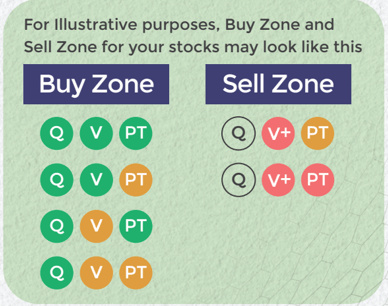
Buy quality Stocks when they are available at reasonable prices and supported by an upward price trend and Sell when they are Overvalued using the Decizen Rating System. Covers 3500+ stocks
Make an informed decision for Funds
You can make an informed decision based on:
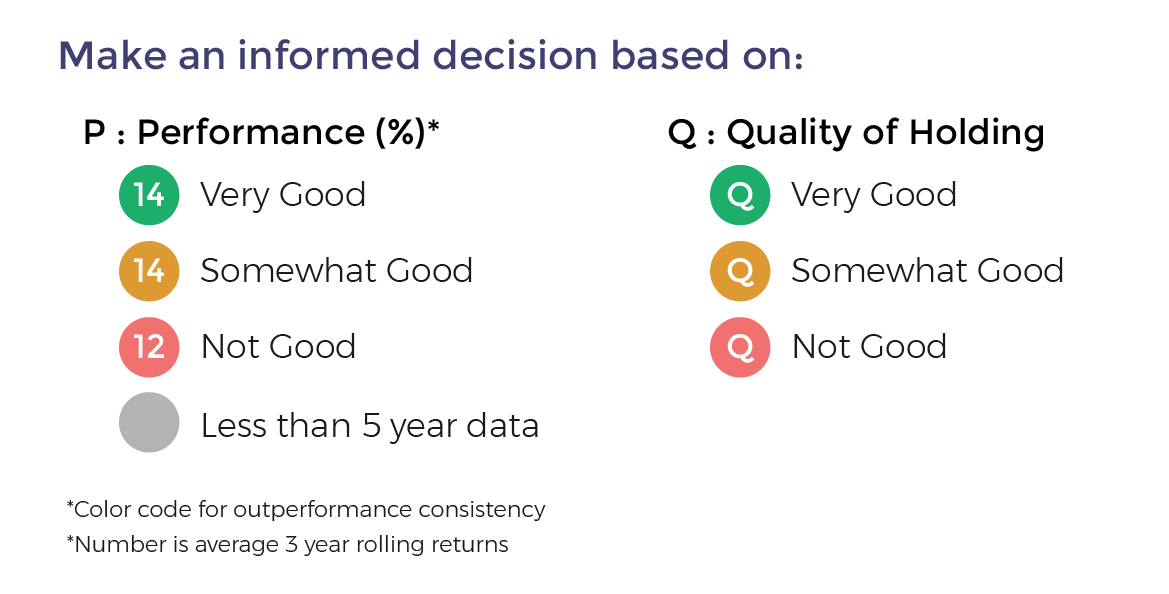
P : Performance (%)* 14 Very Good
14 Somewhat Good
12 Not Good
Less than 5 year data
Q : Quality of Holding Q Very Good
Q Somewhat Good
Q Not Good
*Color code for outperformance consistency
*Number is average 3 year rolling returns
Want to invest successfully in stocks?
How the heck do you select a solution that ensures it?
Does it get you focused on meeting your financial goals?
Does it get you focused on meeting your financial goals?
Investing is to means to funding your goals. Your solution must help you get clarity of your goals and how you should invest to reach them. Does your solution include Financial Planning?


 Download APP