Live Chat
  • Home|
  • Login|
  • Register FREE|
  • Help 
Subscribe +
MoneyWorks4me.com: Stock Investing-The Safest Way
  • Evaluate a Company
  • Portfolio Managers
    • BoughtList
    • WatchList
    • EvaluatedList
  • ComPeer
  • Timing Chart
  • MoneyWorks4me Filter
  • Decision-Maker
  • Stock Shastra
  • How it Works
Home > About Stock Market > Fundamental Analysis > How to select a stock? > Analyze its financial track record > Analyze Financial Track Record of a Company
  • Introduction
  • 1. Why Invest in Stocks?
  • 2. The Two Golden Rules of Sensible Investing
    2.1 First Golden Rule 2.2 Second Golden Rule
  • 3. How to select a stock?
    3.1 Analyze its financial track record
    3.1.1. Analyze financial track record of a company 3.1.2. Analyze financial track record of a bank
    3.2 Take a view on the Future Prospects 3.3 Compare with its Peers- Use ComPeer
  • 4. How to find a stock's right price?
    4.1 What is the right price (MRP) of a stock? 4.2 How do we do our Valuation?
    4.2.1. Valuation for a company 4.2.2. Valuation for a bank
    4.3 How can you do your own Valuation?
  • 5. How to take the final buying decision?
    5.1 Track companies worth watching- Use WatchList 5.2 Tracking companies worth investing in with buy triggers 5.3 Timing chart to time your decision
  • 6. How to Manage your portfolio for high returns
    6.1 Learn to manage your Portfolio for high returns - Use
          BoughtList
    6.2 Tracking companies invested in with buy/sell triggers
    Feature Usage Guide
  • 1. Evaluate
    1.1 10 YEAR X-RAY PRO 1.2 FUTURE PROSPECTS 1.3 PRICE CALCULATOR 1.4 COMPANY PULSE
  • 2. Portfolio Managers
    2.1 WatchList 2.2 BoughtList 2.3 EvaluatedList
  • 3. MoneyWorks4me Filter
  • 4. ComPeer
  • 5 Timing Chart
  • Learn about investment in stock market with MoneyWorks4me eLearning E-learning Videos

How to select a stock?

3.1.1 Analyze financial track record of a company


A company is worth investing in, if it is profitable, and is capable of increasing its profitability at a good consistent rate.

To grow its profits, a company must be able to grow its Net Sales year after year. The company can achieve it by increasing capacity in existing infrastructure; & by expanding its business in the long run.

Any kind of expansion will need funds, and company can arrange it by
  • Reinvesting a part of its profits in the business
  • Issuing new shares, &
  • Borrowing money from banks
This investment is reflected by an increase in the Book Value of the company.

Company should utilise its capital efficiently. An investor / shareholder can check it by monitoring the Return on Total Invested Capital.

A good Company should borrow only so much money that it can repay without any serious difficulty. The Debt to net Profit ratio tells us how many years a company will take to repay its debt. If it's very high we need to investigate closely.

Thus, we have 5 necessary and sufficient financial factors that speak about a company's performance.

Financial Factor Measure of
1 Net Sales Revenue generated from sales of products and services
2 ROIC Efficiency of using money, shareholders' and borrowed
3 EPS Profit per share
4 BVPS Reinvestment done to increase its capacity
5 Net Op. Cash Flow Cash generated from operation
6 Debt/Net Profit Ratio Number of years a company can take to repay its debt


To know a company's real strength, we need to study the company's performance through a full economic cycle, thro' good and bad times. So, we need to evaluate a company on above factors for a period of 10 years.
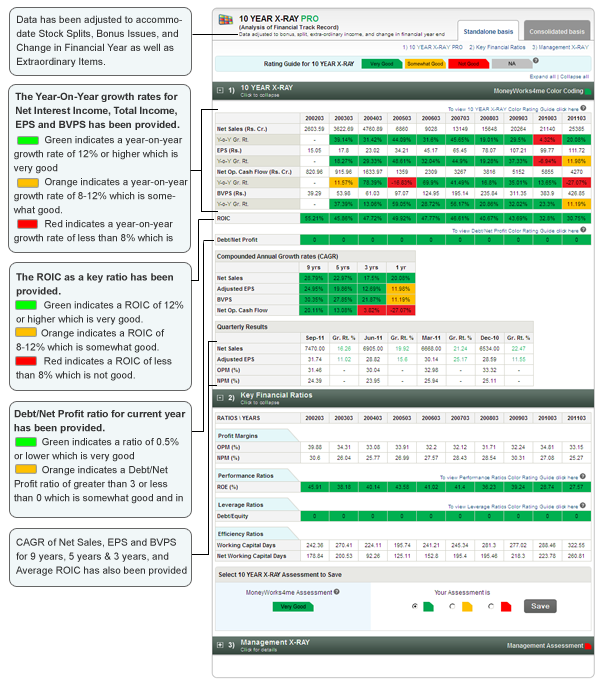
The 10 YEAR X-RAY designed by MoneyWorks4me will help to assess a company's financial track record with ease. Click on the link to know more.

This is how the 10 YEAR X-RAY OF A COMPANY on MoneyWorks4me looks-

10 YEAR X-RAY FOR A COMPANY

Let us understand how MoneyWorks4Me has come up with the color coding for the following-

Financial Factor Assessment of Color Coding
Year-On-Year growth rates of Net Sales, EPS, Net Op. Cash Flow and BVPS In the last ten years, Inflation in India has been growing at a CAGR of around 6%. So, we put our lower limit as twice that at 12% as good consistent growth and code it green as reflected in the 10 YEAR X-RAY.

If the growth rate is 8-12% which just covers the inflation the company is considered somewhat good and is coded orange.

A growth rate below 8% is considered not good and is coded red.
ROIC We must maintain a return on total investment more than that on other investment options. In India, return on a 10-year fixed deposit is 8-10%; so we keep our benchmark for very good ROIC as a minimum 12% every year for 10 years and code it as green as reflected in the 10 YEAR X-RAY.

If it is 8-12% which is similar to returns obtained with other Investment options; the company is considered somewhat good and is coded orange.

ROIC below 8% is considered not good and is coded red.
Debt/Net Profit ratio A good company should borrow only so much money that it can repay without any serious difficulty. We think a company should pay all its debt within 3 years. Hence, we keep our benchmark for very good Debt/Net profit between 0-3 for the current year and code it as green. The ratio greater than 3 or less than 0 have been coded as orange; indicating that we need to study the company further.
Return to Top
About us
  • Who are we
  • How it Works
  • Stock Shastra
  • Contact Us
Products
  • Investor Pro 100
  • Investor 50
  • Investor 25
Usage Guidelines
  • Terms of Use
  • Disclaimer
  • Privacy Policy
  • Sitemap
Need Help?
  • Visit Help Section
  • View Demo
  • Help Videos
  • View Subscriber Experience
Connect with us!
  •  

Find out what our customers have to say about us
Pay online securly with  
Base Data and News provided by Accord Fintech Pvt. Ltd.
Price feed provided by www.nseindia.com and www.bseindia.com
Copyright © MoneyWorks4me 2011 | All Rights Reserved