Investment in securities market are subject to market risks. Read all the related documents carefully before investing.
Disclaimer:
Registration granted by SEBI, enlistment with exchange and certification from NISM in no way guarantee performance of the intermediary or provide any assurance of returns to investors.
In the stock market it is useful to manage the timing of your investments. This enables you to buy and sell stocks at the most attractive prices and at the appropriate time.
MoneyWorks4me makes this possible by providing simple technical charts. The Timing chart has a Stock Price line and a Moving Average line.
Stock Price Line: The Stock Price line indicates the actual closing prices of the stock of the company.
Moving Average Line: The Moving Average line is an average of the closing price of the stock of the company computed for a certain period of time- 13 days, 26 days, 50 days or 200 days. It is the moving average because every day it adds one new closing price and leaves the oldest one from the earlier period.
MoneyWorks4me provides four kinds of moving average:
13-day moving average
26-day moving average
50-day moving average
200-day moving average
It is used for getting a short term signal.
It gives an early buy or sell signal so that we can get a high return.
The risk is very high as it gives many false signals.
It is used together with 13 DMA for getting a confirmation on short term price movements.
It gives a late buy or sell signal in comparison with 13-day moving average.
Risk of false signals is high.
It is used for getting a medium term signal.
It gives a buy or sell signal later than the 13/26-day moving average. So, the return is low in comparison with the one you get by using 13/26-day moving average graph.
Risk is less as the number of false signals is less.
It is used together with 50 DMA for getting a long term signal.
It gives a late buy or sell signal in comparison with 13/26/50-day moving average. So, the return is lower than both of them.
Risk is of false signals is very less.
How do we use moving average graph?
As a value investor we can use the graph at the time of buy and sell to gain from the short term variations in share price. This can be achieved by using the graph as follows:
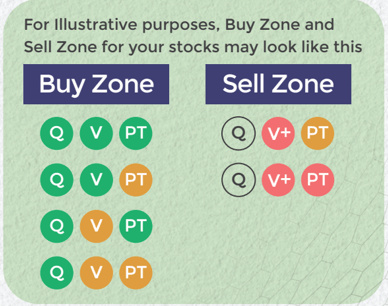
For buy signal the share price must be at or below discount price and the share price line must cut the moving average line from below.
For sell signal the share price must be at or above MRP and the share price line must cut the moving average line from above.
If the share price is in between MRP and Discount Price, then we should not buy or sell the shares of the company, i.e. we should ignore the buy and sell signals of the moving average graph.
MoneyWorks4Me is a SEBI-registered Investment Adviser (IA) dedicated to helping investors build long-term wealth through transparent, research-driven, conflict-free guidance. Founded in 2008, we started our journey as a Research Analyst (RA), providing deep fundamental analysis, intrinsic value insights, and long-term investing frameworks for Indian equities. In 2017, we transitioned to a full-fledged SEBI-registered Investment Adviser, strengthening our commitment to acting as a fiduciary—always putting the investor’s interest first.
Our Vision
To become India’s most trusted, research-powered fiduciary advisory platform—where every investor, regardless of experience, can make calm, confident, and well-reasoned investment decisions.
What Makes MoneyWorks4Me Different
Fiduciary-first advisory model.
As SEBI-registered IAs, we are legally and ethically bound to act in the best interests of our clients. We do not sell or distribute any financial products. This ensures our guidance is 100% unbiased and conflict-free.
Deep fundamental research + robust valuation discipline.
Built on more than 15 years of equity research, our framework combines quality assessment, intrinsic value estimation, and a sensible margin-of-safety approach.
Process—not predictions.
We don’t rely on guesswork or market timing. Instead, we focus on asset allocation, risk management, and long-term compounding.
Technology + Human Intelligence.
We believe a combination of both is essential for investing success. We constantly innovate and upgrade in-house tools, financial X-rays, and portfolio analytics so that our team of analysts and advisors are equipped with the best.
Partner with Clients.
We follow a DIWM (Do-It-With-Me) approach where we partner clients in setting goals, financial planning, educating on our investing process and share decision-enabling resources transparently with our clients who retain control on execution.
Our Approach: Ensuring compounding work its magic on client portfolio.
MoneyWorks4Me ensures this through:
Investing in stocks, mutual funds, debt, and gold
Quality-at-Reasonable-Price way of investing in stocks
Constructing Direct Stock Portfolios with Core, Booster, and Amplifier stocks
A Mutual Fund Portfolio that delivers consistent out-performance and meaningful diversification (low overlap)
Periodic review and rebalancing
Clear Buy-Sell-Hold, and Position-sizing frameworks
MoneyWorks4Me method for rating and ranking mutual funds for SIP
MoneyWorks4Me rating and ranking of funds for SIP is available to subscribers only. Moneyworks4Me is not a rating and
ranking agency, however it is required that users have a way of selecting funds and building a Portfolio. The method used by it are described below to enable users to understand the logic behind the rating and ranking Subscriber will find more details on this in the
various content made available from time to time. In case you need more please write to besafe@moneyworks4Me.com
MoneyWorks4Me rates and ranks mutual funds based on the following data-driven system:
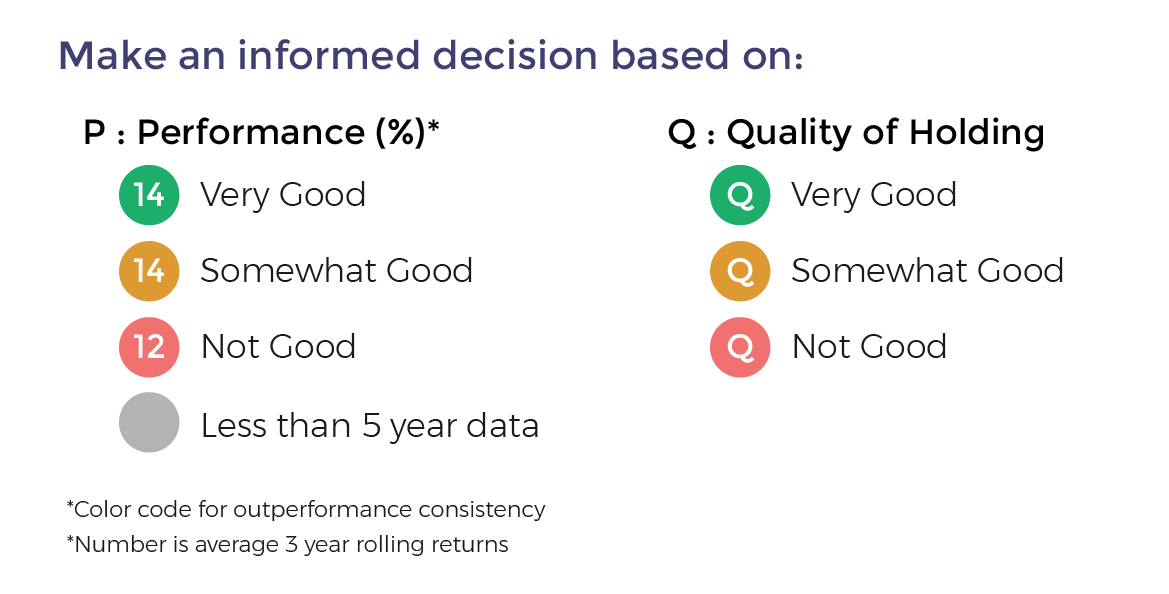
Performance Consistency: This is measure based on whether the fund has beaten the benchmark index consistently. For
this we compare the 3-year rolling returns of the fund with the benchmark for a minimum of 5 years and preferable 10
years. The period of rolling is one month and holding period is 3 years. Fund are color-coded Green on Performance when
the fund beats the benchmark more than 90% of the time. It is Orange if it beats 80% to 90% of the time and Red if less
than 80%. Funds with less than 5 year data are color-coded Grey.
Quality of Portfolio Holding: Moneyworks4Me has color-coded stocks as Green, Orange and Red based on whether the
company's performance has generated a ROCE above a threshold level (cost of capital) over 10 years (minimum 6 years) and
generated positive Free Cash Flow. For Banks it checks whether ROE is greater than 15% and sales has grown over previous
year. Stocks that perform consistently on these combined metrics are color-coded Green (min score 14 out of 20), Orange
(between 8 and 14) and Red (less than 8 out of 20).
Fund are color-coded Green provided the portfolio has 70% holding in Green stocks but not more than 20% in Red stocks.
Funds with more than 20% Red stocks in the portfolio are color-coded Red. The rest are Orange funds
Funds ranking in screeners: Performance Consistency and Quality are two parameters used for ranking funds for SIP. The
ranking as follows GG, GO, GR, OG, OO, OR, RG, RO and RR.
With the same color-coded funds, the one with the higher Average 3-year rolling returns (over 5 to 10 years), the number
that appears in the Performance tag, ranks higher.
Here is the summary:
The third tag Upside Potential is not relevant for SIP. It is relevant for lumpsum investments in Mutual Funds.
Make an informed decision for Stocks
Invest using an intelligent system with powerful data-driven tools that help you identify opportunities and make informed buy-hold-sell decisions
You can make an informed decision based on:
Q : Quality :- Q Very Good
Q Somewhat Good
Q Not Good
V : Valuation:- V+UnderValued (UV) V Somewhat UV
V Fair Value
V Somewhat OV
V+ OverValued (OV)
Buy quality Stocks when they are available at reasonable prices and supported by an upward price trend and Sell when they are Overvalued using the Decizen Rating System. Covers 3500+ stocks
Make an informed decision for Funds
You can make an informed decision based on:
P : Performance (%)* 14 Very Good
14 Somewhat Good
12 Not Good
Less than 5 year data
Q : Quality of Holding Q Very Good
Q Somewhat Good
Q Not Good